How Long Should You Diet To Get A Six-Pack? (AVOID THIS MISTAKE!)
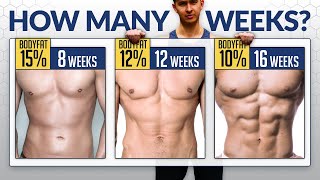
Jeremy Ethier walks through the math for how long a six-pack takes: calculate your lean body mass, subtract your target body fat percentage, then divide by a safe fat-loss rate of 0.7% per week. A 60-person study found diet breaks reduce hunger and improve adherence without slowing results.
Questions this video answers
Around 15% (start), 12% (good definition), 10% (clearly visible and well defined).
Approximately 22% (start), 20% (some definition), 18% (clearly visible) as rough equivalents to the male thresholds mentioned.
About 0.7% of current body weight per week (conservative target).
60 weight-trained athletes.
Continuous dieting group: 12 weeks straight. Intermittent dieting group: 12 weeks of dieting with a 1-week diet break after every 3 weeks (total intervention time 15 weeks).
How long does it take to get a six pack? This is one of the questions that I've always wondered when I first started training seriously. Because for many of us, getting a well defined six pack is the ultimate goal. But the answer to that question is that it depends. And it depends on one, where you're at right now, two, how defined and visible you want your six pack to be, and three, the process that you use to get there. Because, let's face it, six some work out for years and can never quite achieve it because they're using the wrong approach. Which is why in this video, we'll first calculate how long achieving a six pack will take for you. And then, more importantly, we'll cover how to best ensure your success throughout those weeks. First and foremost, anatomically, everybody has a six pack. It's just a question of whether it's visible or not. Abs only become visible once a low enough body fat is achieved to reveal them. For men, your abs will typically start to become visible at around 15%. But at 12% is when you start to really see some good definition with your six pack, and at 10%, your six pack is clearly visible and well defined. And for women, I wouldn't recommend a clearly visible six pack as being the ultimate goal, but some percentage equivalence to what I covered with males would be around 22%, 20% and 18%. Now, to determine roughly how long it would take you to reach those goal body fat percentages and to reveal your six pack, we can use the following formula. So take out a pen and paper and we'll run through this simple calculation step by step, using Joe over here as an example. I'm going to use pounds in my example, but if you use kilograms, then just run through the exact same calculations but with kilograms instead. First, we're going to determine your lean body weight, which is simply how much you would weigh if you had absolutely no fat to do so. Estimate what your current body fat percentage is by looking at the following charts. Then divide that percentage by 100 and multiply that number by your current body weight. The number you get is roughly how much fat you're currently carrying. Subtract that number from your current body weight and that number will now be what's known as your lean body weight. Next, pick your goal body fat percentage based on what I said earlier. Determine how lean and how visible that you want your six pack to be. I'd personally recommend that you be very conservative here because once you reach a certain body fat percentage, you can always keep pushing to get lower if you decide to. In this example, we're going to use 12% as a goal for Joe. Next, once you have this, divide it by 100 and we'll then plug everything into the formula like so. Run that calculation, and the number that you end up with represents roughly what your body weight would be. Once you achieve your goal body fat percentage and desired six pack, then simply take that number and subtract it by your current body weight. The number you get there represents roughly how much fat you'd have to lose in order to achieve your goal body fat percentage and strip off enough fat for your abs to become visible. In this case, Joe would need to lose around 15 pounds of fat to get to his goal of 12% body fat and reveal his abs. And finally, based on this number, we can determine roughly how long it will take you to lose that amount of fat and attain your six pack. But this is also the step where most people screw everything up. Because if you tell someone that they need to lose 15 pounds to get their six pack, chances are that they're going to try to lose that weight as fast as possible in an attempt to attain their six pack as quickly as possible. But what most people don't realize is that there's a limit to how much fat that you can lose every day. Exceeding this limit will cause more weight to be lost, but from muscle, not from fat, which is the opposite of what we want. For instance, in one study, resistance trained males and females were prescribed to lose weight slowly at a rate of 0.7% of their body weight per week, or quickly at a rate of 1.4% of their body weight per week. Although it took the slow group three more weeks of dieting, both groups lost the same amount of total weight. However, of the weight that was lost, those in the slower weight loss group lost significantly more more fat than the fast weight loss group and actually gained a small amount of lean mass compared to a loss of muscle mass in the fast group. Because of this, it's recommended to set a goal of losing an average of 0.7% of your current body weight per week. In our example, Joe weighs 170 pounds and needs to lose 15 pounds. With the goal of losing 0.7% of his current bodyweight per week. This would take him roughly 12 weeks. To put this into perspective for you, here is one of our Viltu Science members, Andrew. His starting point, as you can see, was 202 pounds at around 25% body fat. Using our calculation, he needed to lose about 30 pounds of fat to get down to around 12% body fat to reveal his six pack, assuming that he maintained his existing muscle mass. So at our proposed rate of fat loss of losing 0.7% of your body weight per week, this would on paper take him about 21 weeks to accomplish. Now it actually took him just shy of 21 weeks to lose 30 pounds of fat and get down to 173 pounds at around 12% body fat with his abs now clearly visible, which is just a real life example to help illustrate the potential accuracy of the formula I just went through. Do note however that this formula does have its limitations since it won't account for water weight, muscle gains and anything else that isn't fat that would affect your before and after weight throughout the process. But nonetheless it's still a good way just to get a rough estimate. Just also keep in mind that throughout this transformation, Andrew was following his program to the tee and remained consistent day after day and week after week. And that's exactly what the estimation that you calculated assumes that you're going to be doing. So to be realistic, you should provide yourself with at least a few weeks of extra time and expect the process to have its various ups and downs. In addition to this few weeks of added buffer time to your estimation, another thing that you may want to consider is taking periodic breaks from your several weeks of dieting rather than attempting to do it all in one shot. This is because the longer you diet for, the harder it will inevitably become. As you lose more and more weight, its likely that increased hunger and fatigue will start to set in, making adherence difficult to counteract. This research shows that increasing your calories back up to maintenance calories for several days every few weeks, or what's now commonly known as a diet break, can help to fight off these cravings. Illustrating the effectiveness of this approach is a brand new study led by researcher Jackson Peios. Here he is to provide us a breakdown of the study results and the implications that it may have on the length and approach of your diet. So Jackson, why don't you just give us a really quick breakdown of the study that you ran and then also what it potentially means for the overall approach of our diet.
So we had 60 weight trained athletes come to our lab and they were allocated to one of two groups. One group was a continuous dieting group. Now they dieted for 12 weeks straight, continuously. Then we had another group which was referred to as our intermittent dieting group. Now they did 12 weeks of dieting in total as well, but after every three weeks of dieting, we gave them a one week diet break, which meant that their total intervention time was actually 15 weeks. And during those diet breaks, we would increase their calories to maintenance, so they weren't losing any weight during that period. And we also increased their carbohydrate intake, so they were eating a lot more carbohydrate. After both groups had completed their 12 weeks of dieting, we saw no differences in fat loss or lean mass retention, which was surprising to a lot of people. We also didn't see any difference in the drop in metabolic rate between the two groups, which sort of surprised a lot of people who had been promoting things like diet breaks and refeeds for many years. But we did see some very interesting things. On the flip side, what we did see was that in the group who used the diet breaks every three weeks, they had lower hunger and less desire to eat than a continuous dieting group. Another cool finding that we noticed was that twice the number of participants dropped out from the continuous dieting group than they did from the group that was using the diet breaks. Which gives us the impression that, okay, perhaps when you're using diet breaks, that sort of weight loss regimen is a little bit easier to follow than a weight loss regimen with no breaks whatsoever to support that finding. When we analyzed the adherence data so how well they were sticking to their calories and their macros, we saw that 77% were adherent in the group that was using the diet breaks, but only 58% were adherent in a continuous dieting group. Which again tells us that, okay, perhaps weight loss and fat loss is a little bit easier to achieve when you're using diet breaks sort of intermittently, what can we sort of take away from that to sort of frame a conclusion? If their biggest challenge with weight and fat loss is adhering to their calories or fighting hunger urges, then diet breaks perhaps is going to be a really good tool for you to use. And it also makes sense that perhaps diet breaks might not be needed early on in the dieting phase, because that's when hunger isn't too much of a challenge. Everyone can sort of stick to their calories quite easily. But later on in the diet phase, when you sort of lost a bunch of weight and fat, hunger starting to creep in and get a little bit more challenging, perhaps that's going to be the better time to use this strategy. So if the weight loss is not time sensitive, if you're not in a rush, then perhaps diet breaks, they might make a lot of sense to use in that scenario, but if a certain body composition is wanted as fast as possible. For example, I've got eight weeks until my wedding and I want to be in the best shape as I possibly can. Perhaps just go with continuous dieting, because using diet breaks is probably just going to sort of chew up too much of your of your weight loss time.
So to put this into perspective for you, if let's say you calculated it would take you 12 weeks to get to 10% body fat, then you may want to consider interspersing one to two diet breaks towards the tail end of it to help with adherence and hunger levels. But you can always make that decision based on how you feel when you get there. And lastly, just remember that diet breaks are not an excuse to eat anything that you want, but rather involves strategically increasing your calories back up to maintenance, mainly by increasing your daily carb intake and then continuing to track your intake to make sure that you're staying on track. So all in all guys, despite everything that I went through with regards to timing, please just don't obsess over the exact time that it's going to take. Although it's good to have a rough time frame in mind, which is what the formula that I went through can help you do. Focus on the process and the specific steps that you're going to need to take to achieve your goal, rather than how long it's going to take. Those who set goals and focus on the specific things that they will do along the way are the most successful at achieving them. Which not only applies to attaining a six pack, but to everything in life. But if you're currently seeking for more guidance and looking for an all in one customized approach that shows you step by step exactly how to train and how to eat week after week in order to burn off unwanted fat and build lean muscle, just like thousands of our Built With Science members have done, then simply head on over to builtwithscience.com and take our analysis quiz to discover the best approach for you and your specific body. Anyways, that is it for today guys. I really hope you enjoyed this one and found it useful. Please don't forget to show your support by giving the video a like leaving a comment down below as to what you'd like to see me cover next, subscribe to the channel and turning on notifications for the channel as well as this all really does help me out. Thank you so much and I will see you next time.










