How Many Days A Week Should You Workout? (FASTER GAINS!)
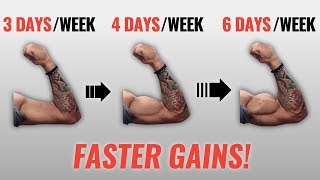
Jeremy Ethier breaks down how often you should train each week for muscle growth. Training frequency matters less than total weekly volume, but spreading workouts across more days reduces fatigue and lets you recover better between sessions.
This is Charlie. Charlie's been hitting the gym three days a week and has seen pretty good gains. But then one day, Charlie meets Jeremy. Now, Jeremy, on the other hand, hits the gym a whopping six days a week and seems to be progressing faster than Charlie. Which gets Charlie thinking. Since Charlie's got the time and energy to work out six days a week, he figures that making that switch will help him gain muscle significantly faster than if he were to just work out three days a week. But Charlie wants to hear what you have to say. So pause the video and comment below whether you think Charlie should make that switch for the gains or not. Now, as for the answer, well, research indicates that it's actually a yes and no kind of answer. Because now we know, based on several studies and a meta analysis on training frequency, that if you can check off each of the following three requirements, then your rate of muscle growth will be similar regardless of how many days you choose to work out. One, your training Training each muscle group at least two times per week. So for example, if you work out only two or three times per week, then you're doing full body workouts, whereas if you work out more often than this, then you're doing some form of muscle grouping split. Basically anything but a bro split. Two, you're doing enough volume within your workouts and enough volume throughout the week, and three, you're performing each of your sets with enough effort and intensity to fully stimulate your muscle fibers. And in fact, studies that have actually specifically tested training three days per week versus six days are week have found this to be true when the above three requirements are in place. Meaning that if Charlie satisfies those three requirements, then making that switch from three to six days per week would not speed up his gains, right? Well, not necessarily. And the complication here lies within requirements two and three, because we know that our workout volume requirements slowly begin to increase as we gain more experience, meaning that over time we have to do more sets per workout and throughout the week in order to continue growing our muscles at the optimal rate. And in fact, researcher James Krieger did an in depth analysis on this and found that for beginners, you don't want to utilize higher volumes right away. So if you're training three times per week, for example, you only need around two to three sets per muscle per workout, or around six to ten sets per muscle per week for maximal growth. But as a beginner then progresses into a more trained state throughout the years, Krieger's analysis suggests that those few sets no longer provide enough stimulus, and that an increase to roughly 8 to 10 sets per muscle per workout, or around 16 to 20 sets per muscle per week, are now what's needed to maximize growth. And this is what creates a complication, because as a beginner, achieving two to three sets per muscle group per workout, or eight to 10 sets per muscle per week, can easily be done with just three full body workouts per week. But then, as a more experienced lifter, fitting 8 to 10 sets per muscle per workout, or 16 to 20 sets per muscle per week into just three full body workouts becomes a challenge. Not only will your workouts be a lot longer and often unenjoyable, but it may even compromise growth. Because during a workout, the ability of our muscles to exert force can be negatively affected by two things. One, the muscle itself getting fatigued from our exercises, which we can call peripheral fatigue, and two, central nervous system, or CNS fatigue, which is the inability of our central nervous system to activate our muscle in the first place so that it produces force. Now, both of these types of fatigue contribute to us reaching failure during our sets, But CNS fatigue is more problematic since it actually reduces our ability to fully activate our muscles during a set. And in fact, when there's a lot of CNS fatigue, we can actually reach failure in a set of an exercise before we achieve full motor recruitment of that muscle, which is obviously detrimental to muscle growth. And since we know that CNS fatigue increases over the course of a workout, this means that later sets and exercises in a workout will contain fewer stimulating and productive reps than earlier sets will. Which helps explain the exercise order. Research out there indicating that exercises done early on in a session are more effective for growth, and that adding extra sets to a workout will have progressively smaller and smaller incremental benefits, suggesting that, as a more advanced lifter, trying to shove in all of your volume into three full body workouts per week is likely not the best option if you're seeking to maximize growth, since many of the exercises you do towards the end of your workouts just won't be as effective. And you may not even fully recruit your muscle fibers during those later sets, meaning that as you gain more experience and your volume requirements increase, it would instead be a good idea to distribute that volume throughout the week by adding in additional training days. And recent research is in support of this. For instance, a 2019 paper analyzed muscle growth in experienced lifters who performed all of their volume with either an upper lower split four times per week, or a full body session just three days per week. And after 10 weeks, the four day per week group provided slightly greater growth at all measurement sites, which would likely reach significance had the study been carried out longer. Now, although further research is definitely needed to clarify this and fully answer Charlie's question, I think we do have enough to provide him with the following general recommendations. As a beginner, Charlie doesn't need as much volume to maximize growth and can effectively do so with just three training days per week. But then as Charlie gains more experience and progresses in the gym and his volume requirements increase, it may then be best to add more training days into his routine in order to spread out that increased volume most effectively to avoid running into the problems we discussed earlier and enable Charlie to get absolutely massive.
Now keep in mind though guys that I've gone through what's optimal to maximize growth. So if you can't commit to higher frequencies as you gain more experience and then it doesn't mean that you're not going to build muscle because you will. And the difference we're talking about is minimal at the end of the day workout volume and consistency is what's most important. So if your schedule only allows you.
To train three days per week, but.
You can hold that up week after week without fail and get enough volume in, then do that as that's going to be a lot more effective than trying to go six days per week but being inconsistent with it. And for a step by step program designed to accommodate your schedule and show you exactly how to build muscle most effectively through the use of science, just like these members have with their built with science programs. Then simply head on over to builtwithscience.com and take the Starting point quiz to discover what program is best for you and your specific situation. Anyways guys, I hope you enjoyed this one. Please show your support by giving the video a like leaving a comment down below as to what you'd like to see me cover Next, subscribing to the channel and turning on notifications for the channel as well as this all really does help me out. Thank you all so much for the continued support. I appreciate it and I'll see you next time.










