How Many Sets Do You Really Need to Build Muscle?
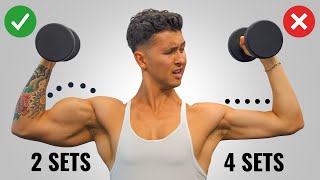
Research shows muscle growth peaks around 10 to 20 sets per week per muscle group, with diminishing returns beyond that. Natural bodybuilder Max Useta shares how he adjusts volume, and the video walks through how to start at 10 sets and add 2 more if you stop seeing progress.
How many sets do you really need to build muscle? Some say just one set taken to all of failure is best, whereas others preach high volume, doing four to five sets per exercise and taking over three hours to complete a single workout. Who's right? And more importantly, how many sets should you do, especially as a natural? Well, the answer might surprise you, and it's probably a lot less than you're currently doing. The first major analysis on how the number of sets you do affects muscle growth was done in 2017. Led by researcher Brad Schoenfeld, they compared 1 to 5, 5 to 9, and 10 plus sets per muscle per week. So, for example, six weekly sets for the chest could be three sets of bench and three sets of flies. Now, what they discovered is a dose response relationship between muscle growth and the number of sets performed, with 10 plus sets per muscle per week resulting in the most growth. After this meta analysis was published, pretty much all of us fitness nerds were under the impression that more volume was better. Almost instantly, I bumped up the number of sets on all my exercises. Unfortunately, it didn't end up skyrocketing my gains the way I hoped it would. It wasn't until more research came out that I realized the mistake I made. You see, while this analysis did suggest that more was better, it didn't let us know just how far we could push it while still continuing to see better gains. Fortunately, six years later, a new group of researchers decided to perform a similar analysis. This time, they compared lower volumes of less than 12 sets, moderate volumes of 12, 20 sets, and high volumes of more than 20 sets per muscle per week. They also standardized the data by only looking at sets performed within 620 reps. The result? Well, although moderate and high volumes led to more growth compared to low volumes in almost all the muscles measured, there were no significant differences between the two. The one exception was the triceps, which responded better to higher volumes. But we'll talk more about what this means later on. But overall, this analysis suggests there may be some kind of upper limit where too much volume doesn't lead to more growth and in some cases might even hinder growth because of recovery issues. The sweet spot seems to be somewhere within the range of 10 to 20 sets per muscle per week. But this is still a very wide range. 20 sets is double the time and work compared to 10 sets. To find where exactly within this range is best for you, there's five other factors you need to consider, the first of which is your individual response. So the studies we covered earlier, while they do provide US with great insight. They look at averages to see what the best general recommendation is. But in the case of volume, it seems to be highly individual. Illustrating this is a 2019 study from the Journal of Sports Science where they had 19 participants train one leg with six to nine sets per week and their other leg with 15 sets per week. After eight weeks, roughly a third of the participants had a leg that responded better from low volume, a third had a leg which responded better from high volumes, and a third had a similar response in both legs, suggesting that what one person can recover well and grow from may end up being too much for someone else. Now, later in this video, I'll show you guys how to determine if what you're currently doing is too much or too little for you. But one thing that will play a big role in that is exercise execution. Max USETA, a 22 year old natural bodybuilder experienced first had.
It was probably 30, 30 to 40 sets per muscle group per week. For example, you know, with chest day, I was doing every chest movement I could think of. You know, upper chest flies, incline, bench press, flat bench press. All these sets were sloppy. And you know, my, I wasn't actually taking the muscles to failure. No. I told myself, all right, 30 reps of bicep curls and I'll stop once I hit 30. And in my last 15, I was, I was just swinging up and down. It was a mess. I mean, eventually I got to a point where months down the line I just wasn't seeing any progress in terms of, you know, my lifts weren't going up, I wasn't putting on any muscle. So now I'm doing anywhere from seven to 12 sets per week per muscle group as opposed to, you know, 30 plus. I definitely seen the most growth I've ever seen in terms of, you know, training at quote, unquote, a lower volume than normal. And you know, the thing that really helped me do that is, you know, training very close to failure. Because when you're training very close to failure, your muscles just won't need that many sets. But you know, when that set gets hard, you need to maintain good form. If your form is breaking down to where, you know, you're using momentum and your reps are getting super sloppy, then, you know you're not taking your muscles to failure. So the last thing I did when it comes to, you know, lowering my volume, that really helped was taking longer rest periods because obviously, you know, when you're training very hard and very intensely, your muscles just need to require more rest. I Think when you maintain proper techniques and you take your muscles to failure, then pair that with a lower volume approach. You're doing everything that you need to do without going overboard and creating all of this fatigue and creating all this muscle damage that needs to be recovered from.
This aligns with my own experience as well. Actually push yourself close to failure on all your sets while maintaining good form and you'll get way more out of less. But Max also mentioned he ended up taking longer rest periods between his sets, which is another factor that will affect how much volume you need to grow. If you take shorter rests between sets, such as less than two minutes, research suggests you'll need to do more sets to get the same amount of growth as you would from taking longer rests. And unfortunately, the research I covered earlier that helped us come up with that 10 to 20 set range used studies where the rest periods differed. Some studies use shorter rests, whereas other studies use longer rests. So if you usually take longer rest periods, I personally Recommend at least 2 minutes between most of your sets. It's likely that the lower end of this 10 to 20 range would be best, whereas the higher end of this range would likely be necessary if you mostly use shorter rest periods. But this also depends on the next factor, how you count your sets. So remember how in the meta analysis we covered earlier, none of the muscles responded better to really high volumes except for the triceps. Well, it's important to consider how they counted their sets. Generally, researchers still count muscles that are indirectly worked with an exercise as one full set for that muscle. So for example, during the bench press, they'll count that as one set for the chest and also one set for the triceps. Now, whether or not this should truly count as one set for the secondary muscle is up for debate, but it does affect the volume recommendations. For example, even though the study showed that triceps responded really well to 20 plus sets per week, if you look at the average person's workout routine, this would only be about six direct sets for triceps if you also counted all the pressing movements they're already doing. Now, the front, side and rear delts, as well as the biceps probably fall under this category as well. Unless you want to prioritize them, they don't need quite as many direct sets because of how often they're indirectly worked. This also applies for regions within a muscle. The chest, for example, doesn't need 10 sets each for the upper, middle and lower portions. Rather, the chest in general would require around 10 weekly sets, and you'd ideally split those sets up by using exercises that emphasize the different regions. And I also think this discrepancy in how people count their sets is why high intensity training, where you usually do just one set per exercise, can work and has worked for many people. You see, in the research we covered, subjects would stop each set once they reach failure or close enough to it. But Dorian Yates, six time Mr. Olympia who has popularized high intensity training, describes his set as one all out set extended beyond failure with force reps, rest, pause reps or drop set reps. A set is properly finished only when additional movement is utterly impossible. So as you can imagine, one set performed in this fashion can very likely be the same time under tension and stimulus that two to three normal sets would provide. Lastly, and probably most importantly, not everyone should be doing what's optimal. Although somewhere within the 1020 weekly set range is probably what will maximize growth, you'd be surprised with just how little volume you need to still get really great results. 10 sets doesn't give you double the growth as 5 sets. Each additional set you do only gets you marginally better gains. And if we look back at the 2017 meta analysis we covered earlier, even though 10 or more weekly sets led to the most growth, five to nine weekly sets still gave about 80% of the max growth. So for example, for chest, this could be as little as three sets of bench and three sets of flyers every week, which could pretty much cut your workout times in half. In fact, in some cases, even in trained individuals, just three sets per muscle per week has been shown to build some muscle. So if you're having trouble just being consistent in the first place, don't chase optimal. Do what you can and realize you can still get great results with far than you think. And at the end of the video, I am going to provide you guys with a free minimalist and optimal workout routine you can use with all the science and the sets taken care of for you. But first we need to discuss how exactly to start applying all the research we've covered. First off, I'd recommend starting off at the low end of the 10 to 20 weekly set range. Especially if you're a beginner, you don't want to do higher volumes than your body can currently handle. 10 weekly sets for chest, for example, could look like this if you trained all your muscles twice a week, which is generally how I'd recommend splitting your volume up. Now, even if you're past the beginner stage, dial in your form, make sure you're pushing hard enough, take longer rest periods and it's very likely you'll start seeing better results despite doing far less than you were before. But eventually, as you get more experience, you may reach a point where your gains are completely stalled and your body is actually ready for more volume. But before you make any changes, I'd recommend going through this flowchart from the Muscle and Strength Pyramids book written by researcher Eric Helms. For example, if you're sleeping well, pushing hard with good form and eating enough yet you're still not seeing gains, then you might actually need more volume. In this case, add about two more weekly sets, especially on muscles that are lagging behind, and see how you progress. Otherwise, you might actually be doing more than you can recover from and might need to take a break or decrease your weekly volume. Now, since you stuck around for this long, I thought I'd leave you with a gift. I've created three different weekly workout plans, a quick three day per week minimalist routine with around six sets per muscle, a four day per week routine with 10 sets per muscle to potentially maximize gains, and a five day per week routine with around 14 sets per muscle for those who might need a little higher volume. They're completely free and you can grab these routines over@builtwithscience.com freeworkouts but for those who want some more help and are looking for a fully customized done for you plan, just take our quiz over@builtwithscience.com to discover the best program for you and your body. Also, give this video a watch next for a new science based training technique you can apply to all your sets to potentially get almost double the muscle growth. Thank you so much for watching and I'll see you next time.










