How Many Sets Should You Do Per Workout To Build Muscle?
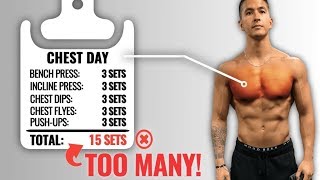
Jeremy Ethier breaks down the science of muscle-building volume: aim for 10-20 sets per muscle group per week, split across at least two sessions. Do no more than 10 sets per muscle in a single workout to avoid wasting effort on junk volume.
One of the most common areas of confusion among lifters is figuring out exactly how many sets one should do in a workout. On the one hand, you have minimalists who offer lower volume approaches, with some saying that even just one set taken to failure in a workout is sufficient. Whereas others are in favor of higher volume approaches and working each muscle to the point of exhaustion each workout. So who's right? Well, in this video we'll figure out just that by using current scientific evidence to determine exactly how many sets per workout you should be doing to maximize growth. But first off, let's discuss what exactly we mean by a set. So just to be clear, a set in this case will refer to a set performed within the 612 rep range. Since this is in line with the research I'll be going through, if you do less reps than this, then you'll need more sets and vice versa. Also, each set should be taken close to failure with high effort. So obviously a warm up set won't count as your real set. So with that being said, let's find out exactly how many sets per workout is optimal. So we know based on recent research that to a certain extent, more volume leads to more growth. For instance, a 2010 meta analysis by James Krieger found that as you increase the number of sets performed per exercise, muscle growth increased as well. In fact, when you compare four to six sets to a single set, you'd experience around 80 to 85% more growth. And in further support of this positive relationship between training volume and hypertrophy is a more recent 2017 meta analysis which found a dose response relationship between sets per muscle per week and resulting muscle growth. So based on this alone, we think that the more volume the better, and that performing five sets for all the exercises in our workouts, or just trying to do as much as possible, would be optimal for growth. But upon further analysis, we realize that this just isn't the case and in fact, doing so can be detrimental. This is because there actually seems to be an upper limit of sets per muscle group that you can do in a single workout before it starts to do more harm than good. And as for an estimate as to what this number is, researcher James Krieger provides some insight. What he did is he took a deeper look into the previous meta analysis I mentioned and found that limit to be roughly 10 sets per muscle group. So for example, on your chest day, performing more than 10 hard sets dedicated to your chest will likely just begin to provide diminishing returns and start to impair your recovery. Something widely known as junk volume. Now of course, this will vary individually and depends on the nature of the exercises you perform, and the limit is likely higher for more trained individuals. Nonetheless, it still is a good rough estimate that's in line with past research on the topic. So what exactly does this mean for you and how you should structure your training? Well, it just means that you need to use the right training frequency and spread out your sets accordingly, as this is going to enable you to avoid doing too much in one workout and helps to minimize any excess junk volume. To clear up any confusion, let's use a step by step example that you can follow. So we know, based on the 2017 meta analysis mentioned earlier, that roughly 10 to 20 sets per muscle per week is a sweet spot for maximizing growth, with beginners being at the lower end of this range and more experienced lifters being at the higher end of this range. So let's say you're a fairly experienced lifter requiring 16 sets per muscle per week, and we'll use chest as an example, rather than using a bro split and hammering all of the 16 sets into one chest day, it would instead be best to split split the required number of chest sets into at least two days per week to be trained with other muscle groups by, for example, using something like an upper lower split. This way you can perform these sets with better quality, you'll remain under the estimated 10 set per session threshold, and you'll now be training each muscle at the optimal training frequency of two times per week, all leading to better gains and more efficient recovery in the long run. In fact, a study by Bagrado and colleagues compared this exact idea. The researchers compared training each muscle group once a week with 16 sets per session, or twice a week with eight sets per session. After eight weeks, they found that the eight sets per session group experienced similar but slightly greater muscle growth and a greater improvement in training load volume when compared to the 16 sets per session group. And the researchers speculate that these findings would likely reach greater significance if the study was done longer. Which is just further evidence suggesting that refraining from doing too much volume for a muscle group in a single session is likely best for hypertrophy in the long run. And that's basically all there is to it. First, figure out what you want to set your weekly target sets per muscle to be, and then work backwards to split that up most effectively throughout the week. Each workout can consist of a total of around 15 to 20 sets, but the number of sets for a specific muscle group in that workout should be at around 10 or below, but obviously this does depend on several factors. And lastly, just always keep in mind that research tells us about averages. Some people respond better to higher training volumes, whereas others respond better to lower training volumes. Meaning that you'll want to use the guidelines shown in this video as a rough starting point, but you should then be adjusting it over time based on how your body progresses.
So to sum the video up, here are the main points to keep in mind. I think that a lot of people are under the wrong impression that more is better and that they have to completely annihilate their muscles every single workout in order for them to grow. And I used to do this as well, but it wasn't until I cut out all the excess jump volume that I was doing and instead focused more on progression that I really started to see results that much faster. And for an all in one science based program that shows you exactly how to do this by optimizing every aspect of your training and your nutrition for you such that you can build muscle and lose fat as quickly as possible. Then you can simply head on over to builtwithscience.com and take the Starting point Analysis quiz which is going to determine what program and what approach is best for you. Anyways, if you haven't already, I'd really appreciate a follow on Instagram. I post a lot more informative videos and content on there, which I think a lot of you will find useful. And as always, if you enjoyed this video, please don't forget to give it a like Leave a comment down below, subscribe to the channel and turn on notifications for my channel as well, as this all really does help me out. Thank you so much for all the continued support everyone. I really do appreciate it. Do let me know what other topics you'd like to see me cover and I'll do my best to cover them. See you next time.










