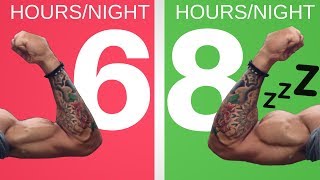
Jeremy Ethier breaks down how sleep deprivation kills your gains by tanking testosterone, increasing protein breakdown, and wrecking workout performance. A 2010 study found people on restricted sleep lost twice as much muscle during weight loss. Seven to nine hours nightly, no caffeine after 2 PM, and better sleep hygiene are the fixes.
If there's one aspect of building muscle and losing fat that's most underrated, it's definitely sleep. According to a recent poll by the national sleep foundation, roughly 63% of Americans say they aren't getting sufficient sleep during the week. And the impact this has on your gains is likely much worse than you think. In fact, sleep may be the exact reason why others seem to progress much faster than you are or or why you just aren't seeing the results you were hoping for, despite putting in the work. The findings of a 2010 study by the American College of Physicians, for example, helps put this into perspective. Researchers split subjects into two groups, one that slept 8.5 hours per night, which is within the range of what most experts recommend, and another group that slept only five and a half hours per night, which, as noted earlier, is pretty common nowadays. Both groups were then put on a regulated calorie deficit for two weeks. The result? Well, as expected, both groups lost the same amount of weight, given that their calorie deficit was equated for. But what's interesting is that of the weight they lost, the sleep deprived group lost 60% more muscle mass and 55% less fat than the group that got adequate sleep, therefore indicating that sleep seems to have a powerful effect on not only muscle recovery, growth and retention, but also fat loss. Now, although the researchers didn't test why exactly this was the case, other research does provide some insight. For instance, a recent 2018 paper from the Journal of Science Advances analyzed the effects of one night of no sleep on 15 young men. After the sleepless night, their muscles already showed signs of increased protein breakdown, and their fat tissue, on the other hand, had elevated levels of proteins and metabolites that are involved in promoting fat storage, which may explain the results we found in the previous study. And to make matters worse, it's also well known that sleep deprivation causes a decrease in anabolic hormones like testosterone. In fact, a 2015 paper found that day to day testosterone levels were significantly decreased by 10 to 15% in young men who underwent just one week of sleep restriction to five hours per night. Add that to the fact that multiple papers have also found that being sleep deprived negatively impacts workout performance performance, since the body tends to give up when it would otherwise normally be physically capable of pushing further. You can see just how much of an impact sleep has on your gains. But just how much should you sleep in order to best support your muscle growth and fat loss efforts? Well, although this will vary individually, I'd suggest sticking with the American Academy of Sleep Medicine's recommendation of getting roughly 7, 9 hours of sleep per night, with more active individuals requiring closer to the higher end or even slightly above this range. So if you haven't been sleeping enough according to this, I'd highly suggest that you make an effort to do so for the reasons previously discussed. And although research does suggest that daytime naps may be beneficial to increase total sleep duration during periods where inadequate sleep is unavoidable, they should not be used as a regular substitute for nighttime sleep since it just doesn't provide quite the same effects. The next best thing you can do though, which is beneficial regardless of if you can get enough sleep or not, is to improve the quality of your sleep. And in order to best do this, there's a couple things that research suggests is optimal coming in. On top is improving your sleep hygiene, which a few papers have shown to be effective at reducing the time required to fall asleep and improve sleep quality. Some recommended strategies to implement this include avoiding any electronic use for at least 30 minutes before bed, using your bedroom strictly for sleep and where the magic happens, and have a consistent sleep wake schedule every day. Aside from this, another big thing you could do is avoid ingesting caffeine shortly before bed. One 2013 paper from the Journal of Clinical Sleep Medicine actually found that moderate caffeine ingestion sleep 6 hours before sleep reduced total sleep time by 41 minutes, whereas moderate caffeine ingestion just 3 hours before sleep reduced total sleep time BY 63 minutes. Meaning that for those working out later in the evening, you'll probably want to avoid taking pre workout or anything with a relatively high amount of caffeine. But all in all, the biggest takeaway from all of these studies is that nothing beats making sure your head is on your pillow for enough hours each night. So although you may be getting by just fine on less than optimal sleep, you're likely doing a disservice to your hard earned gains in the gym.
That's pretty much it for the video. I hope you enjoyed it and found it useful. To sum everything up for you, here are the main points that you want to keep in mind. It's the often overlooked factors like sleep that really are what make all the difference in terms of how fast you progress and how fast you can transform your body. And if you're looking for an all in one evidence based practice program that shows you exactly how to optimize these factors along with your training and nutrition such that you can build muscle and lose fat as quickly as possible, then what you can do is simply head over to builtwithscience.com and take my starting point analysis quiz, which will determine what.
Program and what approach is best for you.
Anyways, as always, if you haven't already, I'd really appreciate a follow on Instagram. I post a lot more informative content.
And videos on there, which I think.
A lot of you will find useful. And if you enjoyed this video, then.
Please don't forget to give it a like leave a comment down below, subscribe.
To the channel and turn on notifications for my channel as well as this all really does help me out and I really appreciate it. Thank you so much for watching everyone and thank you so much for your continued support. It really does mean the world to me. I'll see you next time.