How To Awaken Your Glutes (DO THESE EVERYDAY!) ft. Dr. Stuart McGill
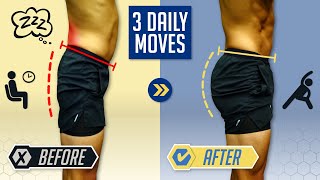
YouTube video (Aug 2020) teaching a four-step plan to reactivate and strengthen the glutes to reduce compensatory lower-back/hamstring loading (gluteal amnesia). Steps: (1) sensory/mindset drills to feel glute contractions (hand palpation, kneeling holds), (2) daily activation exercises—glute bridge and clamshell—with coaching cues, (3) progressions to loaded compound and targeted movements (lateral step-up, goblet squat, cable pull-through) as integration improves, and (4) prevention via reduced prolonged sitting and periodic "wake-up" exercises (toe raises). Expert input from Dr. Stuart McGill frames exercise selection and coaching emphasis.
Questions this video answers
Three sets of 10 reps.
About five seconds per rep.
Get up and move or stretch at least every 30 minutes of sitting.
Your butt is home to the largest, most powerful muscles in your body. It basically acts as a support system and shock absorber for the entire body and it plays a major role in generating power and force in many movements. Not only that though, but well developed glutes that just look good on both men and women. And yes, for the guys out there, we do have insider confirmation that girls do take notice of your butts. The of the the problem nowadays though is that we tend to sit a lot and for prolonged periods of time, which is a great way to potentially forget how to use your glutes, especially if you don't take action to counteract this. And for some individuals due to this glutes inhibition and excessive sitting, this can often lead to lower back and or hip pain. This then worsens the whole problem since research has shown that your body will tend to avoid using the glutes in response to any lower body pain or injury that it has as a protective mechanism. And what often happens is that even after the pain or injury is resolved, the body still remembers this pattern and will continue inhibiting the glutes. World renowned spinal researcher Dr. Stuart McGill has looked into this topic extensively and he terms this phenomenon as gluteal amnesia. Now, the main problem here is that as you forget how to use your glutes due to disuse or pain, your body will compensate. So now when you're squatting, deadlifting or doing any hip extension movement where your glutes are supposed to be helping out, other muscles will take over instead. And oftentimes it's the hamstrings and lower back that take that extra load, which not only inhibits your glutes development, but it's also why we commonly see this pattern of weak glutes, tight hamstrings and lower back pain. It can even get to the point where simple tasks that involve hip extension, like walking or jogging, or will cause lower back discomfort because the glutes are essentially just turned off. So, long story short, your glutes are important. And to find out if your glutes may indeed be needing some more attention, there's four key indicators that we can look at. First, if you just generally have a hard time feeling your glutes working or contracting them during the lower body exercises, and your lower back and your hamstrings just tighten up instead, then this is a good sign that the glutes aren't activating how they should be. Second, perform a single leg glute bridge like so, with one leg straightened and the other leg Bent on the floor, hold this position with your hips in the air. Now, if you feel your hamstrings, your lower back, or your quads more so than your glutes, then this is another indication that your glutes aren't doing what they're supposed to be doing during hip extension. Third, if from the side you exhibit an anterior pelvic tilt posture, then your glutes are likely facing, failing to pull your pelvis into its neutral position due to weakness. And lastly, if you sit for most of the day and have what I'll just call flat butt syndrome, then chances are your glutes could use some work. So if you've tested positive for one or more of those four indicators, or you'd just like to see better results with your glutes training, then it's time to start awakening those glutes and to do so in this video, we're going to go through a four step plan. We're to going where with the use of just a few daily exercises, we'll be able to gradually get your glutes firing harder and harder to the point where you'll be actually using your glutes whenever you walk, move and perform your lifts instead of having your lower back or other muscles compensate and work over time as a result. So the first thing we want to do here is just get you to understand what a glute contraction actually feels like and to get your brain to actually connect with the muscle. So to start, just sit down and place your hands under each butt cheek. Then take turns contracting each of your glutes with your hands. You should be able to feel those glute muscles firing as you contract them one at a time. Then once you're able to do that, we'll progress this by going into a kneeling position. This time, engage your core and place your hand on the glute of the down leg and try to flex it as hard as you can. You should feel the contraction with your hand and your glute changing shape as you do. So keep working until you can establish this and then after you've run a few sets of each of those, and you can actually really feel your glutes contracting in each of those positions. We want to then progress it to some exercises where your glutes are working against gravity, which is where step two comes in to do so, we'll use two simple exercises that Dr. Stuart McGill, based on his 30 plus years of extensive lab and experimental research, found are the best options to getting those glutes firing again. So Based on your research, what exercises have you found are best to just help re establish that connection with the glutes in individuals who suffer from gluteal amnesia or just can't seem to activate their glutes very well in general?
Well, over the 30 years of probing this, we found that two exercises were superior at reintegrating the gluteals, and they both came from the great Czech neurologist Vlad Mirianda, that is the back bridge and the clamshell. Good coaching and mindfulness is essential. We've measured that those who treat these exercises trivially do not re establish the gluteal patterns that are required. So the coaching cues in the way that we've described ensure appropriate gluteal activation.
So proper execution with these two exercises is absolutely essential here. And luckily, Dr. Stuart McGill was kind enough to spend the time to personally guide me through each of these exercises to explain the setup and various cues that he found based on his several years of research tend to work the best to maximize glutes activation. I'll summarize them as I go through each exercise. The first move, the glute bridge, will target the largest of your glute muscles, the gluteus maximus. For these first lay on your back with your knees bent while keeping your core braced and without arching your lower back, squeeze your butt muscles to get them engaged first and then lift up while keeping your glutes contracted at the top, squeeze your glutes as hard as possible for about five seconds before coming back down. Now, if this alone doesn't activate your glutes very well and you feel it more so in your hamstrings, then you can experiment with the following cues. First, you can think about it as if you were holding a $100 bill between your butt cheeks. So to keep that $100 bill, constantly squeeze your glutes throughout each rep to prevent that bill from dropping. Another helpful cue is rather than thinking about driving your heels into the ground, which tends to activate the hamstrings more and more, instead think about pushing your feet away from you. So actively push your feet forwards as if you were trying to perform a knee extension, and you can even perform these against the wall if you need something to push against. What this does is it will activate the quads and then, through a concept called reciprocal inhibition, will as a result decrease the activation of the hamstrings so that the glutes are now forced to do the work. And finally, if needed, you can add a mini band around the knees, which can help boost activation. And since your knees will actively have to use your glutes to keep them spread apart as you perform the movement. So experiment with these various cues and use them as needed in order to maximize your glutes activation. Next are clamshells, which will be used to target another important glute muscle, the gluteus medius. For these, lay on your side with your knees and hips bent. Use one arm to make a pillow for your head, and then with your other hand, place your thumb on the bone in the front of your hip and then wrap your other fingers around over top the upper part of your butt. This muscle is a glute medius and you want to feel this muscle working as you do the following movement. Next, while keeping your feet together and core braced, open up your top knee like a clamshell so that the knee of your upper leg rises towards the ceiling. Avoid rotating your hips as you do so by maintaining that abdominal bracing. Again, you should feel the glute medius contracting with your fingers as you perform each rep. And as for sets and reps of these exercises, Dr. Stuart McGill recommends three sets of 10 reps. But with each rep, perform mindfully and with a strong activation of the glutes. Now, once you do get back to a point where your glutes are firing and you're feeling a lot more relief in your lower back and your hamstrings, you want to then start progressing your glutes with more and more resistance and load and training them in different movement patterns. And to do so, there are three exercises that Dr. Stuart McGill recommends are best. So student. Now, once we do get back to a point where our glutes are back on, so to speak, what should we then progress to in order to further challenge the glutes with more resistance and or load and just to get them reintegrated with our other lower body muscles.
Number one, lateral step up. It challenges the gluteals in hip extension, but also in abduction or frontal plane strength, which is glute medius. So it's an outstanding exercise to stimulate to a very high level the glutes, but it's a very mild exercise, so it's easy on the body. Second exercise, goblet squat. It targets the glutes and with the coaching cues that we use, it really stimulates all of the neuromuscular compartments in the gluteals. The third one, the cable pull through, really sets up squats, deadlifts and some of the more powerful type of exercises that some of your listeners will be very passionate about at the end of this training progression. The idea is to have full integration of hamstrings and gluteus.
Now, as Dr. Stuart McGill suggested, these exercises are essential to just get your glutes back in the habit of knowing how to properly fire and work with your other lower body muscles. Then eventually you'll be able to do your more demanding exercises like split squats, barbell squats and deadlifts and gradually load them with more and more weight, but this time with the glutes actually doing what they should be doing as opposed to having other muscles compensate instead of. Until then, however, focus on these progressions. Now lastly, although you will likely have success with the previous steps, it's important that we don't overlook a potential root cause of all this too much sitting and inactivity, which is where step four prevention comes in. You want to avoid prolonged periods of sitting where you just aren't using your glutes at all, and instead get up and take a walk or have a stretch at least between every 30 minutes of sitting. And even better during your breaks, perform what I'll just call a wake up exercise exercise for your glutes. For example, one great mindful exercise is toe raises where you point your toes outwards, squeeze the quads and then rise up to the balls of your feet while squeezing your glutes as hard as possible. Hold the top position for five seconds and then come back down and repeat for a total of 10 reps. This will just serve as a quick exercise to keep your brain in the habit of knowing how to properly fire and use your glutes throughout the day. So as a summary, here is the action plan. Perform the two activation exercises, the glute bridge and the clamshell, every single day, at least once a day with the following reps and sets. Then, in addition to this, you want to add in one wake up exercise like toe raises that you can do throughout the day to break up your periods of sitting. As your glutes activation improves and you've had success with these progression exercises, eventually you're going to reach a point where these daily glute exercises for the most part just will no longer be needed sitting. Since you'll be able to activate, strengthen and grow your glutes to a much greater degree through your main lower body exercises. But to get to that point, it's absolutely vital that you stay consistent with the plan that we've outlined and for a step by step program that uses science to show you not only how to properly train each of your muscles week after week, but also then shows you how to best fuel them for recovery and growth so that you can build lean muscle and strip off fat in the most efficient way possible. And simply head on over to built with science.com and take the Analysis quiz to discover what program will be best for you and your specific body. Also, big thank you to Dr. Stuart McGill for his help with the video. His wealth of knowledge is truly incredible and he really is a blessing in the industry. I'd highly recommend that you check out his work and some of his books as well, which you can view@backfitpro.com Anyways, that's it for today everyone. Thank you so much for watching. Please don't forget to show your support by giving the video a like leaving a comment down below as to what you'd like to see me cover next, subscribing to the channel and turning on notifications for the channel as well as this all really does help me out. Thank you so much everyone. I'll see you next time.










