How To Bench Press For Chest Growth (2 Quick Fixes For Faster Gains)
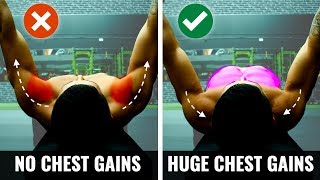
Two fixes for more chest growth from bench press: improve mobility with foam-roller snow angels so you can keep your chest up, and boost chest activation with band drills and cues like pulling your biceps together. One study showed activation cues increased chest EMG by 22%.
Hey, you want a bigger chest, you better bench. How many times have you heard, want a bigger chest, then you have to bench. But this is actually pretty good advice because we know that the bench press is highly effective at growing the chest. In fact, when we look at recent papers that track an individual's bench press strength and chest growth over time, we see a strong positive correlation between them. Meaning that a bigger bench does seem to lead to a bigger chest. But here's the catch. If we look at the numbers a little more closely, we can actually see a few instances where despite some subjects being able to bench significantly more weight than another subject, they didn't seem to have any extra chest growth to show for it. And similarly, other instances where two individuals with the same bench press strength experience experienced a whopping 30% difference in the resulting growth of their chest. Just meaning that some individuals just don't seem to respond as well as others do when it comes to growing their chest with a bench press. And believe me, I used to be one of these individuals. Everywhere else would grow except for my chest. Now, although yes, genetics can play a role in determining this, research clearly indicates that you can quickly improve the resulting chest growth you experience from the bench press by just applying a few simple tips. And. And it wasn't until I finally applied the two steps I'm going to share with you today that I finally started to see my chest responding to the bench press and growing very quickly as a result. So the first step has to do with opening up your chest so that you can actually use it more effectively when you perform the bench, because in order to place most of the tension onto the chest while benching, you need to be able to keep your chest up and out and your shoulder blades retracted back or pinched together as if you were going to pinch a pencil between those blades. This then naturally creates a slight arch in your upper back with space between your back and the bench. And it's a position that you need to maintain as you're pressing, because not only is this position safer on your shoulder and contributes to a stronger press, but based on biomechanical analyses of the bench press, we know that it also increases the involvement of the chest in the movement by preventing the front delts from rounding forward and taking over, which is something you need to avoid doing at all costs, because the more you let your shoulders round forward and chest cave in as you press, like doing here on the left, the more the tension is going to be shifted away from the chest and onto the front delts instead, resulting in less chest growth and more front delts growth instead, which is exactly what happened to me back in the day. So the better you can keep that chest up and shoulder blades pinned back throughout the press, the better you're going to be able to actually use your chest when you bench, resulting in better growth. But the problem nowadays is that most of you are stuck in a four forward rounded posture, which makes applying what I previously mentioned a lot more difficult because as soon as you hop on the bench press, you'll be naturally inclined and essentially designed to round your shoulders forward when you press and shift more tension to the front delts as a result of your posture and various mobility restrictions. But by improving these mobility restrictions, you'll then be able to maintain a better position and hence indirectly boost the chest growth through experience from the bench press. Now, I do have a recent video up on fixing rounded shoulders, which you should definitely give a watch and I'll link it in the description box down below. But basically the two things you need to focus on are both opening up your chest and getting more upper back mobility in your thoracic spine so you can keep that chest up and out and that upper back arch back as you press. And one great dynamic stretch to help you achieve this are snow angels on a foam roller, where you lay vertically on a foam roller with your head and butt supported and your shoulder blades pulled back together. Then you simply perform snow angels with your arms slowly rotating up as far as you can while keeping your hands touching the ground for around 20 to 30 reps. And then as your mobility improves from this for an even deeper stretch, you can start adding weight to your hands like so with your arms held at 90 degrees. But by regularly doing exercises like these to open up your chest and loosen the upper back, you're going to then be able to get into a much more efficient benching position to actually use and place tension on the chest instead of the front delts. Now, although you could be executing the bench press properly with the form I previously went through, chances are you still aren't using your chest as much as you could be, which is where getting better at actually activating your chest becomes important. For example, in one study from the Journal of Strength and Conditioning Research, even well trained athletes were able to boost the activation of their chest by 22% by simply using a few chest activation cues during the bench press. And given that a recent 2018 paper by Dr. Schoenfeld has indicated that boosting the neural muscular activation and mind to muscle connection with your muscles as you train them leads to significantly greater growth. It's clear to see how improving the activation of your chest as you bench can lead to greater growth as a result. But if you're someone like me who has always had a very difficult time activating their chest, then there's a few things that you'll want to do, which has personally worked wonders in terms of me finally being able to feel my chest working. First, it's important to understand what the chest does in the first place, which is mainly something called horizontal adduction. And it's simply the act of pulling your arm towards the midline of your body. So whenever we perform the bench press, it's a horizontal adduction and the movement of our arms together that's activating our chest, and as a result, presses the weight up. In order to properly activate your chest while you bench, you need to learn how to pull your arms together by using your chest muscles as opposed to other muscles. And to do this, simply stand with one of your hands on the opposite pec and your other arm out to the side and your shoulder blade blades retracted and pinched together. Now, think about the following two points. Point A at your biceps and point B at the inner part of the chest that you're holding. All you're going to do now is simply bring point A to point B by contracting that chest that you're holding in order to pull your arm in to bring the two points together as close as possible. As you do so, avoid letting your shoulder round forward. Instead, you want to keep the shoulder pinned back by retracting your shoulder blades. And as you're doing this movement, you should be able to feel your chest contracting with your other hand. Once you get this down, though, next you want to bend your arm as if you were doing the bench press. And again, just think about bringing point A to point B to fully shorten that pec without letting your shoulder take over. And then after this, you want to now loop a band around a fixture and grab it with the one hand, take a few steps out to your side until there's a little bit of tension in the band. Now you simply perform the exact same motion we previously did. Again, just thinking about pulling the biceps inwards. Then, when you get to the middle, hold this position for 10 seconds or so while contracting and using your chest to prevent your arm from being pulled away. After you do these steps on both sides and feel a strong chest activation, it's time to apply what you learned to the bench press. First, start with just the bar, but before lowering it, pre activate your chest by thinking about bringing your hands inwards and pulling your biceps in towards each other. Obviously your hands won't move as they're stuck on the bar, but this will just help you engage your chest. After this, start slowly performing reps with the bar, but you should no longer be thinking about just pressing the weight up. Instead, on the way up of every single rep, I want you to just think about pulling your biceps together. So focus on points A and points B that we previously went through and just think about bringing those two points together every single rep. This, when done in combination with the form I went through in step one, should enable you to now feel a much stronger contraction in your chest. And then from here you can slowly add weight to the bar. But just keep in mind that the weight you'll now be lifting will likely be considerably lighter than the weight that you may have previously been lifting, but this is exactly what we want. You've effectively minimized the involvement of your front delts and incorporated more of your chest instead, which is undoubtedly going to lead to much better chest growth in the long run, even if you have to use lighter weight. So guys, I hope you're able to see that. If you want to see the best results and build muscle in the right areas, then you need to be activating the right muscles during all of your exercises exercises and executing these movements optimally, which doesn't just apply to the chest, but to all of your other muscle groups as well. And for a step by step program that provides you with these crucial muscle activation drills and exercise tutorials so that you know exactly how to build muscle most effectively and in the right areas just like these members have done with their built with Science programs. Then simply head on over to builtwithscience.com and take the starting point quiz to discover what program is best for you and your specific situation. Anyways guys, I hope you enjoyed enjoyed this one. Please show your support by giving the video a like leaving a comment down below as to what you'd like to see me cover next. Subscribing to the channel and turning on notifications for my channel as well as this all really does help me out and I appreciate the support. Thank you so much guys and I'll see you next time.










