How To Build A Big Back At Home (NO WEIGHTS & NO PULL-UP BAR)
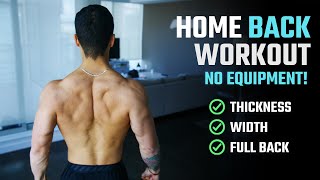
A YouTube instructional video (Jeremy Ethier, Apr 2020) explaining a progressive home back workout requiring no weights or pull-up bar. It presents a bed-sheet-over-door rig (TRX-style) and alternative regressions, then demonstrates exercises to target lats, mid-traps/rhomboids, rotator cuff/mid-lower traps, and lower-back/hip-extension. Guidance is given on set structure, rep ranges, progression thresholds, and programizing across the week.
Questions this video answers
Roughly 10–15 reps per set.
When you can perform more than roughly 30 reps per set.
buildwithscience.com
Tie knots in two long bed sheets, throw them over a door and close the door inward so it leans against the frame.
If you're familiar with home workouts and you already know that the back is probably the most difficult muscle to adequately train at home without equipment, and especially when you don't even have a pull up bar. And although there are plenty of home back workouts out there that do target the back muscles to a certain degree, they either fail to actually work your back muscles through their full range of motion or they just don't provide enough load or resistance to enable you to actually build muscle in your back without using heavy weights. And in this video though, I'll go through a home back workout that avoids those two common pitfalls and will instead enable you to target and grow your various back muscles in the comfort of your own home. The first exercise we'll be doing here will be a replacement for the pull ups or lat pulldowns that you typically perform in the gym. To target the lats, and to do so most effectively, you ideally want to use the bed sheet setup that I presented in my other home workouts where you tie a knot at the end of two long bed sheets, throw them over your door and then close the door inwards. To now create a home version of the trx, I highly suggest you at least try this setup since we'll be using it quite a bit in this back workout. But just make sure that when you actually close the door, you want to close it so that the door leans in against the frame as you're pulling rather than the other way around as this is going to enable it to hold strong as you perform exercises. Once you have that set up ready, we'll perform body weight lat pulldowns with it where you wrap the sheets around your hands, lay on the floor with your legs straight and then pull your elbows down and back just as you would in a pull up a lat pull down to lift your body off of the ground and then you want to use your lats to control your body back down to the ground and repeat. If these are too difficult, you can regress them by bending your knees like so and then using your legs to help push you up during each rep. And then over time, you can use your legs less and less by gradually straightening them until they're completely straight and your upper body is now doing all the work. Now if you aren't using the bed sheet setup, an alternative is something I've shown in my past home workout video, the sliding lat pulldown. Although this does eliminate the all important eccentric portion of the movement when compared to the bed sheet lat pulldowns or standard pull ups. It's still better than nothing to at least work the lats if you don't have access to a pull up bar or a suitable bed sheet setup at home. Next, we're going to now move on to a bodyweight row to now shift a little more emphasis to our mid back musculature like the mid traps and rhomboids for more back thickness. For these, we're going to go back to the bed sheet setup. So grab each sheet, take a few steps back, lean back until there's tension in the sheets, and then pull yourself upwards by driving your elbows back and squeezing your shoulder blades together. For the easiest modification, you can perform these with a split stance and use your back leg to help raise your body up during each rep. And then you want to move on to doing these with your feet together. And then from there you can continue moving your feet closer and closer to the door in order to make the movement more difficult. The more horizontal you position your body, the more load you're going to be lifting, and it's a great way to effectively progress this exercise without weights. If you're not using the sheet setup though, then ideally you'll want to find a table sturdy and long enough to safely perform your row, which can be made easier by bending your knees and using your legs for assistance. And then as you get stronger, straighten your knees and gradually make your body more horizontal to increase the load of your body weight that you'd be lifting. Next, we're going to move back to targeting the lats for more back width. And we'll use the sheets here again in order to best simulate a dumbbell pullover or straight arm pull down that we typically perform in the gym. To target the lats for these, wrap the sheets around your hands, straighten your arms in front of your body, engage your core and then simply let your body fall forward. As you let your arms raise overhead, then you want to bring your body back up to the starting position by driving your arms downwards. By engaging your lats, your torso and your arms should remain straight the whole time. And you want to think about driving your elbows backwards to best engage the lats as you raise your body up. To start out, I recommend doing these with your feet further away from the door so that your body doesn't fall forward as much as this is going to be the easiest regression. And then as you get stronger, move your feet closer towards the door to enable your body to fall forward more. You can also shorten the range of motion to make it easier when starting out and then gradually increase the range of motion by letting your arms travel further overhead as you get stronger. An alternative if you're not using the sheets though, are to perform a sliding version of these on the ground. Here you want to place your forearms on something that can grip the floor, so like a yoga mat or even shoes, for example. Then, while keeping your elbows tucked close to your sides, you want to simply drag your elbows down towards your torso to slide your body upwards. This exercise is quite similar to the sliding lat pulldowns done earlier, but by keeping your elbows tucked close to your body, you'll be able to effectively target the lats through a slightly different angle. Next, we're going to use the sheets to now perform face pulls to target the mid and lower traps, as well as the various rotator cuff muscles that are all important muscles for postural improvements and overall scapula and shoulder stability for these. Wrap your hands around the sheets, take a few steps back from the door and lean back until there's tension in the sheets. Then raise your torso up by performing a face pull, where you pull your hands towards your face while keeping your elbows high and externally rotating your shoulder such that your arms are in a biceps flexing pose. At the end position, you should feel this exercise in the middle of your back and in the back of your shoulders. To start out, you can perform these with a split stance to use your back leg for assistance. And then as you get stronger, you can perform that with your feet together and gradually move your feet closer and closer to the door to increase the difficulty over time. And if you aren't using the sheet setup to hit some of these important muscles, you can perform wall slides instead, where you simply lean your back against the wall and slide your arms up and down against it, mimicking a compressed movement pattern. When done properly, you should feel these light up your mid back muscles. Next, we're going to finish the workout off with a move that will enable us to not only work all of our upper back muscles, but will now target and strengthen the lower back as well through hip extension. For these, lay on your stomach with your arms and legs extended. Your palms should face downwards and your feet should be about hip width apart. Then you want to raise your arms and legs up off the floor by about an inch or two. Try to get at least your chest and your thighs up off the ground if you can. And from this alone, you should already feel your glutes, your lower back and your mid back, all very highly engaged. And then from Here you want to slowly bring your arms out to your sides and then all the way back behind your back while twisting them such that your palms now face upwards when they reach your back position and then slowly move them back to the starting position for one complete rep. You can take a break for a few seconds before before performing the next rep, and if this is initially too difficult for you, I recommend raising your legs in your upper body to a lesser degree and then also performing the arm circle movement faster. And then over time as you get better and better with the movement, you can progress that by raising your legs and your upper body up a little bit more while slowing down the tempo of your arm circles. So to sum the video up, here is what your home back workout could look like and this can be performed as a back workout on its own, but I recommend instead splitting it up into at least two days throughout the week by using an upper lower split for example, to better manage the training volume frequency. And ideally you do want to use a rep range of roughly 10 to 15 reps per set, but as I've explained in my past, home workout videos worry less about the rep range and instead focus on taking each set of the workout either to failure or then a rep or two short of failure in order to maximize growth despite having no access to heavy weights. And then once you can perform more than roughly 30 reps per set in any of the exercises, you want to then progress to a harder variation that are provided for each movement in order to continue maximizing growth over time. But by executing and progressing this workout properly over time as you get stronger, you'll be able to build your back in the comfort of your own home without the need for heavy weights and for a step by step program that shows you not only how to optimally train to build muscle, but also then shows you exactly how to properly fuel your body for growth so that you can truly transform your body and pack on size as efficiently possible with science. And simply head on over to buildwithscience.com to take the analysis quiz to discover which program is best for you and where your body is currently at. Anyways, that's it for today guys. Thank you so much for watching and please don't forget to give me a follow on Instagram as well. That's where I post all of these workouts in a more condensed version that you can easily follow. And also don't forget to show your support by giving the video a like leaving a comment down below as to what you'd like to see me cover. Next. Subscribe to the channel and turning on notifications for the channel as well as this all really does help me out. Thank you so much, everyone. See you next time.










