How To Build MORE Muscle With Home Workouts (4 Science-Based Methods)
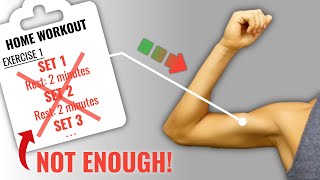
Home workouts struggle to build muscle because they can't match the heavy weight tension of a gym. Four methods fix this: overcoming isometrics with a towel, rest-pause sets, high-intent reps with maximum squeeze, and pairing resistance bands with light weights to change how resistance feels throughout the movement.
One of the biggest challenges with home workouts is that if we don't have the right equipment or access to a good amount of weights, then it becomes increasingly difficult to get the same level of muscle stimulation and growth that we get at the gym with heavy weights. And if you're not a complete beginner anymore and instead have some training experience under your belt, then this can become even more problematic if you're seeking to maintain or even continue building muscle at home or, or whenever you're limited in terms of your equipment. Why exactly is this the case though? Well, there's one main reason why training in the gym with heavier weights is typically, quote, unquote, superior for muscle growth when compared to home workouts. And that has to do with something called mechanical tension, which we know is the main driver of muscle growth. Now, in order to maximize mechanical tension and the resulting growth from an exercise, you need to be able to recruit as many muscle fibers in your muscle as possible and as you perform that exercise. And the beauty about having access to heavier weights in the gym is that you're able to maximally activate your muscle fibers by simply performing a relatively challenging set of 8 to 12 reps, for example. Whereas if you're just training with your body weight or lighter weights, then you aren't eliciting nearly as much tension on your muscles as you are with heavier weights. And as a result, your muscle fibers won't become fully recruited unless you really push the ticker sets to near failure with by performing a ton of reps. And even then, research has shown that if the weight of resistance used just isn't challenging enough and your rep range per set gets too high as a result, then muscle growth will be compromised. However, don't lose hope, as there are a couple solutions to this. Because although it does become more difficult to fully activate our muscles with lighter weights, there are ways that we can manipulate our sets and exercises to ensure that we're still able to fully stimulate our muscles with without having to do a ridiculous number of reps every single set. And on a similar note, although as I mentioned earlier, mechanical tension is a primary driver of muscle growth, metabolic stress is another pathway for growth that we can now take advantage of and emphasize in several ways. And in this video, that's exactly what I'll show you how to do with four science based methods that when properly applied, will enable you to build muscle more effectively with your home workouts. The first method is something called Overcoming Isometrics, a brutal home workout method that was first brought to my attention by Coach Eugene Teo all you need is a towel and a box of tissues to wipe the tears off your face after these grueling sets. But basically, here's how it works. Let's say you're about to perform a set of banded or lightweight squats that wouldn't typically challenge you as much as squats in the gym with heavyweights would. What you can do to compensate for this is first perform a squat isometric before you go into your set. So simply wrap a towel or a bed sheet under your feet and wrap it around each of your hands. Then use your legs to push up with maximal effort against the immovable resistance and keep this up for 20, 30 seconds. You can even elevate your heels onto books to increase the demands placed on the quads. Then, after you just can't stand it anymore, immediately go right into your set of lightweight squats. Chances are you're not going to be able to perform nearly as many reps as you normally would be able to as a result of the added fatigue and metabolic stress in the legs from that overcoming isometric we did prior. And this isn't just limited to squats. You can perform this before any lighter leg exercise you do at home, and can even perform these overcoming isometrics with other muscle groups as well. For example, before your lateral raises, you can perform a shoulder isometric like so. Before your biceps curls, you can perform a biceps isometric like so. And before your back movements, you can perform a back rowing isometric like so. It works for virtually every one of your muscle groups and is just an effective way of ensuring that you're able to activate all of your muscle fibers and accumulate more metabolic stress during your sets with lighter weights in order to boost the growth you experience from those sets. Next is a method that has to do with how we go about executing our sets, and it's something called rest pause sets, which, when compared to traditional sets over a period of six weeks, have been shown to provide a slight benefit to muscle growth, especially for the lower body. And the researchers suggest this is because rest pause sets help us push closer to failure during our exercises and also boost the level of metabolic stress that we experience in our sets. And how it works is as follows. So traditionally, what we do with our sets is we'd perform a set of 10 reps, for example, and rest for a couple minutes, then proceed to our next set, rest again, and then proceed to our last set if we're doing a total of, let's say, three sets. With rest pause sets, however, what you do instead is basically perform just one extended set instead of three total sets. So you perform your first set until failure or close enough to it, and then jot down how many reps you got. In this case, let's say you got 20 reps. Then you would stop and rest for just 20 seconds and then go right back into the exercise and again take it as close to failure as you can and note down how many reps you got there. Then you keep repeating the short rest and work cycle until you manage to match the number of reps you got in your first set. So in this case, 20. The benefit of executing your sets in this fashion is not only that it saves time, but for many individuals it mentally pushes you to get closer to true failure than you would have otherwise, while considerably boosting the metabolic stress in your muscles, both of which being important for muscle growth, especially when working with lighter weights. Now, I wouldn't typically advise you to perform your heavy compound movements in the gym in this fashion, as it does get risky and counterproductive there, but for home workouts where you're limited to lighter weights and minimal equipment, it's a viable way to increase the difficulty of your sets and the growth you experience as result. The next method has to do with boosting the activation of your muscles during each set, because although we may not be able to add more weight to an exercise to provide more tension to the muscles, for we can instead increase the demands of the muscle by mindfully squeezing the target muscle as hard as possible both during and even in between each rep, depending on the exercise. What this does is it helps elicit a little bit more metabolic stress, fatigue and tension to that muscle in order to signal it to get bigger despite using the same load. And in fact illustrating the power of this Method is a 2016 study which had subjects perform curls with one of their arms with no weight, and were instead instructed to contract their biceps as hard as possible in a curling motion for four sets of 20 reps three times a week. Whereas in the other arm they used a weight equivalent to 70% of their one rep max and performed that for four sets of eight 12 reps three times a week. After six weeks, the researchers measured the growth in each of their arms and found that both subjects experienced the same amount of growth. And as stated by the researchers, the high levels of muscle activation in the biceps produced from the repeated strong contractions seem to provide sufficient stimulation of their muscles for growth even when no weight was used. Now, although these were untrained subjects, it still goes to show you the potential power of forcefully contracting your target muscles as you train them, especially when you're limited to just lighter weights. So what I'd suggest is with something like curls, or rather than just mindfully curling the weight up, focus instead on contracting your biceps as hard as possible as you do so. And for something like split squats or dumbbell squats, focus on squeezing the quads forcefully throughout your squat and at the top position between each rep. What you'll notice is that when properly applied to your various exercises, you're not going to be able to do nearly as many reps as you could do previously due to the heightened level of fatigue and metabolic stress in your target muscle, which. Which will, as a result, lead to better growth from those sets. The fourth and final method is to combine the various equipment you have available, because odds are most of you have light weights and some kind of band laying around at home. And although the light weights on their own may not be challenging enough for growth, by throwing a band into the mix, it now becomes increasingly challenging to the point where you're now able to fatigue your muscles to a greater degree despite using lighter weights. And the added benefit about using bands to accomplish this is that they complement the resistance curve of many of your exercises very well by providing a progressively increasing resistance to provide resistance to parts of the exercises where they normally would be none. So get creative with it and implement bands wherever you can. For example, here's how you could do so with weighted squats, here's how you can do so with split squats, here's how you can do so with a dumbbell floor press, and here's how you could do so with a Romanian deadlift. Remember, tension is tension, and your muscles are going to respond and grow in the same way regardless of whether you add more tension with a band or or add more tension by using heavier weight. So, as an action plan for you, what I recommend is experiment with implementing some of these methods into your home workouts as you see fit, especially in exercises where you're quite limited in terms of your equipment and struggling to make them challenging enough on your muscles. And if you're feeling up to the challenge or just have a weird thing for pain, feel free to even combine all four of these methods into your sets. Just please make sure you have a Kleenex handy. But hopefully you're able to see that regardless of how limited you are with your home workouts, there are ways that you can manipulate the way in which you perform them in order to increase the level of growth that you experience from them. And on that note, I do have an exciting announcement as I've just launched my Home Workout Program bundle that consists of a dumbbell only program, a resistance band only program, and a bodyweight only program. They're all designed so that regardless of what equipment you may or may not have available you, you can continue maximizing results and building muscle while working out at home and for a limited time only. Given this crazy time in our lives, I've decided that with the purchase of any of my main built with science gym based programs, I'll be throwing in this three program home workout bundle and for free. Just so that you can use these home workout programs for the time being and then seamlessly transition to the gym based programs once gyms reopen. If you wish to do so and to find out which program will be best for you, see, simply head on over to buildwithscience.com and take the Analysis quiz which will guide you to the best program for your body and where you're currently at. Anyways, that's it for today. Thank you so much for watching. Hope you enjoyed it. Please don't forget to show your support by giving the video a like leaving a comment down below as to what you'd like to see me cover next, subscribing to the channel and turning on notifications for the channel as well as this all really does help me out. Thank you so much everyone. I'll see you next time. Sat.










