How to Build Muscle 2x Faster (Genius Strategy)
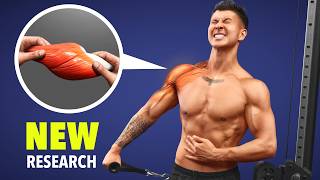
Jeremy Ethier breaks down research showing training muscles in a stretched position produces roughly 2x more muscle growth. He explains why heavy weights and partial reps limit stretch, then walks through exercise selection, slower lowering, and lighter loads to increase range. A new UBC study starting September will test this on shoulders, glutes, and chest.
We all know that guy who says he could do 30 pull ups and then they look like this. But what if he's onto something? Today I'll show you why new research suggests using bad form can help you put on muscle almost twice as fast. And it's actually pretty simple. It's all about the stretch.
Taking your current training and focusing more on the stretch could take some of your lagging muscles to be a lot bigger. And could take some of your currently pretty good muscles and take it to the next level.
That's Dr. Milo Wolfe, the world's leading expert on this new area of research, research and how to use it to speed up muscle growth.
There seems to be something unique about training a muscle group in the stretch position. There's about 10 to 12 studies and in many of these studies you see around double the growth by focusing on the stretch versus missing out on the stretch.
But here's the problem. Most people don't know how to target the stretch properly. And it's not just beginners who make this mistake. Often the stronger you get, the easier it is to neglect it. First, we'll dive into how to fix this common mistake. And later I'll show you some new stretch techniques that have been growing my muscles faster than anything I've tried in the past.
For many exercises like the bench press, like the squat, like the rdl as well the Romanian deadlift. If you're using more weight and therefore unable to get into that stretch position, you will be limiting how much growth you see.
But why does more weight stop you from getting into the stretch position? Well, it doesn't have to. But just think about guys who stop halfway when squatting or don't touch their chest when doing the bench press, assuming they have the mobility for it. Why aren't they going all the way down? That most commonly happens. And exercise like you mentioned, which are hardest in that stretch position. Right, so like the bench press, the squat people, typically they'll do half reps, maybe three quarter reps. Not going all the way down because the body wants to avoid the most painful part of the exercise. But not going all the way down isn't the only mistake people tend to make.
Yeah, and I similarly see also with the tempo, for example, the bench press, they'll take a few seconds up top of each rep to kind of reset, maybe rest for a little bit and then go for another rep. But conversely, they'll often be super quick in the stretch position. If anything, I would err towards the opposite. I would control a little more in the lengthening position, maybe even pause in the lengthening position, and really try to be explosive out of that stretch position.
So lowering the weight to get deeper and controlling that bottom position is definitely one way to improve the stretch and get more growth from your workouts. But there's more to it. To get the best results, you'll also want to add in two key techniques that most people had never even considered. The first one is obvious. Choose exercises that stretch your muscles the most.
For example, in the barbell bench press, you're often limited in how much of a stretch you get on the pecs by when the barbell touches your chest. If they then switched from a barbell bench press to a dumbbell bench press, you're able to get a bit deeper. But then if you want to take the stretch even further, you. You could do something like a deficit pushup, where there is essentially no longer a restriction on when the ground touches your torso. And so you can get as deep as you want. For your pecs, get a maximum stretch on them, and probably build more muscle.
Now, before you change your whole routine, there's something else you need to know. There's a second way to use a stretch that's less obvious, but might be even more effective. Let's use an example. Choosing an exercise for your biceps. Compare the preacher curl to a regular incline curl. Technically, the incline curl stretches the biceps more than the preacher curl because the arm is positioned behind the body. But there's one subtle difference. Incline curls are most challenging in the middle when the biceps are contracted, whereas preacher curls are most challenging near the bottom when the biceps are more stretched. This difference is thought to be the reason why, in a 2023 study, preacher curls actually led to more growth than incline curls, especially in the bottom of the biceps.
The main thing might be getting a decent stretch and making that stretch challenging. So if I had to pick one right now, like certain exercises, kind of trade off one for the other, I would pick resistance in the stretch position over just maximizing the stretch.
Now, aside from preacher curls, exercises that do a great job of challenging your muscles in the stretch include dumbbell flies for chest, overhead extensions for triceps, reverse cable flies for rear delts, and behind the body, lateral raises for shoulders. But with the cable set at wrist height, unfortunately, there's no really good back or calves exercise that challenges the stretch. And we'll talk about the fix for this in a minute. But basically, anytime you try an exercise, think about this.
If the stretch position feels really easy, like there's barely any weight there, that's not going to be the best movement for hypertrophy. If, on the other hand, the stretch position feels very difficult, something like a dumbbell fly, where it's really challenging in that stretch position, that is going to be a better exercise in all likelihood for hypertrophy.
However, although the research is very promising, it's limited. We don't yet know if all muscles benefit from this, and we also don't know if the extra growth we see only happens in specific areas of a muscle. But I've personally become so fascinated with this area of research that I've decided to take matters into my own hands. So, starting in September, I'll be funding and helping run a unique study at the University of British Columbia to determine how much challenging your muscles in the stretch leads to growth. And we're using three custom machines that, by the switch of a pin, can make each exercise either more difficult in the stretch or the contracted position. And we're also testing the shoulders, glutes, and chest. These are three of the most understudied muscles due to the high cost of using MRI for proper measurement. It's a big project to take on, but it'll help shape the way we work out and the exercises we choose to maximize growth. And honestly, science has done so much for myself and my channel and that getting involved in advancing the field is the least I could do to give back. Milo and I have already placed our bets on the outcome, but I'll keep you guys updated and show your support by commenting for Science Down Below. But what I really want to focus on now is the counterintuitive lesson you can take away from all this stretch research, how you can use bad form for faster muscle growth. So remember this guy? Well, he was actually onto something.
If you're doing the wrong type of half reps, you're hurting your muscle building. However, we do have research on the opposite of that, where you do half reps in the stretch position of a movement and across around five studies. Now, four studies have found more muscle growth with half reps in the stretch position compared to a full range of motion.
In other words, some reps that look bad might actually be good. Think about it. When you train certain muscles like the back or calves, where does it feel the hardest? It's usually at the end of the movement when your muscles are fully contracted. But it's really the beginning when the muscle is most stretched that seems to be most important for growth.
We have research, for example, on the calves, and when we compared doing just the bottom half of the movement to doing a full range of motion, we observed around twice the growth that both sides measured.
So for certain exercises, which I'll list out in just a second, replacing full reps with half reps has the potential to double your growth. But there's another option that's also been shown to be extremely effective and it's quite simple. After you can't do any more full range of motion reps, keep pushing past failure by doing as many half reps as you can in that stretch position. As for what exercises benefit the most from these half rep methods, it's any exercise that's hardest in the contractor position. This includes pretty much all calves exercises, most back exercises like lat pulldowns and rows, but also certain exercises like chest flies, reverse flies, dumbbell lateral raises and leg extensions. As you can see, there's various ways you can apply more stretch to your workouts, but rather than trying to do it all yourself, I would highly recommend just following a proven science backed program that takes care of all the guesswork for you. These programs are extremely effective yet simple to follow and are also updated whenever new research comes out. If you want to join today, just head over to built with science.com and and take our quiz to find the best plan for you and your body. And you can also use the code Stretch at checkout for 15% off. Highly recommend giving this shoulder workout or this arm workout to watch next which both focus on the stretch and have personally grown my muscles faster than anything I've tried in the past. Thank you so much for watching. I'll see you next time.










