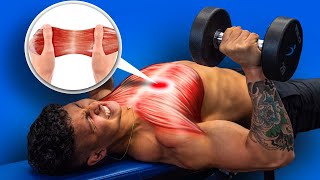
Recent studies show muscles grow faster when you emphasize the stretched position. Bottom-half preacher curls produced 2.6x more biceps growth than top-half curls in five weeks. The key is using full range of motion and occasionally doing partial reps at the bottom of exercises.
Questions this video answers
About 2.6 times more biceps growth (preacher curl study; 5‑week duration).
Bottom‑half leg extensions produced greater quadriceps growth at almost every measured site after 12 weeks compared to top‑half and full‑range groups.
Overhead cable extensions produced ~1.5× more triceps growth than cable pushdowns across all three heads after 12 weeks (within‑subject arm comparison).
Seated leg curls produced significantly more growth in the three primary hamstring muscles than 'lion' leg curls after 12 weeks.
(1) Use full range of motion and controlled eccentrics to reach a deep bottom/stretch position; (2) Favor exercises that put biarticular muscles in a lengthened position (e.g., seated leg curls, overhead triceps extensions, incline/behind‑body biceps curls, Romanian deadlifts for glutes); (3) Occasionally perform "lengthened partials": continue sets with bottom‑position half reps after reaching failure on full ROM, used sparingly and not on heavy compound lifts.
You could be building muscle almost twice as fast as you are right now. Not with this, but with stretch focused training, which has seemed to crack the code to building muscle. I've even started experimenting it with my own training, and honestly, it seems like it's working. Don't just take my word for it, though. I've assembled my elite crew of researchers to dive into the science, separate the truth from fad, and figure out the best way to use this training to build muscle faster. So whenever you lift weights, your muscles contract to lift the weight up and then stretch in order to lower the weight back down. But something special seems to happen when your muscles become stretched under load. The muscles can sense the stretch in the contractile units and in response, kickstart a complex process that tells the body to build more muscle. This is what researchers now term stretch mediated hypertrophy. But not until fairly recently has more specific research actually put this theory to the test. And the findings were quite surprising, even to me. There's four studies I want to look at, with each of them testing a different muscle group. The first two tested what would happen if you only performed the bottom part of an exercise where the muscle is stretched. One of the two published just last year tested this using preacher curls and assessed the growth in the biceps after five weeks. The result? The subjects that performed only the bottom half of the curl experienced 2.6 times more biceps growth than those who only performed the top half of the curl. Pretty cool, right? Another study, also published just last year, replicated an almost identical design, but this time on the leg muscles using leg extensions. They had subjects perform the bottom versus top half of the leg extensions. And one more group who did the full range of motion. They measured the growth of the quad muscles at four different sites. After 12 weeks, growth at almost every single one of the measurement points was greater for the group who only performed the bottom half of the leg extension. Now, these two studies, they highlight the importance of the bottom position of your exercises because that's when your muscle is stretched the most. We'll talk about what this means for your training later on. But before that, what about exercises that can put your muscles into an even more stretched position than traditional exercises do? Would those exercises lead to more growth? Here's two studies that tested just that. The first study was done on the triceps. In this case, subjects had one arm assigned to cable pushdowns, whereas the other arm was assigned to overhead cable extensions. They perform these exercises twice a week, and to avoid favoring one arm over the other every Workout, the subjects alternated which arm that they trained first. Now, based on the stretch focus training theory, since the overhead position places one of the triceps heads, the long head of the triceps, into a position of greater stretch, which when compared to pushdowns where your elbows remain by your side, it would be the more effective exercise. But what actually happened? Well, after 12 weeks, the overhead arm experienced about 1.5 times more growth, not just in the long head of the triceps, but surprisingly, in all the three heads of the triceps. By the way, guys, before we dive into the last study, can we just give the subjects from the previous triceps study a big round of applause? These guys are literally walking around with one arm one and a half times bigger than the other. And they did it all for science. So comment below for science to show your support. Who knows, maybe one of them is even watching this video. Alright, let's move on to the final study. The last study I want to cover was done on the hamstrings. In this case, there were two groups of subjects, each assigned with a different exercise. One group did seated leg curls and the other group did lion leg curls. Now, since three of our four hamstring muscles go from the hip down to the knee, a seated position stretches them into a longer length than a lion position does. So based on this, can you tell which exercise came out on top? You guessed it. After 12 weeks, the seated leg curls provided significantly more growth in these three hamstring muscles than the lion leg curls. Alright, we've covered all the research. Now let's dive into the practical. How exactly do you go about applying all this to potentially speed up your gains? Easy. There's three training tips that I have for you. But before we dive into those tips, I do want to mention that science is always changing and evolving, especially in new fields of research. As of now, I do believe there's sufficient evidence supporting what I'm about to share with you. At least enough to start experimenting with it. Especially because there's no real downsides to them. But as someone who appreciates science, I must also be willing to be wrong and change my thoughts when new science comes comes out. So we'll see how the science develops in the next few years. And if you give me a follow on Instagram, I'll keep you guys updated with new research and my personal results. But for now, let's dive into these tips. The first tip applies to all your exercises. We know how important the bottom position of an exercise seems to be for growth, so don't cut it short. When bench pressing, bring the bar down all the way to your chest and consider using dumbbells to get an even deeper stretch. When doing curls, fully extend your arm at the bottom. When squatting, come down to at least parallel or even further if you can. In addition to this, make sure you're actually controlling the weight down to the bottom position. And then when you get there, don't cheat or bounce out of it using momentum. It's often one of the hardest parts of the movement and you'll be tempted to cheat. But don't control the weight. And remember that is potentially the most important part of the movement for growth. The next tip has to do with your exercise selection. To be honest, you don't need a bunch of special exercises that will provide more stretch mediated hypertrophy. You're already doing them. The tried and true exercises like bench press, curls and squats, they all put your muscles in a deep stretch position given that you perform them with a full range of motion. However, as we discussed earlier, there are some muscles that can potentially benefit from being stretched to a greater degree. These are what's known as BIA articulate muscles, muscles that cross over two joints rather than just one and as a result can be positioned in a way that stretches them even more than normal. So for these muscles, you want to make sure that you're doing an exercise that puts them into that position of extra stretch. But until more muscle groups and exercises come up in future research, here's the four muscles and exercises I'd be comfortable recommending that you incorporate. The first two are the hamstrings and triceps. As we saw earlier, using exercises like seated leg curls and any sort of triceps overhead extension or will provide a greater stretch and lead to more growth. The biceps is another muscle I'd add to the list. One of its heads, the long head can be positioned into an even greater stretch by performing a slight incline curl or behind the body cable curl. Although there isn't direct evidence on this yet, it does seem very likely to provide a benefit. Lastly, the glutes. While there's no direct evidence yet, Romanian deadlifts, squats and split squats will likely be your best bet since they challenge your glutes in that old important stretch position. Last but not least, here's a more advanced tactic that I like to call lengthened partials. So given how important the bottom position seems to be for growth, why not spend more time in it? Here's one way of doing it before I share this technique though. Just realize you don't want to use this on big exercises like squats, deadlifts and overhead press. And you also don't want to do this very often since it can be quite fatiguing. But every now and then, such as during your very last set. For a safe exercise such as a dumbbell press, flies, leg extensions, triceps extension and bicep curl, try this out. After you reach the point where you can't do any more full range of motion reps, continue your set by performing half reps at the bottom position to stress your muscle in that stretched position until you reach failure. If you guys can't tell, I'm obsessed with doing everything possible to maximize gains in the time and effort I spend at the gym. Four years ago, I compiled everything I knew and all the current research into an online program designed to use science to shortcut your transformation. These programs went on to transform the lives of over 100,000 members, but since then I've expanded the team, collaborated with experts, continued mastering my craft, and stayed up to date with new research. I've made mistakes and I've been wrong about a few things along the way, but there isn't a better teacher than failure. I appreciate you guys joining me along this course incredible journey, but we are just getting started because today, four years later, with the help of my incredible team, I'm proud to present my new and improved line of 2.0 programs, fully equipped with the latest cutting edge science to join our community today and start pushing the boundaries of your potential. Head over to builtwithscience.com or click the link in the description box down below and I'll see you in there. Thank you for watching and I'll see you next time.