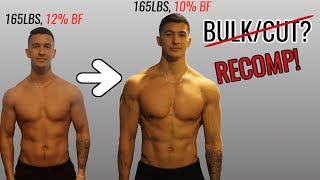
The video explains how natural lifters can achieve body recomposition (simultaneous muscle gain and fat loss) and when it is most feasible: primarily for beginners, detrained individuals, or those with higher body fat (~>25%). It presents three practical, science-backed tips: maintain a slight caloric deficit (aiming for no more than ~0.7% body weight loss per week), consume high protein (roughly 0.8–1.6 g per lb of bodyweight, with many studies using ~1 g/lb), and follow progressive overload resistance training. The video also notes limitations: recomposition slows or may not occur close to genetic potential or at low body fat, and hard-gainers should lean-bulk instead.
Questions this video answers
0.7% of body weight per week (example: ~1 lb/week for a 165 lb individual).
Around 500 calories per day.
At least 0.8 to 1.0 grams of protein per pound of body weight.
About 2.2–3.6 grams of protein per kilogram of body weight (≈1.0–1.6 g/lb).
Common belief has us convinced that building muscle and losing fat simultaneously, also known as body recomposition, isn't feasible for most natural lifters. You often hear that you're stuck with one of two options. You can either build muscle by eating at a caloric surplus, or you can lose fat by eating at a caloric deficit. But based on my own experience and a review of dozens of body recomposition studies, building muscle and losing fat at the same time is definitely possible. It just comes with a catch. Body recomposition protocols are typically, typically more effective if one, you're a beginner, meaning you're within your first year of proper and consistent training, two, you're detrained, meaning that you've taken at least a couple months off from training, or you've never really trained or eaten properly and consistently, or 3, you have quite a high body fat, for example, anything over 25%. Keep in mind that if you're a more intermediate lifter, body recomposition can still occur in some cases, but at a much slower rate and mainly only if you're at a higher body fat percentage and and willing to perform a slow cut. But regardless of which category you fall under, in order to successfully achieve a body recomposition, there's a few key points that you need to implement correctly, and that's what I'll be covering in this video. In order to successfully build muscle and lose fat simultaneously, the first step is to eat at a slight caloric deficit. Higher deficits will maximize more fat loss, but will counteract muscle gain as a consequence. Therefore, you need to set up your caloric deficit so that you're still able to lose some fat while enabling muscle gain. One 2011 study by Garth and colleagues showed that even elite trained athletes were able to gain muscle while losing fat over a nine week period. They achieved this by performing a slow cut, meaning that they aimed to lose a maximum of 0.7% of their body weight per week. This means that for a 165 pound individual, for example, they'd aim to lose a maximum of around one pound per week. For most people people, this equates to a maximum daily caloric deficit of around 500 calories. Keep in mind though, that your weight might actually stay the same throughout the process, especially if you're a beginner or detrained and have a greater ability to build muscle while losing fat. But regardless of what your weight is doing, just make sure it's not dropping too fast and maintain your slight deficit throughout the process.
Hey, I got you guys protein shake.
Awesome. I love protein. Protein.
I know you love protein. I love protein too.
Adequate protein intake is essential for a body recomposition in order to maintain a positive nitrogen balance despite being in a caloric deficit, which just ensures that your muscles still have what they need for growth. Generally, research shows that anything over around 0.8 grams per pound of body weight is unnecessary in terms of muscle growth and maintenance. But with that being said, in recent studies where subjects were able to achieve a successful body recomposition, they were often in taking around 2.2.4 to even 3.6 grams of protein per kilogram of body weight, which is equivalent to roughly 1 gram to 1.6 grams per pound of body weight. In fact, one 2018 study by Schoenfeld and colleagues even showed that every single subject on a high protein diet of a little over one gram per pound of body weight gained muscle while losing a kilogram of fat, whereas the subjects in the low protein group still lost 1kg of fat, but many of them also lost muscle with it or didn't see any muscle gain. Based on this, it's clear that body recomposition is more likely to occur with a high protein diet. Although the exact protein intake that is optimal for your body recomposition is relatively unclear at the moment. I think the literature suggests that intaking 0.8 to 1 gram per pound of body weight, and maybe even more, is ideal. And keep in mind that going higher than this has no harmful effects and may help with keeping you full. But I'd personally suggest just experimenting with it and seeing how your body responds to your protein intake. The third tip is to ensure that you're progressing in the gym. Your muscles need a stimulus to grow, and we provide that through resistance training. As a beginner or D train lifter, this is relatively easy to do since you're able to gain strength quickly in the gym. So stick to a solid training program and ensure that you're progressively overloading it throughout the weeks, which can be done by simply increasing reps or the weight lifted in your exercises. On the other hand, the more training experience you have, the harder this is to do. But given that you're utilizing only a small, small deficit with adequate protein, your body still has the energy and positive nitrogen balance it needs to progress in the gym. This has been shown in several studies of trained subjects, for example, elite gymnasts, aspiring physique competitors, and even football players who were already squatting over 380 pounds and benching over 280 pounds when starting their body recomposition. All of them were able to drop body fat while gaining some muscle and strength. The key for more advanced individuals though, is sticking to tips one and two and properly setting up your training program in a way that allows consistent progression, which is something I'll cover in a future video. So to sum the video up, in order to effectively achieve a body recomposition, focus on one Maintain a slight caloric deficit that allows a maximum of 0.7% weight loss per week. Just keep in mind that weight loss might not occur, especially in beginners 2 intake adequate protein of at least 0.8 to 1 gram per pound of body weight. You can experiment with this and try going higher if you please, and three Stick to a solid training program that focuses on progressive overload. Now, with that being said, I also want to touch on the limitations of body recomposition. It's clear that the closer you are to your genetic potential, the less drastic your body recomposition will be and it may not occur at all. The same applies for how lean you are. The leaner you are, the less likely you are to recomp since your body has fat to utilize for energy. And finally, this isn't an effective strategy for hard gainers or those with a low body fat and need to put on a lot of size. In this case, you should instead focus on lean bulking, which I have a video on and we'll link in the description box down below.
Thanks so much for watching guys. I hope you enjoyed the video and found it useful.
I just wanted to take a quick.
Moment to thank Audible for sponsoring this video. For those of you who don't know, I personally read a lot of books, especially about training, but nowadays I just personally prefer listening to the audio versions of them as it's a lot more convenient for me and it helps me get my reading done even while I'm on the go. Which is where Audible has really come in handy for me in the past couple of years. One book that I'd personally recommend is something called Peak Performance which covers the health and science behind human performance and leaves you with a lot of practical applications that you can carry over into your training and just your day to day life in general. Another one I'd highly recommend is the biography of Elon Musk. Any of you guys who are a big fan of his work like I am, you'll really enjoy this book. So if you guys want to give Audible a try, they're giving away a 30 day free trial to their platform which comes with one free book of your choice. All you have to do is follow this link audible.com jeremyetie or you can text jeremyetie to 500, 500 and yes, my last name is French. I'll also leave a link to it in the description box down below so you guys can follow that to get your free trial as well. So again, huge thank you to Audible for making this possible and I hope you guys enjoy it. Anyways, that's it for this video guys. If you enjoyed it, please don't forget to give it a like leave a comment down below. And also if you haven't already, please subscribe to my channel. I really appreciate all your support. I'll see you guys next time.