How To Build Muscle WITHOUT Lifting Heavier (5 Science-Based Hacks)
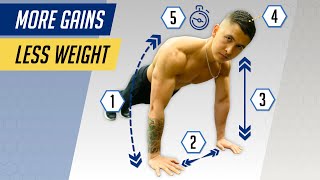
Five ways to build muscle without heavier weights: vary your rep tempo between 0.5 and 3 seconds, improve your form and mind-muscle connection, shorten rest periods to 60-90 seconds for isolation work, increase your range of motion, and push reps up to 30 per set before adding load.
When it comes to building muscle, we all know the importance of progressive overload. If we can go from curling 20 pound dumbbells for 8 reps to now curling 40 pound dumbbells for 8 reps, with all things being equal, your arms will be considerably bigger as a result of that progressive overload. But what most of us fail to realize is that progressive overload is not limited to just adding more weight to an exercise. By definition, it simply means doing more than you've done before, which just places greater tension on your muscles over time, and that's what causes them to grow. And there's a var of ways to accomplish this to continue stimulating and maximizing growth, but without the need to add on more weight, which can be beneficial if you have various equipment limitations or if you just tend to experience joint aches and pains once you do start working with heavier weight. And so, in this video, I'll show you five ways that you can do just that and continue maximizing growth without having to lift any heavier. The first thing we can do to stimulate more growth without adding more weight is to vary our repetition duration, or in other words, our lifting tempo, which simply represents how fast or how slow we perform our reps. Because by simply slowing down our reps, our muscles will now experience greater time under tension to stimulate more growth, even though we haven't added any additional weight. However, there is a threshold beyond which slowing down the speed of your lifts has a detrimental effect on hypertrophy. Because in the event that you do go too slow during your reps, although your muscles do experience far greater time under tension, you're going to pay the price in terms of fully activating the motor units of your target muscle. In fact, research has shown that reducing the tempo down to as slow as 10 seconds per rep. So, for example, five seconds up and then five seconds down resulted in a 36% decrease in chest activation when done on the bench press and would likely lead to diminished growth as a result. And this is why research suggests that a lifting tempo of roughly 0.5 to 3 seconds for the concentric and eccentric portions of your reps is best for growth. Which, to be honest, if you think about, is quite a wide leeway with respect to how fast you can lift. I mean, if you think about it, most of us likely take just about a second on the way up and the way down of each rep. Meaning that instead of adding more weight to an exercise, you can simply slow your reps down considerably in order to elicit more tension on the muscle without compromising Its activation and hence stimulate more growth without the need for added weight. Another way that we can build more muscle without having to add more load is by using the same load and performing the same amount of reps, but with more efficiency. Meaning that you're lifting the same load, but now with better form, more control, and with better activation of the target muscle. Because to be honest, many of us lie to ourselves and we pretend that we've gotten stronger on our movements, but instead we've just gotten sloppier with our execution. I mean, I've been guilty of this on countless occasions, and I'm sure many of you have as well. So with someone like the bench press or even push ups, if you went from performing, let's say 10 reps at a certain load, and to now performing those same 10 reps with the same load, but now with better form and a better mind to muscle connection with their chest, that for muscle growth, that is just as effective since the target muscle will still experience an increase in tension comparable to if you would have added more weight to the movement. The next thing we can do is shorten the rest periods that we take between our sets. Because if we can go from performing, let's say, a dumbbell shoulder press for 10 reps a certain weight with 3 minutes of rest in between sets, and to now performing the same reps and the same weight, but now with just two minutes of rest in between sets, we'll now again be able to stimulate more growth without the need to add more load due to the added metabolic stress your shoulders are going to experience from the shortened rest times. However, at the same time, we don't want to shorten the rest times to the point where our volume and our reps perform suffer and decrease significantly as a result, as this is going to counteract the benefits of the added metabolic stress that we get from the shortened rest periods. And, and based on the current state of the research, it seems that for your main compound movements in the gym, and even compound bodyweight movements like pull ups and hard sets of push ups, for example, you typically would not want to decrease your rest times to shorter than two minutes between sets if you want to maximize growth. Whereas for isolation movements like curls, for example, you have a little bit more leeway and can decrease your rest periods there down to even just 60 to 90 seconds, as these movements don't show the same decrements in performance from shorter rest periods as compound exercises do. Another thing that we can do is alter the range of motion of our exercises because we know Based on research that for the most part, performing our exercises with a full range of motion tends to lead to greater growth, which is true for many exercises like the squat, bench press, pull ups and push ups, for example. And if you perform these various exercises with the same amount of weight, yet simply increase the range of motion of the exercise, you can effectively increase both the stretch and the time under tension that your muscle experiences during each rep, and as a result, stimulate more growth without having to add any additional load. For instance, instead of adding ten pounds to your squat, another option to stimulate more growth would be to simply squat an inch or two deeper during each of your reps. Or instead of trying to add more weight to your push ups, you can instead perform them at a deficit by stacking your hands on dumbbells or a stack of books. If you get creative with it, there are countless ways that you can apply this concept to your exercises to take them past their usual range of motion limits and as a result, increase the muscle growth stimulus without having to add more weight. As I've explained in past videos, it's been shown on numerous occasions that lifting light weights with a higher rep range builds comparable muscle growth as heavier weights with a lower rep range do, as long as you're taking each set close enough to failure. So rather than adding more weight to a movement, we can instead just simply increase the number of reps that we perform per set to get the same effect as for how high reps to go, there is a threshold to this, which seems to be right around 30 reps or so, meaning that if you're working with a certain weight, you have the freedom to increase the number of reps that you perform with that weight, all the way up to 30 reps per set before. You'll want to then either add more weight or overload the movement further by using another one of the tips that I covered in this video in order to continue maximizing growth. So as for how to best implement these five methods, what I'd recommend is always start with efficiency before moving on to the other methods. So, for example, let's say that you can perform three sets of 15 reps of a weighted pushup, and you're now ready to overload it to stimulate some more growth. To do so, you should first start by aiming to perform those three sets of 15 reps with better form and with better activation of your chest. And only once you nail that down should you then move on to the various other methods I discussed to make the movement even more difficult. But while still ensuring that your form and your efficiency don't get compromised as a result. All in all though, guys, tension is tension and your muscles can't tell whether you apply that extra tension on your muscle by lifting heavier or by using some of the methods that I went through in this video. And although there does eventually come a point where it just becomes more convenient to overload your movements by adding more weight, I hope you're able to see that nonetheless, there still are many viable ways you can continue stimulating growth without the need to lift heavier and for a step by step all in one program that shows you exactly how to train and eat to build muscle and lean down most effectively with science. Then simply head on over to builtwithscience.com and take the analysis quiz to discover what program is best for you and where your body is currently at. And again guys, I do have the recently launched home workout programs up and running on the site as well. So regardless of what equipment you may or may not have right now, you'll be able to continue progressing and making progress at home. Anyways guys, this it for today. Thank you so much for watching. Hope you enjoyed the video. Please don't forget to show your support by giving the video a like leaving a comment down below as to what you'd like to see me cover next, subscribing to the channel and turning on notifications for the channel as well as this all really does help me out. Thank you so much everyone. See you next time.










