How To Burn More Calories Lifting Weights (Do These 3 Things)
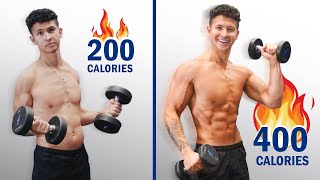
This is a YouTube video titled "How To Burn More Calories Lifting Weights (Do These 3 Things)" created in October 2021. The content is a detailed fitness tutorial explaining how to increase calorie burn during weightlifting workouts by applying three specific tweaks. It includes scientific studies on fat loss, muscle building, and workout efficiency, followed by a practical full-body workout routine using dumbbells. The video is instructional and aimed at helping viewers optimize their fat loss and muscle building results through combined resistance training and cardio methods.
Lifting weights is great for building muscle, but not so great for burning calories. In this video, I'll explain how that affects your ability to build muscle and lose fat, and then cover three tweaks that you can make to increase the number of calories you burn during your lifting workouts. By the end, we're going to apply this to a full body workout that you can get started with right away. First off, it's important to understand that exercise alone is not very effective at losing fat. If your diet is not under control. For example, it would take nearly two hours of running to burn off the calories from a cheeseburger and small fries. This isn't very practical, but with a proper diet, adding the right type of exercise to it can significantly speed up your results. Illustrating this very well is a 2012 study that took 119 participants and compared the fat loss effects of dieting with cardio, dieting with resistance training, or dieting with both cardio and resistance training. Each group ate 2,000 calories a day. The cardio group went jogging for 45 minutes three times a week. The resistance training group lifted weights for an hour three times a week, whereas the last group did both of these throughout the week. After several months of this, the researchers then analyzed how much fat each group lost. And this is where it gets really interesting. The group that only did resistance training, they only lost roughly half a pound of fat. The group that only did cardio lost almost five times as much as this. Whereas a group that did both resistance training and cardio experienced the most fat loss. Now, the reason for these results is that resistance training, it just doesn't burn many calories compared to cardio. Research has shown that on average, lifting weights only burns about 2 to 3 calories per minute. A simple brisk walk burns more than this. This means that a single cardio session can easily burn two to three times as many calories than the traditional resistance training workout does. However, resistance training did have one important advantage over cardio. Doing cardio alone led to a small amount of muscle loss, whereas resistance training led to almost a 2.5 pound increase in muscle. This is important to know because muscle is what's going to help keep your metabolism high as you lose weight and will help ensure that you end up looking lean and muscular rather than just skinny after your diet. This means that for the best fat loss and muscle building results, a combination of resistance training with cardio is best. But let's face it, for most people this is a big commitment. And traditional cardio, it can be Quite unenjoyable. Another option? Combine them both into a single high intensity workout. A workout that gives the calorie burning efficiency of cardio as well as the muscle building benefits of lifting. I'm going to show you how to do this with three tweaks and then give you an example workout that puts this into practice. The first tweak is with how much weight you'll be lifting and how many reps you're going to be doing in your sets for each exercise. A 2011 study analyzed the calories burned during sets of the bench press by having participants either do sets with heavier weights for less reps or lighter weights for more reps. The researchers found that participants could nearly double the number of calories they burn in a set by lifting lighter weights for more reps. However, although we can burn slightly more calories the lighter in weight that we go, there's two scientific findings we need to apply to avoid making the workout less effective at building muscle. Number one is from a recent 2020 analysis of several studies where researchers tested if you could build the same amount of muscle using either light weights or heavy weights. They found that this was in fact possible, but only if participants pushed themselves hard enough during their sets to the point where they could only do one or two more reps if they went all out. Number two is from a similar paper done just this year which found that although you can build just as much muscle with lighter weights, there's a point where the weight becomes too light and less effective for muscle group. Because of this, for the best muscle building results while still burning significantly more calories, a good recommendation is to use a weight that's between 40 to 60% of the maximum weight you can lift for that exercise. For most people, this means choosing a weight that you can do around 1530 reps with. Just remember, you still need to push yourself hard enough for this to be effective. Tweak number two. So this involves using the most muscle mass as possible within your workouts. This is something we implement into my Built with Science programs because of the several benefits it provides. Illustrating this is a 2017 study which tested a variety of resistance training exercises and compared the calories burned. They compared several isolation exercises that only worked one small muscle at a time to compound exercises that worked several different muscles simultaneously. And what they found is actually quite surprising. For example, lat pulldowns, which work several back muscles as well as the biceps and burned almost 20% more calories than bicep curls. They also found that squats, which work the Whole lower body burn almost 35% more calories than leg extensions, which only work the quads. We're going to apply this by filling our workout with big exercises that will work every single muscle of our body. Finally, the most important thing you can do to increase the calorie burn of lifting weights is improve your time efficiency. Think about it. During a 60 minute resistance training workout, you don't actually spend much time working out. Much of it is spent resting, letting your muscles recover before the next set. This is great if you're trying to maximize muscle growth and strength, but not very helpful for burning calories. There is, however, a way that we can structure our workouts to increase our calorie burn without sacrificing gains. A 2011 study showcased just how effective this method can be. The researchers talk took a group of trained men and randomized them into two groups. One group performed a traditional resistance training workout that involved three minutes of rest between each set and moving through each exercise one at a time. The other group performed a circuit style training where they performed each exercise one right after the other, taking just 30 seconds to transition to the next exercise. They then repeated the circuit for the same number of total sets as a traditional group. After eight weeks of this, the researchers found that both groups experienced similar increases in muscle mass and strength. But the circuit training group had a significant decrease in body fat percentage while the traditional training group did not. And this occurred even with the workouts in the circuit group being half the time of the traditional group workouts. Using this method will enable us to add more exercises and sets into our workout without having to stay in the gym any longer than normal. But we will want to be careful with the exercise selection to ensure that we don't compromise our gains by overworking the same muscle groups with not enough rest. Alright, we got the science down. Now let's apply it into a workout that can be done either at the gym or even at home with just dumbbells. The workout includes three circuits that each have four exercises. Within each circuit, you're going to progress from one exercise to the next, resting for only 15 to 20 seconds. And for each exercise, you're going to pick a weight that you can do somewhere between 15 to 30 reps with. If you push really hard, if you reach above 30 reps, then you know it's time to use a heavier weight. Finally, if you're a beginner, perform each circuit two to three times, intermediate three to four times and advance four to five times. Let's now dive into the first circuit. So the first circuit is going to focus on the upper body and all you're going to need is a bench and two pairs of dumbbells. First, start with a flat dumbbell bench press to work the chest and triceps. If you don't have a bench, these can be just done on the floor. Once you finish your set using the same pair of dumbbells and move on to a bent over dumbbell row to now work your back and biceps. Pull the dumbbells into your hips, not your chest. After you finish rows, take a quick breather and then grab a second set of dumbbells. You'll want these to be a little bit lighter. We'll use them to perform shoulder presses and we're going to do these standing to slightly boost shoulder muscle activation when compared to the seated version. When you're done with this, set the dumbbells down. I will now focus on working the core with reverse crunches and take it slow and feel your abs working every part of the rep. After that, you've completed one round. Take 15 to 20 seconds to rest and then repeat for the required number of cycles based on your experience level. Once you're done with circuit one, take two to three minutes to rest and prepare for circuit two to now focus on the lower body. First, we're going to start with a tough yet very effective exercise for the quads. Hold the dumbbell at your chest and squat down to at least parallel pace yourself here. Not going too fast or too slow. Around rep 15, your legs will be on fire, but keep on pushing. Once you're done, grab a pair of dumbbells and we'll now focus on the hamstrings and glutes with a Romanian deadlift. Lower the dumbbells only as far as you can while keeping your back flat. Then use your hamstrings and glutes to pull yourself back up to the starting position. After this, keeping the same dumbbells will now work the calves. No, we're not skipping them. While standing, raise up on your toes as far as you can, squeeze hard at the top and then control the weight back down and repeat. We'll then finish the circuit off with some core work. Grab either a 10 or 25 pound plate, lie on your back and perform weighted crunches. You don't need to sit all the way up, just think about trying to touch your chest towards your belly button. Once you're done, take about 15 to 20 seconds to rest and then it's back to squats. When you're all Done your required number of circuits, take another two, three minutes to rest and get ready for the final circuit. So the third and final circuit is going to focus on the full body and all you need is a heavier and lighter pair of dumbbells. First, we're going to work the lower body with the heavier dumbbells held by your sides. Take a step back into a reverse lunge. Keep your chest up and push up with the front leg. Alternate legs each rep. After this, you're going to drop down for push ups. Depending on your experience level, you can elevate your hands up on a box to make it easier or elevate your feet to make it harder. What's most important is that you're pushing yourself hard and getting no more than 30 reps. After this, grab your lighter pair of dumbbells and we're now going to focus on the mid back and rear delts. Bend over, then raise your arms into a W position at the top. Hold this briefly and then come back down for another rep. Finally, we're almost there. We're going to finish this circuit off with a plank. Squeeze your glutes together and keep your chest and hips parallel to the floor. Don't worry about reps here, just hold it until you get to about an 8 or 9 out of 10 difficulty, just like the last two circuits. So cycle through these exercises two to five times, depending on your experience level. After that, give yourself a much needed pat on the back and congratulate yourself for hopefully making it through. So you're going to get the most benefit from this workout if you implement it no less than two, but no more than four times a week. That being said, I wouldn't use this style of workout if your main goal is to build muscle and improve your strength. I have other workouts on my channel that are much better suited for that. And for those who are looking for an all in one step by step program that's personalized, specific specifically for your body and your fitness goals. You can take a free quiz over@builtwithscience.com and we'll determine which of our programs is right for you. Anyways, thank you so much for watching. You can click here to watch some of my other videos and I'll see you next time.










