How To Fix Elbow Pain (BULLETPROOF YOUR ELBOWS!)
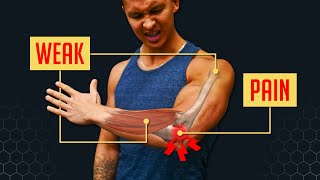
Elbow pain during training usually comes from weak forearm strength, shoulder instability, or training through injury. Fix it with wrist extensions, grip work like suitcase carries, scapular pull-ups, and neutral-grip exercises instead of barbell curls.
We don't realize it, but every set and every rep we do adds to the stress that we place in our body. And it's not just our muscles that take a beating. Our joints take on a lot of that stress too, and often become sites of discomfort. And one of the most common areas where this discomfort and pain occurs is at the elbow. Because of how complex this joint really is and how often it's involved during our exercises. This can be felt as pain on the inside of the elbow or or more commonly, pain at the outside of the elbow. Now, I've personally experienced elbow pain before, and I know it's just not fun. It hinders our training, it diminishes our performance, and it's just plain hurts. So today I want to go over three causes that are likely contributing to the pain in your elbow and what you need to do in order to not only alleviate that pain, but also prevent it from coming back. So you can start lifting pain free as soon as possible and and protect this joint for life. The first culprit is an imbalance in your forearm strength and just weak grip strength in general. Study after study has consistently linked weak extensor muscles in the forearm to be the main culprit for elbow pain and cite repetitive gripping to be what can kick off your pain initially. Now, what makes these extensor muscles on the outside of your forearm more susceptible to overuse and discomfort is due to their heavy involvement during gripping. Because whenever we go to grab something, our flexor muscles on the inside of our forearm forearm will first help flex to grip the hand, but our extensor muscles then kick on and stay on in order to prevent our wrist from excessively flexing. In fact, EMG studies have clearly shown that every extensor muscle in the forearm is firing during gripping movements and tends to be firing to a greater extent than our flexors are. And the harder or longer you grip something or the heavier the object that you're gripping, the greater the stress that's placed on the extensors and the tendon that attaches the extensors to the outside of the elbow. Just meaning that if your extensors are weak due to a lack of forearm and or grip training, then they'll be more susceptible to fatigue, which can then result in an overuse injury from all of the gripping that you do during your workouts. And this overuse injury then manifests as pain on the outside of the elbow, right in the tendon that is connecting the extensor muscle. So strengthening your forearms, especially your extensors as well as just increasing your overall grip strength, is what's key to creating bulletproof elbows and has consistently been shown to be an effective approach to relieving that elbow pain. And the simplest way to start out is just to regularly perform standard wrist extensions to help strengthen and build more endurance in your weaker wrist extensors. Use lighter weight and aim for a few sets of about 10 reps, then increase the weight over time as long as you're able to do so without increasing pain. If, however, the pain you experience is on the inside of your elbow rather than on the outside, then you'd want to perform wrist curls instead of wrist extensions to help build the endurance of your wrist flexors. Since in this case you have the opposite imbalance, then eventually, if you can do so without pain, you'll want to then progress to more functional movements such as situation single arm suitcase carries. The neutral wrist position of this exercise makes it easier for your elbow to tolerate and can help you build your overall grip strength and endurance over time. I suggest performing a few sets of these exercises once per day, but play around with the volume and frequency just to avoid increasing any pain. As your forearm and grip strength improves, you should gradually experience more and more relief as a result. So we addressed a problem below the elbow, but now we need to look above the elbow for some other possible problem, and the most common culprit here is weakness in the muscles involved in stabilizing the shoulder and the scapula. Because a lack of stabilization here then means that the muscles surrounding your elbow joint will be forced to work over time to compensate for that lack of stability during our pushing and pulling exercises, which again leads to elbow pain due to overuse and over dependence on these forearm muscles. A case study by Batten colleagues showed just how drastic this can be. So in this case study, a patient with elbow pain in one arm was found to be weak in their middle and lower traps, resulting in one of their shoulder blades to be sitting in an off position, which just so happened to be on the same side as their painful elbow. But after completing a strengthening program focusing completely on these weakened muscles, the shoulder blades sat back in the correct position and the elbow pain was completely eliminated. Many other studies have shown similar results with a strong association between between shoulder and scapular instability and resulting elbow pain. So just realize the importance of these often overlooked muscles, especially when it comes to fixing and preventing elbow pain. And I have put out quite a few videos that do address these muscles and I'll link those videos down below. But Some of the best options for you to get started with right now would be exercises like scapular pull ups which help strengthen the traps, and then simple external rotation movements to help strengthen your rotator cuff. Again, perform these moves daily or at least a times per week. Over time, this increase in stability that you're going to develop will help reduce the demands that are placed on your elbow and help alleviate that pain you may be experiencing. The last cause of elbow pain or the worsening of your existing elbow pain is often just trying to push through the pain. We need to listen to our bodies. When you feel discomfort in your joints, don't ignore it. The thing with overuse injuries is that by the time you feel the pain, it has already been overused and continuing to train it is just going to make it worse and possibly cause more severe problems. The good news though is that as long as the pain is minimal, we don't need to completely stop training. We just need to choose less stressful variations of our exercises to give those tendons a break. So for this reason, dumbbells are going to become your best friend as they allow you to manipulate your hand position into basically any position that feels comfortable. Basically, we want to take our hands out of a supinated or pro pronated position and into a neutral grip as much as possible since this places the least stress on our forearm muscles and eliminates our tendency to excessively flex and extend our wrist as we perform exercises. So opting for exercises like hammer curls, dumbbell rows and neutral grip chest presses are all great options since it takes our grip out of a pronated or supinated position. In addition to this, always be mindful of your wrist positioning during your exercises. You want to avoid flexing or extending your wrists excessively during exercises like chin ups, curls and even push downs as this creates a ton of stress on the forearm muscles and tendons. Instead, focus on keeping the wrist neutral and in line with your forearms as you perform these movements and if it still hurts, just try something else or consider decreasing the weight and aiming for higher reps instead. There's of plenty, plenty of ways that you can work around your elbow pain to continue stimulating your muscles and getting good workouts in while letting the overused muscles in your forearms recover. So to sum up the video, here is what you want to do. First, dedicate more time to your forearm training and grip training. Then address potential weaknesses in your shoulder and scapular stabilizer muscles and finally, manipulate your exercises and be mindful of your wrist positioning to avoid worsening the pain. But all in all, you need to realize that if you're feeling stress in certain joints that is often a result of imbalances or weaknesses elsewhere in the body. And for a step by step program that prevents this from happening by showing you exactly how to train and maximize growth while correcting your imbalances and weaknesses in the process. And simply head on over to builtwithscience.com and take our analysis quiz to discover which program is best for you and where your body is currently at. Anyways, that is it for today guys. I hope you enjoyed this one. Please do show your support for the video by giving the video a like leaving a comment down below as to what you'd like to see me cover next, and subscribing to the channel as well. This all really does help me out and it's much appreciated. Thank you so much guys and I'll see you next time.










