How To Fix Rounded Shoulders FAST (10 Minute Science-Based Corrective Routine)
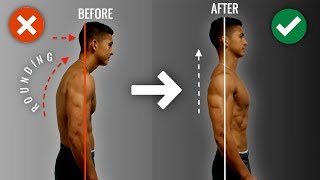
A 10-minute routine fixes rounded shoulders by loosening tight chest and upper back muscles, then strengthening the mid-back and serratus anterior. Do thoracic extensions and chest openers first, then band pull-aparts and Y-raises. Perform it daily or at least three to four times weekly for results.
Questions this video answers
Roughly 10 minutes.
Daily if possible; otherwise at least three to four times per week.
28 individuals (2010 clinical trial).
2017.
If your posture currently looks more like the photo on the left, and you desperately want your posture to look more like the photo on the right and fast, then you've come to the right place. Forward rounded shoulders, like the posture I'm demonstrating here, which is admittedly exactly what my posture used to look like as a student, has become increasingly common and is often developed from sustained periods of slouching and or the result of an unbalanced training routine. In fact, a recent 2017 paper actually found that regular weightlifters exhibited significantly greater values of forward rounded shoulders when compared to untrained individuals due to the various imbalances created by their training routines. And this is a problem not only because it's just generally aesthetically unappealing, but also because it can negatively affect your ability to perform certain exercises in the gym and can potentially put you at a higher risk of developing shoulder pain and injuries. But before we dive into the most effective way to correct this, we need to first take a look at the specific muscle imbalances responsible for creating this posture. And based on the analysis of multiple papers, we can confidently conclude that this posture is a combination of two things. One, overactive muscles that have become tight and are pulling the shoulders into this forward position, with the main culprits often being the pecs and upper traps in combination with the general lack of thoracic mobility. And two, underactive muscles that have become weak and are failing to pull the shoulders backwards into its neutral position, with the main culprits often being the mid and lower traps and the serratus anterior. And what's interesting is that research actually shows that these muscles tend to become weak over time, partly due to the overactive muscles I previously mentioned, actually preventing us from being able to turn on these underactive muscles in the first place. And therefore, for the fastest results, we're going to use a two part corrective routine that first involves stretching the overactive muscles and then moves on to turning on and strengthening the underactive ones using the most effective exercises. Based on current scientific literature, the first exercise for step one is going to be thoracic extensions, which have been shown in case studies to be an effective drill to improve your thoracic mobility. To open up the restricted area contributing to your rounded shoulders, what you'll want to do here is place the foam roller across your upper mid back area with your hands placed behind your head, then exhale while letting your upper back extend over the foam roller. And make sure you avoid compensating during this by excessively arching your lower back, you want to hold this position for a few deep breaths and then repeat this a couple more times further down your upper back. And if you don't have a foam roller, I'll leave a link in the description box to a couple that I personally use and would recommend. For now, though, a decent alternative is simply performing the same movements, seeing seated or with your back on a chair. Again, focus on extending the upper back and avoiding arching your lower back to compensate. Next we want to move on to band over and backs to stretch out the overactive muscles we talked about earlier that are pulling the shoulders forward. What you'll want to do is grab a band or any kind of stick and hold it straight out in front of your chest with an overhand grip. Pull the band apart slightly to create some tension, and then without bending your elbows, you want to slowly raise the band up over your head and behind your back as as far far as you're capable of doing in a controlled manner. And then as you get behind your back, you want to focus on pulling the band apart rather than just losing all the tension in the band. Try your best to avoid shrugging and tense in the upper traps as you perform the movement, and instead keep your shoulders pulled down and away from your ears throughout each rep. And to progress this exercise, what I'd suggest is starting out with a wider grip and not coming all the way back at first, and then you gradually narrow your grip and go further down your back as your mobility improves. As you perform the movement, you should feel a deep stretch in your pecs, your shoulders and your upper traps, which are the exact muscles that we're trying to lengthen. And if you don't have a band, I'd highly suggest getting one, and I'll leave a link in the description box to the one that I'm using here. But in the meantime, a decent alternative is simply the standing chest opener stretch, where you clasp your hands behind your back, squeeze your shoulder blades together, and pull your arms up to deepen the stretch. For these, you'll want to hold the back position for about five deep breaths at a time. Now, although we have done a good job of stretching out the tightened muscles, it's crucial that we move on to step two of the routine to now strengthen the three key muscles that have become weak over time and are failing to pull the shoulders back. And in fact, case studies analyzing rounded shoulder posture have found that this step actually provides significantly greater corrective results and than the stretching that we previously did. And proving this Point is a 2010 clinical trial on 28 individuals struggling with rounded shoulder posture. The study found that activating and strengthening these three underactive muscles in the subjects was key to successfully decreasing the extent of their rounded shoulder posture and thus illustrates the importance of this step and to start, we'll focus on first strengthening the mid traps with the band pull apart, which has been shown in case studies to be an effective exercise at doing so. To perform it, what you'll want to do is hold the band like so, with your thumbs pointing up and arms directly in front of your chest. Then you want to pull the band apart slowly and with control while twisting your hands such that your thumbs point behind you. At the end position, you'll want to squeeze your shoulder blades together as you pull back to engage the mid traps, which you should feel working during each rep. And then after a few sets of the band pull apart, we'll want to then slightly modify it to hit the lower traps instead by changing the line of pull using a Y raise. And to perform it, simply set up how we previously did with the band pull apart. But this time what you want to do is push your fist forward slightly to protract your shoulder blades and pull the band apart slightly to create some tension. And then from here all you want to do is slowly raise your arms up to make a Y overhead and again, try your best to avoid any shrugging or tensing of your upper traps as you do so. When done properly, as you raise your arms up, you should feel a strong contraction in the lower traps shown here. And don't worry if you're not feeling too much in that area right now as your ability to turn on the lower traps will improve over time from both consistently practicing the movement as well as stretching out the overactive muscles from step one of the routine. Now again, I'd highly suggest investing in a bench for these exercises, but in the meantime, for those without access to one, you can instead perform these two movements on a bench or stability ball to hit the mid and lower traps or respectively. And I show how to perform these two exercises in more detail in my Traps workout video, which I'll link in.
The description box down below.
Lastly, we're going to work on strengthening the serratus anterior by doing something called the push up plus, which has been shown to be extremely effective at doing so for those with rounded posture since it not only elicits high EMG activity, but it also minimizes the involvement of the overactive upper traps when compared to other exercises. And to perform it, you simply want to get into the end of a push up position with your arms fully extended and then from here push your hands into the ground to protract your shoulder blades, lifting your upper back towards the ceiling. Briefly hold the top position and then come back down to the starting position with your shoulder blades now retracted and then repeat for more reps. You can also perform these on your knees if this is more doable for you. It's a very subtle movement and you'll only move a couple inches upwards, but you should feel the serratus muscle working and to further intensify this contraction, I'd recommend externally rotating your shoulders by twisting your hands outwards before you perform the movement, as two EMG analyses have shown that this modification leads to significantly greater serratus anterior activation than the standard grip. With all these exercises, it's vital that you make each rep count, which means performing each rep slow and controlled with proper form and a focus on engaging the right muscles that I went through.
So now let's put this all into a corrective routine that'll only take you roughly 10 minutes to do yet it's going to work wonders for your posture, but with this routine, consistency and frequency really are key if you want to correct your posture as quickly as possible. So if you can do so consistently, then perform this routine every day. Otherwise I'd aim for at least three to four times per week for the best results. And keep in mind guys, that for long term results you need to not only always be aware of how your posture is throughout the day and correct it accordingly, but you also need to ensure that your training program is structured in a way that prevents these muscle imbalances from developing. And that's exactly why within my built With S programs we've taken the time to carefully select each and every exercise included in your weekly training routines such that you can build lean muscle while actually improving your posture and correcting your muscle imbalances in the process. To join today, simply head on over to builtwithscience.com to take the Starting Point quiz and discover what science based program is best for you. And big shout out to the Transformation of the week Felix, who in just 12 weeks managed to improve his posture and imbalances while completely transforming his body in the process. Anyways, thank you so much for watching guys. I hope you enjoyed this one. Please don't forget to give the video a like Leave a comment down below as to what you'd like to see me cover next, subscribe to the channel and turn on notifications for my channel as well as this all really does help me out, and I appreciate your support. Thank you so much, everyone. I'll see you next time.
It.










