How To FORCE Muscle Growth (5 Science-Based Methods)
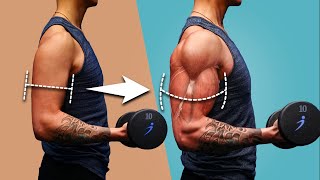
This is a YouTube video titled "How To FORCE Muscle Growth (5 Science-Based Methods)" created in February 2022. The content is a detailed instructional talk explaining five scientifically supported methods to progressively overload muscles for growth, including increasing weight, reps, sets, tempo, and improving form. The speaker provides practical examples and advice for different experience levels and encourages viewers to try their programs for personalized guidance. The video is educational and fitness-focused, aimed at helping viewers optimize their muscle-building workouts.
In order for a muscle to grow, you need to continuously challenge them with more than they're used to. As simple as this sounds, most people's workouts don't accomplish this. Sure, they'll get a good pump and sweat out of their workouts, but they aren't actually doing much to signal their muscles to grow over time. To better explain this, let's take a quick look at the science behind what actually makes the muscle grow. So let's say we just finished a workout immediately after our muscles don't actually get stronger, and in fact they become temporarily weakened from the damage that we put them through. It's not until after a few days of proper recovery that they adapt to the damage we put them through and will come back bigger and stronger than they were before in order to be better prepared for the next workout we put them through. However, no matter how good of a pump you get or how much you sweat, if that next session isn't providing your muscles more of a challenge than the previous previous session did, then the muscle will have no reason to grow and will simply maintain its current size and strength, or in some cases even start to become smaller and weaker. For consistent gains over time, your workouts need to be designed such that they literally force your muscles to grow every single session. Today we're going to cover the five ways to do just that. Increasing the amount of weight lifted is a method that most people rely on to apply it. It's quite straightforward. Lets say you can currently bench press £100 for eight reps. Next week you might try to increase the load and do 110 pounds for eight reps, which would create a new stimulus for your muscles to have to adapt to and grow from. Now, if you're a beginner, then this method of progressive overload will be your bread and butter. To help you make gains quickly, you'll likely be able to add five to ten pounds to the bar every single week, especially on your main lifts like the bench press, the squat and the deadlift. However, if you take our previous example of bench pressing 100 pounds in week one and adding 10 pounds of weight every week, at the end of the year, theoretically you should be benching £620, as cool as that would be. Neither myself nor Alex, one of our record breaking built with science coaches who can bench over twice his body weight, is anywhere close to that. This is where people get stuck. They rely on only adding more weight as their method of challenging their muscles to grow and and eventually get stuck in a plateau to break through this we have to get more creative with how we continue challenging our muscles. This is where our next point comes in handy. When applied properly, adding more reps is another great way to force your muscles to grow. The way this works can be illustrated with a very simple math equation. If I can bench press £100 for 10 reps one week, I can multiply those numbers together and calculate that I've lifted £1,000 total across that set. If next week I go to the gym and lift that same weight, but for 11 reps, I will have lifted 1100 pounds across that same set. This means that by just adding one rep to my set, I've technically lifted £100 more than last week. Which, just like adding more weight does, would create a new stimulus for your muscles to grow. But how high in reps can you go while using the same weight? Well, Based on a 2017 meta analysis, the as long as you're continuing to push hard, you can keep the same weight and increase all the way up to 30 reps and still get the same growth compared to adding more weight. This is extremely helpful if you only have limited equipment or a nagging injury and can't increase the weight on your lifts even if you wanted to. However, for those who do have access to more weights, what we found to be most effective and teaching our built with snatch programs is something called double progression. This is a system that utilizes both reps and weight to ensure that week by week, you're forcing your muscles to grow. The way it works is quite simple. Let's say you're doing three sets of squats for eight to 12 reps. With 100 pounds in week one, you could do eight reps for each set. Next week, you'd aim to do nine reps each set. If that went well, you continue doing that until you were able to do 12 reps for all three sets. At that point, rather than continuing to increase your reps, you could add 10 pounds and restart the process by going back down to 8 reps. However, again, this often only works for so long. What happens when you get stuck, unable to add more weight or do more reps? Well, here's where another often overlooked form of progression can come into play. The next method has to do with how many sets you perform. Let's say you're trying to build up your biceps. Adding sets can be as simple as going from three sets of 12 one week to four sets of 12 the next week. Using the simple math equation we used earlier, if we were curling £40 in each hand, Then each of our biceps would be lifting £480 more volume in the second week by just adding that one set. It's a really simple way to add a massive amount of training volume to your program, and it's something we use in our more advanced built with science programs to help bring up lagging muscle groups. However, when using this method, you need to use it sparingly. Based on the literature, we know doing at least 10 sets per muscle group per week nearly doubles the amount of gains that you would get compared to doing just five sets per muscle group per week. But there comes a point of diminishing returns when you get into the 20 to 30 set zone. So a good rule of thumb is to increase volume no more than 10 to 20% per week. So if you're currently doing 10 sets of chest per week, for example, but you're stuck, unable to lift more weight or do more reps, then the next week you could instead still use the same weight and do the same amount of reps, but just add one extra set to each exercise and continue doing so every week. Then once you get to the 20 to 30 set zone, or you just begin to feel quite fatigued, you can cycle back down to the original program that you started with. Now, although this method does have its benefits, it is quite taxing on the body and can make your workouts considerably longer. The next two methods are ways you can continue continue forcing your muscles to grow while lifting the same weight and doing the same number of reps and sets every single week. Tempo refers to how fast or slow we lift weights. If we slow down our reps, we can increase the amount of time that tension is placed on the muscle to stimulate more growth. This is especially effective for exercises involving smaller, weaker muscle groups like lateral raises. We're adding just a little bit of weight or often disproportionately increases difficulty or bodyweight exercises like push ups and pull ups, where adding weight may not even be an option. However, you want to avoid going too slow, as that can provide the opposite effect and start to hinder muscle growth rather than boost it. Based on the recommendations of Dr. Brad Schoenfeld, who ran a 2015 meta analysis analyzing the effects of tempo on muscle growth, it seems that we can slow down our reps up to about 6 seconds seconds total. So for example, let's say you're doing 20 pound lateral raises and for each rep you usually take about a second on the way up and a second on the way down. Rather than doing more weight reps or sets to stimulate growth. You can instead just slow down your reps by one second every week and you could apply this until you reach three seconds on the way up and three seconds on the way down, at which point the reps would just get too slow and is when you'd want to apply another form of overload, which could be as simple as increasing the weight up to 25 pounds or or utilizing the next method. Oftentimes when people think they are challenging their muscles more by adding more weight to their lifts, they really just end up compromising their form in the process. As a result, despite using the heavier weight than they were previously, their target muscles aren't actually working any harder. You need to realize that if you do the same workout you did the week before, but you perform your exercises with better control, less momentum and more activation of your target muscles, the then that is progression. Better form involves relying more on the target muscles and will result in growth even if all other variables remain the same. Although this method may not catch your eye as much as some of the others on this list, many of you watching could easily stimulate a significant amount of growth for all your muscles by simply cleaning up your form with your exercises. Even advanced lifters, we still spend time analyzing and tweaking our form because we know that any other method of growth or will be meaningless unless your form remains intact. Now as for which of these five methods is best and is going to provide you with the most growth, the truth is it depends. It depends on your level of experience, your equipment availability, and if there's a certain type of plateau that you're stuck in, the best way to find out is to just experiment with them and see what works best for you. But if you're looking for a step by step program that takes care of all the guesswork for you and ensures that week by week you're challenging your body in the right way to consistently, consistently build muscle and lose fat. Just head on over to built with science.com and take our analysis quiz to find out which of our programs is best for you and your body. Anyways, that is it for today guys. Thank you so much for watching. Don't forget to show your support by giving the video a like subscribe to the channel and leaving a comment down below as to what you'd like to see me cover next. Thank you so much and I'll see you next time.










