How to get a WIDER Back FAST (4 Science-Based Tips)
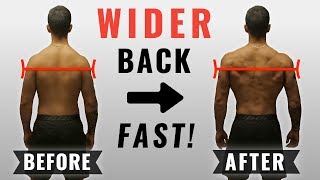
YouTube instructional video (Jeremy Ethier) explaining four science-based strategies to build back width quickly by improving lat activation and targeting. Covers lat activation drills, verbal/positional cues to increase mind–muscle connection, differentiating upper vs lower lat training via exercise selection, making rows more lat-focused, and using the deadlift to develop lats. Concludes with a promotional call-to-action for Built With Science programs.
Like many other gym goers, one of the main things I wanted to achieve when I first started lifting was to add more width to my back, and for good reason as it helps build out your V taper and creates the illusion of a smaller waist. And if you're seeking to do this, then the main muscle that you're going to want to develop are the lats, as growing this muscle will help effectively add the width to your back that you're after. But unfortunately, doing so often isn't as simple as just hammering away at the lat pulldown machine because because adding a decent amount of width to your back requires more than just performing all of the right exercises. Luckily though, if you're serious about improving your back width and doing so quickly, then there are a few back training strategies that research indicates are able to considerably speed up the process, which I've personally implemented and benefited from over the years as well. And in this video that's exactly what I'll cover so that you can build a bigger, wider back as as fast fast as possible. First, you need to ensure that you're able to maximally activate and utilize your lats in the first place. This is because for most lifters, one of the more difficult muscles to activate and actually feel working when training tends to be the lats, which often leads to other muscle groups like the biceps and traps to take over and essentially steal gains from the lats during back training. And this is detrimental since we know, based on a recently published 2018 study, that establishing a strong mind to muscle connection with your muscles when training them seems to boost growth. So if you aren't actively feeling a strong contraction in your lats during your various back exercises, then this is something that you'll want to improve and you can start doing so by performing lat activation drills. One drill I'd highly recommend trying out is something I came across from John Meadows that incorporates many movement functions of the lats to help you feel them working, simply lean forward slightly, straighten one arm in front of you with your thumb up and then try to flex your lat. You should feel it slightly contracting at this point and you can also tap it with your other hand to help out. Next, use your lat to bring your straight arm down while keeping it close to your sides until it extends just behind your body. Next, rotate your arm outwards while slightly bending it as this puts the lats in a stronger position. Then finally pull your elbow back and in towards your spine while focusing on contracting the lat and then hold this contracted position for a few seconds. If done properly, you should feel a very strong contraction in your lat, almost to the point where it even cramps. I'd highly recommend performing this drill a few times on both sides before your back training as it's going to help you establish the much needed mind to muscle connection with your lats as you train. In addition, I'd suggest incorporating various cues to use during your actual back training as this has also been shown to significantly boost the activation of the lats. A few things I'd recommend implementing are to one Think about pulling the weight with your elbows rather than pulling with your hands. You want to simply think of your hands as hooks and visualize yourself pulling your elbows down and into your back pocket. 2 Use a thumbless grip during your pulling exercises and try to keep most of the pressure in your pinkies as you pull, as this seems to help minimize biceps involvement and three during vertical pulling movements, make sure that you depress your shoulders down and away from your ears before you pull as this will help you better involve the lats. Utilizing these various cues along with the activation drill mentioned earlier will help you significantly boost the activation of your lats during back training. Next, you need to ensure that you're emphasizing both the upper and lower lats within your training. Although we know that the lats are the main muscle you want to develop when it comes to building a wider back, most people are unaware that anatomical studies have shown that the lats are actually composed of an upper and a lower region. Therefore, if you want to maximize your back width, then it's vital that you target both regions appropriately during your training, which most people unknowingly fail to do. But we can successfully do so by paying attention to the way that the lat fibers run. The upper region of the lats, for example, runs almost perpendicular to the body or more horizontally. Therefore, exercises that involve more shoulder adduction where the angle of pull is more in line with the upper lat fibers where will more effectively hit this region. Such exercises include wide grip pull ups or wide grip pulldowns, for example, whereas the lower region of the lats they run more parallel to the body and are basically straight up and down and therefore exercises involving more shoulder extension where the angle of pull is more vertical, such as close grip pulldowns, chin ups and close grip rows will more effectively hit this region. So you'll want to ensure that within your back training you're incorporating both the types of movements for full lat development or on the other hand, if one region of Your lats, for example, the lower lats is less developed and needs more work. Then allocating more volume to that region and less to the other can also significantly improve the overall width of your back. Next, we want to tweak your rowing exercises to focus more on the lats. Now, when most people think of lat exercises, they mainly think of pulldowns and pull ups. But it's important to realize that many rowing exercises, when done properly, are just as effective at building the lats. In fact, as shown in this EMG analysis from a 2018 study by the American Council of Exercise, we can see that many rowing movements elicit lat activation similar to that of pull ups and lat pulldowns. But in addition, there's a specific way to maximize the recruits of the lats even more when you perform your rowing movements. Lets take a look at the seated row, for example. If you perform it by angling the elbows out away from the sides more and focus on squeezing the shoulder blades together every rep, then you'll be mainly emphasizing the traps and the rhomboids. Whereas if you instead tuck the elbows in close to your sides, pull slightly lower, and think about pulling your elbows down and back, then you'll be able to emphasize the lats much more since you're putting it in a more mechanically advantageous position. And if you apply this properly, then these two slight variations should even feel like two completely different exercises. And this is something that you can implement into all of your rowing movements in order to make them more lat focused if you're seeking to maximize your back width. Lastly, you'll want to ensure that you're properly using your lats during the deadlift, because when done properly, the deadlift is a great exercise for not only adding back thickness, but width as well. I'd even personally attribute a lot of my back width to the years that I've spent progressively overloading the deadlift. However, in order to best utilize the deadlift for back width, then it's vital that you learn how to properly use your lats as you perform it, which is important since they play a crucial role in stabilizing your upper body throughout the lift. So to do this, what you want to do is before you lift, pull the bar into your shins and think about essentially performing a straight arm pull pull down with the bar in order to engage the lats. You should now feel your lat muscles activated and turned on as a result of this. And then as you pull the bar up from the floor, maintain this lat engagement by thinking about pointing your elbows back towards the wall behind you rather than out to your sides. You can also think about squeezing your armpits tight together throughout each rep if that helps you as well. If you still struggle to feel your lats despite these cues, you then Something I've recommended doing in past videos is attaching a resistance band to the bar as you warm up in order to feel your lats firing during the deadlift. Doing so is going to help you properly activate the lats when you deadlift, leading to not only a better deadlift, but resulting in better lat development for you as well.
It really is key training tips like the ones mentioned in this video that's going to make all the difference if you're seeking to build muscle as fast and as effectively as possible. And that's exactly why within each of my Built With Science programs, we've taken the time to not only carefully select each and every exercise that's included in your weekly routines, but we'll also show you exactly how to optimally perform it and use it in order to build muscle based on science. To join today, simply head on over to builtwithscience.com and take the analysis quiz that's going to determine what program is best for you and your specific starting point. Anyways, I hope you all enjoyed this video. Please please don't forget to show your support by giving the video a like leaving a comment down below as to what you'd like to see me cover next, subscribing to the channel and turning on notifications for the channel as well as this all really does help me out and I really do appreciate it. Thank you so much everyone and I'll see you next time.










