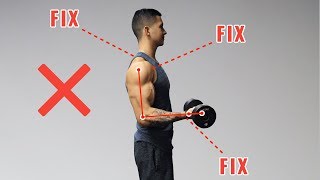
Jeremy Ethier breaks down five mistakes limiting biceps growth: letting other muscles steal the work, skipping full range of motion, ignoring mind-muscle connection, neglecting the long head, and piling on too much volume. Studies show full range of motion beats partial by 25% strength gain, and mind-muscle focus nearly doubles growth.
Questions this video answers
Full ROM: 25% increase in strength; Partial ROM: 16% increase in strength (Pinto et al., 2012).
2018 — subjects focusing on squeezing the biceps experienced almost double the biceps growth compared to subjects instructed to simply lift the weight.
Brad Schoenfeld's 2016 meta-analysis on training volume and hypertrophy.
When it comes to which muscle groups contribute the most to an aesthetic and attractive physique, the biceps are definitely among the top of the list. The biceps, when well developed, will help contribute to the overall fullness of the arm and creates a prominent peak when flexed. But despite the biceps being probably the most trained muscle by most people, it's also one of the more stubborn muscle groups to develop. Why is this? Well, mainly because aimlessly picking up a dumbbell and curling it like likely isn't going to be enough to provide you with the biceps development you're looking for. Instead, you need to pay close attention to how exactly you're performing your biceps exercises and use a more methodological approach when training them. Take this video of me curling, for example. If you can't spot at least two of the mistakes I'm making, then chances are you're probably doing one of them, which might very well be the mistake sabotaging your growth. Therefore, in this video, I'll go through five of the most common mistakes people make that hinders biceps growth. The first, and probably the most common mistake is letting other muscles take over and steal tension from the biceps during your curling exercises, which is something that I was unknowingly doing for a very long time. And the three main culprits for this are the front delts, upper traps and forearms. But luckily these can all be quickly fixed with simple tweaks in your form. You can easily tell if your front delts are taking over if your elbows move forward as you curl, although a few degrees of movement is normal and expected during a curl, since the biceps also weakly assist and shoulder flexion once it becomes excessive is when it becomes a major problem since it takes tension away from the biceps. So what you want to do instead is lower the weight and ensure that you're keeping your elbow locked in place and pinned to your side throughout the curl, like so, which will allow your biceps to take on almost the entire load and minimize the involvement of the front delts. Another option if you're still struggling with this, is to perform the curl with your back and elbows against the wall, and which will physically force your elbows to stay locked in place. The next muscle, the upper traps, is a little more subtle to catch, but it's just as common. You can tell if your traps are taking over the curl if you're shrugging your shoulders up towards your ears every time you curl. This, once again, takes a lot of the tension away from the biceps and is an indication that you should probably lower the weight. Instead, you want to depress your traps by bringing your shoulders down and away from your ears before your curl and keep them in this depression press position throughout the movement. Doing so will instantly shift a lot of the tension back to the biceps and finally, letting your forearms take over happens when you flex your wrists as you curl the weight. This not only shifts tension away from the biceps, but also puts your wrists at a mechanical disadvantage. Instead, you want to keep the wrists in a neutral or slightly extended position to both increase wrist stability and place more tension on the biceps. Although as mentioned in my biceps Peak video, a partial range of motion can be used to target specific regions of the biceps. Generally you want to use a full range of motion to optimize overall development of the biceps. This is because several studies have favored the use of full range of motion over partial range of motion for both strength and muscle growth. For example, one 2012 study by Pinto and colleagues found that in four 40 male subjects, using a full range of motion during the biceps curl led to significantly greater growth of the biceps and a 25% increase in strength as opposed to just 16% in the partial range of motion group. You can implement this when curling by contracting the triceps at the bottom of every rep to ensure that the biceps are fully lengthened before each rep, which will also help maximize biceps recruitment in the following rep during due to the concept of reciprocal inhibition. Although the previous tip will dramatically improve the tension placed on the biceps, it's also important that you actually feel and focus on the biceps working during your exercises. And yes, this will make a huge difference in your growth. For example, one very recent 2018 study by Schoenfeld and colleagues found that subjects who use this mind to muscle idea by focusing on squeezing the biceps during each rep of a curl experience almost double the muscle growth in their biceps compared to subjects who were instructed to just simply get the weight up. So instead of just trying to curl the weight up, you need to focus on really feeling the biceps working, which often will require you to set your ego aside and lighten the weight that you use. And one helpful cue to think about as you curl is to think about squeezing the bar into your body. So think about squeezing your biceps to move the bar towards your body as opposed to thinking about just simply lifting the weight. Doing so will help enhance the contraction of your biceps during each rep. I've made this point clear in a few of my past videos that in order to get well rounded development of the biceps, you need to train both the short head and the long head. We can emphasize the short head more by utilizing biceps exercises where the elbows are moved in front of the body, which causes the long head to enter active insufficiency. Exercises that accomplish this are spider curls, preacher curls, chin ups, and so on. And on the other hand, we can emphasize the long head more by utilizing biceps exercises where the elbows are moved behind the body. Exercises that accomplish this are inclined dumbbell curls behind the body, cable curls and drag curls. But rather than trying to perform all these exercises, I suggest that for those past the beginner stage, you can include one to two exercises for the short head and one to two exercises for the long head in your overall routine and focus on progressing these movements over time. One of the first things people do if a muscle isn't responding well is increase the volume for that muscle group. And although we know based on Brad Schoenfeld's 2016 meta analysis that up to a certain point more volume does mean more growth, you have to be aware of how your volume is accumulating through other movements. For example, on your back or pull days, your biceps are heavily involved in almost every single exercise you typically do. Adding in tons of isolation exercises on top of this will very likely lead to the opposite effect you're looking for. This is especially true in the case of non responders, since research shows that they typically exhibit a magnified inflammatory response to training compared to high responders, simply meaning that they exhibit more inflammation and muscle damage than usual after training and indicates that a lower volume approach may in fact be ideal. So instead, if you aren't seeing the results that you want despite increasing volume, take a step back and decrease the volume dedicated to your biceps and see how they respond. Instead of, for example, adding in four or more biceps isolation exercises to your your overall routine, stick to just a couple and focus on progressively overloading those as well as your main pulling movements. It's very likely that you'll find your biceps respond much better to this adjusted level of volume.
That's pretty much it for the video guys. To sum up the video, here are the main points that I want you to take away. If you've been struggling with growing your biceps, then it's very likely that at least one of the following mistakes is the reason why. Choosing the right exercises is one thing, but performing them correctly and properly incorporating them into your routine is what makes all the difference. Anyways, as always, for those interested, you can check out the written summary of this video on my website builtwithscience.com and if you enjoyed this video, please don't forget to give it a like leave a comment down below, subscribe to my channel and turn on notifications for my channel as well as this all really does help me out and I'd also really appreciate it if you guys gave me a follow on Instagram and Facebook as well, where I try to post a lot more informative content and workouts on a more regular basis. Thanks so much for the support guys. I really do appreciate it. I'll see you next time.