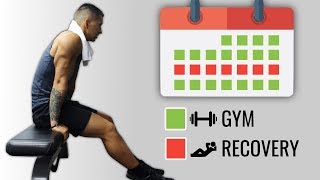
Deload weeks are planned easier training periods that let your body recover without losing muscle gains. A 2013 study found six weeks of training plus three weeks off produced the same results as continuous training. Experienced lifters should deload every four to eight weeks by cutting volume in half, dropping weight ten percent, and sticking to light activity.
Questions this video answers
Intermittent: six weeks on with three weeks off versus continuous training throughout 24 weeks.
About 50% or more (e.g., half the usual number of sets and fewer reps per set).
Roughly 10% lighter for each exercise.
Every 4–8 weeks, depending on age and training history.
Come on.
Let'S face it, building muscle is no easy feat and requires you to consistently push yourself harder and harder in the gym week after week. Because generally the more effort you put into your workouts, the more you get out of it. But there is one often overlooked aspect of training that can enable you to gain more size and strength more effectively, while all with less effort than you're currently putting in. How exactly is this possible? Well, it's with something called deload weeks, and if you've never heard of them and or currently aren't implementing them, then it's likely time that you do so. So what exactly is a deload week and how can they help you? Well, a deload week is basically a week where you take it easier on your training by significantly decreasing your workload in order to allow your body to fully recover and come back bigger and stronger. I'll provide specific details and a protocol for you to use later on in this video, but for now, just think of it as an easy week. And the reasoning behind this is based on research of how the body deals with and recovers from the physical stress of our workouts. Basically, we provide physical stress to our muscles during our workouts, which breaks down portions of our muscle and as a result tends to temporarily decreases our fitness, like our strength, for example. And then as we recover by using rest days and deload weeks, the body adapts and comes back bigger and stronger for the next session, which is a phenomenon commonly known as super compensation. But on the contrary, what happens when we push too hard for too long without proper recovery in place is that we eventually burn out and experience symptoms like joint aches and pains, fatigue and little motivation to train. This then often results in a plateau or even a decrease in your strength, which then obviously hinders your ability to build muscle. Fortunately, though, if you've reached this point, then the solution is more often than not simply taking a deload week. And although there's not much formal research out there on how exactly deloads affect muscle growth, a 2013 paper from the University of Tokyo does provide some insight. The researchers took two groups of subjects and had one train six weeks on with three weeks off, versus continuously training throughout the 24 weeks. Surprisingly, they found that both groups gained virtually the same amount of muscle by the end of the 24 weeks. But as shown in the following graph, the intermittent group experienced rapid growth to catch up every time they returned from their three weeks off, thus hinting at the fact that if we better optimize rest through the use of one week deload weeks instead of three complete weeks off, we'd likely be able to grow at an even faster rate by better managing recovery while maintaining our strength and size during the time off. In fact, two papers that analyzed the effectiveness of deloads both showed a slight increase in strength after subjects returned from their easier period of training. However, in order to successfully reap the benefits of deload weeks, you need to ensure that you're properly implementing them, and how you do so will mainly depend on your training experience. If you're a beginner just starting out in the gym or someone who just goes through the motions with their training and doesn't really push their body or train hard enough during their workouts, then in these cases a deload week is actually less applicable since you have yet to accumulate much fatigue. Instead, what you'll want to do is simply track your workouts and focus on getting stronger week to week while staying at least a couple reps away from failure in order to prevent excessive fatigue. Then, once you reach a plateau and can't seem to further progress in a certain lift, you can apply a similar concept as a deload in the next session by slightly decreasing the weight for that lift by 10%, for example by before retrying the weight that you were stuck on. This will just help to dissipate fatigue and often enables you to come back stronger in the following workout. On the other hand, if you're a more experienced lifter who's consistently progressing in the gym, then in this case you'll want to schedule a deload week into your routine every four to eight weeks or so, depending on your age and training history, or just when you recognize the need for a deload based on the symptoms I described earlier. Now, as for what your deload week entails, we'll use the guidelines of multiple papers on the topic which suggest the 1. You still want to go to the gym and perform your usual workouts rather than taking a week off to rest, as that may negatively impact your strength when you return. 2. During this week, reducing your training volume is more important than reducing the weight you lift. Thus, you should a Reduce your workout volume by 50% or more, which can be done by simply performing half the number of sets you usually do in your workouts and doing less reps per set.
B.
Reduce the weight you lift for each of your exercises by roughly 10%. This way you'll be able to effectively dissipate fatigue and enhance your recovery for the following week while preventing preventing any strength loss and excessive muscle damage from occurring when you get back to your usual workouts. Now as for your nutrition and your cardio, during this week it's quite simple. You'll want to eat at roughly maintenance calories in order to provide your body with adequate energy and nutrients to fully recover. This is true even if you're cutting and have been previously eating at a deficit. And as for your cardio, you'll want to avoid too much high intensity cardio as the goal of this week is to reduce the stress placed on your body and the central nervous system. Instead, if you're going to do some, stick with light intensity activities such as walking and keep the more intense forms of cardio to a minimum. And that's pretty much it. Although deload weeks can be boring and feel counterproductive in your pursuit of gains, just trust me when I say it's absolutely vital for your long term progression in the gym and will be the key to consistently getting bigger and stronger over time while minimizing injury.
So to sum the video up, here are the main points that you want to keep in mind. If you want to see the best results, then it's vital that you not only push yourself hard enough in the gym such that you can actually make progress, but that you also implement the right recovery strategies as this is what's going to enable you to progress even faster in the long run while avoiding injury in the process. And if you're looking for an all in one evidence based practice program that does just that for you, such that you can build muscle and lose fat as quickly as possible, then what you can do is simply head over to builtwithscience.com and take my body type analysis quiz which is just going to determine what program and what approach is best for you. Anyways, if you haven't already, I really appreciate it. Following my Instagram account, I post a lot of informative videos and content on there as well, which I think a lot of you will find useful. As always, if you enjoyed this video then please don't forget to give it a like leave a comment down below, subscribe to the channel and turn on notifications as well as this all really does help me out and I really appreciate it. Anyways, that's it for this video. I hope you all enjoyed it. Please let me know what other topics you'd like to see me cover and I'll get to doing that. Thanks so much for the support everyone. I'll see you next time.