How To Get Bigger Legs FAST (3 Science-Based Tips For Bigger Quads)
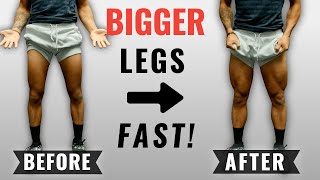
Jeremy Ethier breaks down three mistakes holding back quad growth: poor exercise form that shifts load away from quads, skipping full range of motion, and limited ankle mobility. Fix your foot position on lunges and split squats, go deep on leg press past 90 degrees, and work on ankle mobility to unlock bigger legs.
What's going on, everyone? Jeremy here, and today we're going to be talking about the quads. More specifically, why they may not be growing for you, despite you actually showing up on your leg days and doing all the exercises that technically should be growing them. I'll be honest, I personally struggle with growing my quads ever since I started training. Even though I never skipped my leg workouts and was actually lifting heavy weight during them. My quads just never really grew much and always seemed to lag behind. But fast forward to now, and although my quads still aren't where I'd like them to be, their development and the rate of growth has improved significantly, mainly due to correcting three key mistakes that I never even realized I was making. And these same mistakes are what I now see other people unknowingly do all the time with their leg training. So to prevent you from doing the same, let's go through each mistake and show you what to do instead so you can actually start seeing some results with your leg development.
The first mistake has to do with your exercise execution. What most people don't realize is that you can actually make minor tweaks to the way you perform your leg exercises to shift more of the tension away from the glutes and hamstrings and onto the quads instead. To prioritize their development during your leg workouts, let's take a look at the forward lunge, for example. There's essentially two completely different ways that you can perform this exercise that biomechanical research has shown will significantly affect the emphasis that's playing placed on the quads during the movement. To emphasize the glutes and hamstrings more during the lunge, you would take a long step forward such that your shin is vertical over your foot. Each step, lean your torso forward slightly to increase the flexion of your hip joint and hence increase the involvement of the glutes. And lastly, push through the heel of your foot to better activate the glutes during each rep. Whereas to hit the quads more, which is what we want to do, you would instead take a short step forward so that your front knee positions itself just over the top of your toes or slightly past them. As long as you don't experience discomfort, keep your torso upright to minimize the flexion of your hip joint and involvement of the glutes, and then push up through your whole foot rather than focusing on pushing through the heel. So by doing this version when you perform your lunges, you'll be able to biomechanically favor your quadriceps more and hence enable you to better grow them over time. And also keep in mind that these three tweaks can be easily applied to pretty much any lunge or split squat variation you do in order to just shift more of the tension onto the quads. And we can even apply a similar concept to exercises like the leg press as well by simply tweaking your foot placement. For example, one paper from the Journal of Strength and Conditioning Research actually analyzed the effect of various leg press foot placements on resulting muscle activation. What they found is that a low foot placement elicited significantly higher quadriceps involvement than a standard or high foot placement, which both favored the glutes more due to the greater hip flexion involved. So applying this to your leg press by shifting your feet down slightly as long as you have the mobility to do so is a great way to further emphasize the quads and can also be applied to other pressing machines, like the Hack squat, for example. But do keep in mind that for these various tweaks, it will shift a little more force and stress onto the knees as a result, which isn't a bad thing at all and perfectly safe unless you currently experience knee pain or are going through a knee injury, and in which case it wouldn't be advised. The next mistake that's slowing your quad gains is cutting your range of motion short during your leg exercises, and it's something I see people do all the time at the gym, especially on exercises like the squat and leg press, for example. Yet what these half reppers don't realize is that you literally get half the gains as a result. For instance, multiple EMG studies looked at how the activation and muscular effort of the quadriceps changes based on how deep you go during both the squat and the leg press. What they found is that the deeper you go, the more the quads are activated, up until around 105 to 120 degrees of knee flexion. Which just to put it into perspective, is right around the point when your upper thigh becomes parallel to the ground during the squat. And then for the leg press, it's right around the point where your knees pass 90 degrees of bend. Simply meaning that it's the very bottom of these lifts that seem to be the most important for quad growth. And cutting short, which most people do, is definitely cutting your gains as a result. And to illustrate the importance of this even Further is a 2013 paper that now looked at how quad muscle gains compared during a partial versus a full range of motion squat, pictured here. So the Researchers had subjects do one or the other for 12 weeks and measured the resulting growth at six different measurement sites on their quads. And as pictured in this graph from the study, quad growth was significantly greater with the full range of motion squat at all six measurement sites. And just to really hammer in this mistake for you, even though you'll be able to handle a much heavier weight with a partial squat than you can with a full squat, it's still not going to be as effective for gains. In fact, one study actually showed that subjects were able to get 25% higher quadriceps activation with a full squat compared to a partial squat, despite having to use 60 pounds less weight. So my point is, guys, that to finally start seeing improvements in your quad gains and actually also protect your knee joints in the process, it's time to put the ego aside, lighten the weight, and use a full range of motion. And you can start doing so with your squat or any similar movement by aiming to get your upper thigh at least parallel with the ground or even slightly lower, if your mobility safely allows for it. And then for your leg press, as I mentioned earlier, you want to go to at least past 90 degrees of knee flexion or as deep as you're capable of doing safely. Doing this will just guarantee that you're working your quadriceps through those peak degrees of knee flexion described earlier, where the most growth is likely to occur. However, if you struggle with doing this, then it's time to address mistake number three, which is that you're neglecting your ankle mobility. And to illustrate the importance of this, let's take a look at a recent 2015 paper that looked at various mobility restrictions in 100 subjects in an attempt to see what affected squat depth the most. They found that of the restrictions tested, ankle mobility seemed to be the most dominant factor that affected squat depth, and that increasing ankle mobility was strongly correlated with a greater ability to squat deeper. Which is obviously problematic for most of you out there trying to grow your quads, because without sufficient ankle mobility, if you try to achieve a full squat or leg press, or even if you try to apply the quad modifications that I mentioned earlier, your body biomechanically just won't let you, and it's instead going to compensate by lifting your heels up and or bending your torso forward, for example. So in order to both indirectly boost your quad gains and improve your form, you need to focus more on your ankle mobility. And although lifting shoes will slightly help with this, I think the vast majority of lifters should still be doing more ankle mobility work regardless, and this can be easily done by just getting into the habit of regularly doing the following first, roll out the bottom of your feet and calves side to side as well shins just to loosen up the soft tissue. Then you'll want to move on to a couple dynamic ankle mobility drills like the knee to wall drill and or a weighted stretch like I'm doing here for example. But by regularly doing a routine like this, especially right before your actual leg workout, you're going to drastically improve your ability to apply the various tweaks I mentioned in this video and hence boost your quad growth in the long run.
Guys, I hope this video was useful for you and I hope it helped clear up why you may not have been seeing the leg growth that you're after and for a step by step program that avoids these mistakes for you and applies the science to enable you to build muscle and add size as effectively as possible, just like Brian over here did in just nine months. Then simply head on over to builtwithscience.com and take the starting point quiz to discover what program is best suited for you. Anyways, guys, thank you so much for watching. Hope you enjoyed this one. Please don't forget to show your support by giving the video a like leaving a comment down below as to what you'd like to see me cover next, subscribing to the channel and turning on notifications for the channel as well as this all truly does help me out. Thank you so much everyone for the continued support and I'll see you next time.










