How To Get MORE Gains From Pull-Ups (4 Mistakes You Need To Fix)
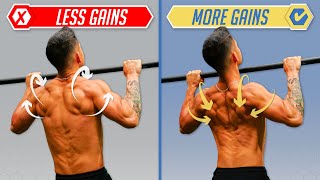
Four pull-up mistakes that limit your gains: grip too narrow, weak core bracing, losing form at the top, and not doing enough pull-up volume. Use 1.5x shoulder width grip, brace your core into a C position, and lead with your chest. Pull-up specific work beats lat pulldowns for building reps.
Pull ups are one of the oldest yet most widely used back exercises out there, and for good reason. They're convenient to do and very effective at growing and strengthening your mid and upper back muscles. But despite how simple this exercise may seem, the truth is that most lifters screw this movement up with a few common errors that take away from the effectiveness of this exercise. And in this video, I'm going to cover exactly what those errors are so that you can instantly start experiencing better gains with the cycle exercise. The first mistake has to do with grip width. Most people overlook the importance of something as simple as a grip during a pull up and fail to realize how this actually shifts the muscles that are being targeted. On one end of the spectrum, you have those who grip the bar way too wide with the train of thought that this is going to be more effective at hitting the lats. But instead this makes pull ups less effective for two reasons. One is that it shortens the range of motion of the movement, which may enable you to do more reps but can compromise growth due to the limited range of motion that your back muscles experience each rep. And second is that it puts your shoulders in a more compromised position. In fact, a 2016 observational study analyzed the risk of various pull up grips and found that a wide grip pull up due to the position that the shoulders placed in throughout the movement exhibited the highest risk of shoulder injury and impingement, which can obviously be detrimental to your gains in the event that you do actually end up harming your shoulder. However, however, on the other end of the spectrum, you also don't want to grip the bar too narrow. What this will do is it increases the degree of pronation that your forearm experiences during the pull up, which then shifts more emphasis to the forearm muscles like the brachioradialis. This can not only shift some of the tension away from your back muscles, but it can also make your forearm muscles now become the limiting factor in your pull up. Meaning that instead of stopping the set because your back muscles have fatigued you, you're forced to stop because your forearm muscles are fatigued. So what you want to do instead is grip the bar not too wide and not too narrow. And there does seem to be a sweet spot with this. If we take a look at grip width research on the lat pulldown, which is executed in a similar fashion as a pull up, we know that a medium grip of about 1.5 times shoulder width seems to be the best grip to not only maximize activation of the back muscles, but but also seems to be the grip width and which were the strongest. So apply this to your pull ups by using a grip that's slightly outside of shoulder width and you'll likely experience not only a stronger and safer pull up, but one that actually hits the muscles that you're trying to target. The second mistake you're making is you're failing to properly engage your core muscles during the exercise. Muscle activation research on the pull up has shown that when performed correctly, your core will often be the highest activated muscle during the movement. Yet when most people perform their pull ups, they completely forget about their core and as a result, their pull ups will look something like this, where the lower back arches, the feet dangle loose and the ribs flare out. Now, although this isn't necessarily bad, it does create a great deal of instability and wasted energy during the pull up, which can negatively affect your strength in the movement. So instead, before you even go into your pull ups, start with your legs straight if possible, and then crunch yourself into the C position by engaging your abs. Then from here, keep your core engaged and maintain this position as you perform each rep. This will not only instantly provide a ton more stability into your pull ups, but by setting your lower back into this more stable position, it can also enable your lats to pull with more force because they attach into the low back. So apply this tip and you'll very likely notice the resulting strength improvements right away. The next mistake is losing form at the top of the pull up. Most people will show pretty good form in the beginning of the pull up, but towards the end of the pull up, they'll fatigue and start compensating. And usually they do so by letting the shoulders shrug up to the ears and roll forward as they struggle to get above the bar. This not only puts the shoulders in a compromised position, but it also disengages the back muscles that we're trying to target. Instead, we want to the shoulders back and externally rotated as we come up to the bar. And to ensure that this happens, we need to first make sure that we're starting the pull up correctly to begin with. To do so, before you initiate the pull, first set your shoulders by pulling your shoulder blades down and back so that your shoulders move down and away from your ears. This subtle movement will engage your back muscles and set up the rest of the pull up to be back dominant. And then as you're pulling, simply think about pulling yourself up by leaning with your chest and trying to get your upper chest or your collarbone to the bar. Doing this is just going to help ensure that your shoulders remain in the proper position and that the back muscles remain engaged throughout each rep. The last mistake you're making is you're simply not doing enough volume for your pull ups. Most people who are stuck only able to do a few pull ups or so, or even, let's just say under 10 strict pull ups per set, they attempt to improve this or compensate for this by just hammering away with more volume on lat pulldowns. But research has shown that the strength correlation between these two exercises is actually very weak and that your strength on lat pulldowns are not highly related to the amount of reps that you can do with pull ups, which is likely at least partly due to the difference in muscle activation patterns that we see with the two movements. So instead what you want to do is you want to focus on doing more total pull up volume as this is going to better transfer to your pulling strength. And there's a variety of ways that you can achieve this, even if you can't do very many pull ups to begin with. In fact, a 2017 paper found that either doing five sets of pull ups to failure, five sets of pull ups to failure with additional weight, or five sets of pull up negatives to failure over the course of 12 weeks, they all led to similar pull up improvements of about six additional reps over the course of the 12 weeks. Meaning that there's a variety of ways that you can improve your pull ups and that sufficient volume of practice with the actual movement speed seems to be what matters most. So if you're currently stuck, then add in some additional sets of pull up negatives after you fatigue yourself during your normal pull up sets. Or if you can only do, let's just say five or so pull ups in a row, then just perform more sets, but with less reps per set. 10 sets of three pull ups performed with proper form will be far more effective and will enable you to accumulate more total pull up volume than something like three sets of five pull ups to failure would. By using this approach, and by finding ways to fit in more actual pull up volume instead of simply using alternatives, you'll be able to improve your body's coordination and motor control during the pull up and hence be able to very quickly improve your strength and the number of reps that you can perform. So, to sum the video up, here is a quick recap the main points. First, use a proper grip width of about 1.5 times shoulder width. Second, keep your core engaged before and during the movement. Third, don't lose form and roll your shoulders forward at the top. And lastly, ensure that you're doing enough pull up volume as that is what's key to improving your strength with this movement. So hopefully you were able to see that although choosing the right exercises is important, executing these exercises in the right manner is really what's key to maximizing the growth that you're going to experience from that. And for a step by step program that uses science to not only show you what to work out week after week, but then shows you exactly how to perform each and every exercise for maximal activation and growth while pairing this with a nutrition plan to support your recovery. And simply head on over to builtwithscience.com to determine which of our science based programs is best for you and where your body is currently at. Anyways, that is it for today guys. I hope you enjoyed the video. Please don't forget to show your support by giving the video a like leaving a comment down below as to what you'd like to see me covered next and subscribing to the channel and turning on notifications for the channel as well. This all really does help me out. Thank you so much everyone. I'll see you next time.










