How to Get MORE Growth In Less Time (3 Gym Hacks)
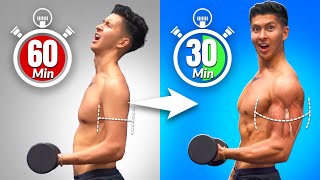
Three ways to build muscle faster: do 4-7 sets per week instead of 10+, use antagonist supersets with short rests to cut workout time in half, and add drop sets to safe exercises. The speaker provides 30-minute routines and emphasizes training near failure with strict form.
Questions this video answers
4–7 sets per muscle per week.
5–9 sets produce about 80% of maximal gains; 1–5 sets produce about 60%.
Keeping transition time as short as possible, no longer than one minute.
About 20% per drop.
Protocols replacing 3 normal sets with 1 normal set plus 2 drop sets, and another replacing 3 normal sets with 1 normal set plus 4 drop sets—both showed similar growth to traditional sets.
Is it possible to work out half as much as you are right now, do just a few 30 minute workouts per week and build just as much, if not more muscle? According to the latest science, yes. There's three time saving strategies that have been shown to be most effective. I'll show you how to properly apply them to your workouts to get more gains in less time. So the first strategy has to do with your workout volume. During a workout, the first few sets you do for a muscle give the most gains. But as you do more and more sets, you get less growth relative to the additional effort you're putting in. Eventually you actually reach a point where you don't get any additional growth from doing more sets and may even result in muscle loss if you take it way too far. So to save time in the gym, you want to do the least number of sets that still gets you a solid return in gains. And there's a few studies we can look at to find what that amount is. One. One study from back in 2002 had trained subjects do just one set of bench press and one set of leg press three times a week for 12 weeks. Despite the extremely low volume, in this case just three sets per muscle per week, they were still able to build a bit of muscle. Another study took a different approach. They had subjects do 27 sets for their quads every single week. After four months, they measured how much muscle was built and then split the subjects into one of three groups. One group dropped their volume to just nine sets per week, another dropped to just three sets per week, and the final group didn't lift at all. After eight months at this new volume, the no lifting group's muscles returned back to normal. The three set per week group were able to maintain their new gains, whereas the nine set per week group ended up gaining even more muscle. Now the last study I want to look at before providing some recommendations is a meta analysis led by Brad Schoenfeld. They compared 1 to 5, 5 to 9 and 10 plus sets per muscle per week. What they discovered is a dose response relationship between muscle growth and the number of sets performed with 10 plus sets per muscle per week resulting in the most growth. But what's interesting is that the 5 to 9 set group still experience about 80% of the max gains and the 1 to 5 set group were still able to get about 60% of it. So based on the research we have so far, it seems likely that three sets per muscle per week is pro probably enough to maintain your gains and maybe even build a little muscle depending on how inexperienced you are, but four to seven sets per muscle per week is likely the sweet spot to get the most gains with the least amount of time and effort. Now, at the end of the video I'll give you guys some free time saving workout routines that take care of all the sets, reps and exercises for you. But for now, here's an example of what this could look like with a three day per week full body workout that would train each muscle with around 6 sets per week. Assuming 2 minutes rest between sets and 1 minute transition time between exercises, the whole workout could be completed in as little as 30 minutes. And you can also just apply this strategy to your current routine by cutting down the number of sets and or exercises on all your workouts, or just do so on days where you're busy or just not feeling it and need a quick workout. However, if you are going to go with this minimal volume, there's three things you need to start doing in all your workouts to continue making almost as much or possibly even more gains than you were before. First off, research has shown that the closer you train to failure, the more growth you'll get, but also the more fatigue you'll create. In your case, you don't have that many sets to recover from, so to get the most growth possible, every single set you should be pushing at least one to two reps short of failure and even going all the way to failure on exercises where it's safe to do so. Second, since you're only doing a limited number of exercises, it's crucial you pick the ones that are most likely to give the most gains. And there's a really exciting area of research called long muscle length training. Basically, it seems like some muscles may respond better to exercises that challenge them the most when they're in a stretch position. I cover this research in more depth and explain exactly what exercises to do for what muscle groups. In my past video, which I'll link in the description box down below, I and at the end of the video and lastly, you need to dial in your form. Every single rep you do matters that much more. Now, some of you may be wondering, what if I don't want to do less? What if I still want to train at the optimal volume and use other ways to cut down my time? Or what if I want to make my minimalist workout even more time efficient? This is where the next two time saving strategies come in handy. So you've probably heard of supersets where you do two exercises back to back with no Rest. While this can cut your workout time down in half, most people don't do them properly and end up compromising their gains. The key is to use what's known as antagonist supersets. This involves doing an exercise that works one muscle and then almost immediately after doing an exercise that works the opposite muscle. This way, one muscle is resting while the other is working, but how long it takes you to catch your breath between the two exercises seems to be important. One study showed that keeping the transition time as short as possible, no longer than a minute, led to a unique benefit where subjects could actually do more reps than they could when they took longer rests or just perform the exercises without supersets. However, keep in mind that supersets will only work if you're still pushing your muscles close to failure every set. So just take as long rest as you need to prevent your cardio from holding you back. Now here is a list of the best antagonist supersets that you can start applying to your routine, but also don't feel limited to just these. You can basically superset any two exercises that don't train the exact same muscles and wouldn't be overly fatiguing when done. Back to back bench press with calf raises, chest flies with lateral raises and leg extensions or leg curls with pretty much any nearby upper body exercise are all great examples. But if there's any exercises you can't end up supersetting or would just prefer not to, this is where the next method can come in handy. So usually you do a set of an exercise, rest, do another set, and repeat until you've completed your desired number of sets. But with strategy three, you do your first set until you can't do any more reps, decrease the weight and immediately do as many reps as you can and continue dropping the weight until you complete about two or three drop sets in total. Now, before I share what exercises you should and should not apply this method to, I know what some of you may be thinking. Won't this reduce the amount of weight and reps I can do, leading to less gains? While that is true, drop sets take advantage of what's commonly known as effective reps. Let's say you're doing a set of 10 reps to failure. The first few reps you do contribute very little to muscle growth. It's the last few reps, when the muscles are being pushed to their absolute limit, where the most growth happens. So even though you're decreasing the weight during each drop set, your muscles are already exhausted from your previous set. To the point that every additional rep it does now is far more effective for growth. This is likely the mechanism behind why a handful of studies and a recent 2022 meta analysis, which is basically a study of studies have all shown drop sets to provide the same and in some cases even more growth despite cutting workouts down to a third of the time. But you should only use this on certain exercises. Keep in mind that during every set you have to train to failure, so you need to use exercises where it's safe to do so and also really quick to decrease the weight for each drop set. Lateral raises, arms exercises, dumbbell chest presses, calf raises and many machine exercises are all great options. I definitely wouldn't apply this to squats and deadlifts, and only with bench press if you have a good spotter. Now as for how many drop sets to do, one study replaced 3 normal sets with 1 normal set followed by 2 drop sets, whereas another study replaced 3 normal sets with 1normal set followed by 4 drop sets. In both studies the drop set group led to similar growth as the normal group. So I'd say try to at least match the total number of sets including your drop sets with how many normal sets you usually do. Lastly, as for how much to lower the weight during each drop set, the study protocols usually decrease it by 20% of the time, so so don't drop by too much or too little. You probably won't be able to do as many reps as you could do during the previous set, but you should definitely be able to get more than a few. Just make sure you're still tracking how much weight and how many reps you're doing and try to progress this over time just like you would with normal sets. So as promised, I created three timesaving workout routines for you guys to download. There's a three day, four day and a five day per week workout routine for you guys to pick from. Each workout can be done in as little as 30 minutes. Now I have designed these with the optimal volume, but within each PDF I also explain how you could cut it down to the minimalist volume we talked about earlier if you wanted to save even more time. And you can download them all over at built with science.com forward/fast workouts. That said, one thing we have yet to discuss is nutrition. You can train far less than someone else but actually end up getting dramatically better results by simply dialing in your nutrition. And for a step by step customized plan that shows you both how to train and what to eat to build lean muscle and lose fat faster and with less effort. Then head over to buildwithscience.com and take our quiz to find the best plan for you. Also, I highly recommend giving this video a watch next to learn about a new training technique that you should start applying to all your workouts to build muscle even faster. Thanks so much for watching and I'll see you next time.










