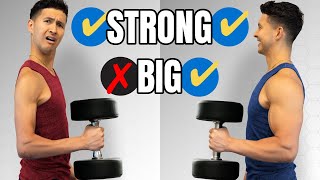
You can get stronger without building muscle if you're doing heavy low-rep work, cheating on form, relying on neurological gains, or not eating enough. Fix it by using higher reps, strict technique, patience with exercises, and adding 10 to 20 percent more calories.
Questions this video answers
About the last five or so reps.
About eight to 12 weeks.
The higher-rep/lighter-weight group experienced almost twice as much overall muscle growth compared with the low-rep/heavier-weight group (after eight weeks).
Participants reduced daily calorie intake by 30% for six weeks and did not gain any muscle despite training.
Increase current calorie intake by around 10–20%.
Some people's muscles tend to get stronger over time, but not bigger. There's several possible causes for this. By the end of this video, you'll have four ways that, when all applied together, will prevent this from happening to you. Your training being more geared towards improving your strength rather than size might be a reason your gains are lacking. Your muscles are made up of several of what are called motor units. To maximize the muscle growth you get from an exercise, you you need to make sure that you're activating all of the motor units in the muscle that you're working. Now, this doesn't happen until the last five or so reps in the set where you're pushing really hard. This is why these reps are typically called effective reps. This means that when using lighter weight, the first several reps that you perform are not as effective for growth, with the last several reps providing the most gains. On the other hand, when using a really heavy weight, you you're actually able to fully activate the muscle much earlier on because it needs all the help that it can get to lift that heavy weight. But as a result, you're not able to do as many reps. In this case, you're not exposing the muscle to enough of these effective reps to maximize growth. Illustrating this Effect was a 2016 study where participants performed all of their exercises in a workout with either low reps with heavy weight or more reps with a lighter weight. After training for eight weeks, the group training with higher reps and lighter weight experienced almost twice as much overall growth, despite the heavier weight group beating them in terms of strength gains, a result that's been backed up by other studies as well. So an easy way to apply this is to simply do more reps with a slightly higher rep range and less sets of very heavy low rep training. Your strength gains may slow down as a result, but your muscle gains will benefit considerably. It's all about picking and choosing what you'd like to prioritize and training accordingly. The next cause is artificial strength gains. This is where on paper, you may be lifting heavier weights, but in reality, you're actually cheating to get there. You're incorporating more momentum, you're using less range of motion, you're performing your reps faster and recruiting other muscles to help you out. And believe me, it can be very difficult to catch yourself doing this. For example, in week one, you do a set of a dumbbell press with four 45 pounds using a full range of motion. In week two, you decide to bump it up to 50 pounds can you spot the three major differences? I'm performing the rep slightly faster, I'm stopping about an inch shorter at the bottom, and lastly, I'm bending my forearms inward slightly to reduce the moment arm and to recruit more of my triceps to help out. Although it may enable you to lift slightly heavier, it comes at the cost of less gains. So whenever you decide to add more weight to an exercise, pay very close attention to how you perform the exerc with the new weight and ensure that every little detail in your execution remains the same. Otherwise, the only thing that you're going to be growing is your ego. When you first do a new exercise, you'll get stronger rapidly. This is not because your muscle got a lot bigger, but it's because your brain's ability to activate that muscle during the exercise has improved. This is what we call neurological adaptations, which typically last about eight to 12 weeks. But the good news is, after you've maxed these adaptations out, further increases in strength are mostly because of increase in muscle size. This is one of the reasons why it's so important to stay consistent with your exercises week after week. The more frequently you're changing exercises, the more you'll have to repeat this neurological adaptation phase and the harder it becomes to actually experience gains from that exercise. So if you've only been in the gym for a few weeks or have recently reintroduced a new exercise into your regimen, then this is a likely explanation for why you're experiencing a ton of strength gains with not much muscle to show for it. In this case, the most important thing is to not give up. Your gains are just around the corner. The final cause is very common, but the easiest to fix you're not eating enough. I was guilty of this when I first started training and really struggled to see noticeable growth. It's important to eat enough because muscle growth requires having enough energy available. Illustrating this is a 2011 study that had well trained participants reduce their daily calorie intake by 30% while continuing to work out after six weeks. Despite working out, these participants did not gain any muscle. They were effectively wasting their time from a muscle gains point of view. But interestingly enough, they were still able to increase their strength. Now, although in certain scenarios you definitely can build muscle while in a calorie deficit, being in a calorie surplus does appear to optimize the muscle building process and seems to become more and more important as an individual becomes more trained. Meaning that when it comes down to it, many of you watching simply just need to eat more. But this doesn't mean simply adding an extra thousand calories to your daily intake because that's going to lead to a ton of fat gain instead of muscle. Instead, a good recommendation if you haven't been gaining weight and increasing in size is to take your current calorie intake and increase it by around 10 to 20%. This small bump should help to provide you with the additional energy needed to maximize the muscle building process while also limiting excess fat gain. Implement what I went through in this video and you'll visually start seeing the results that you're after. And for a step by step program that takes care of all of the guesswork for you, then simply head over to builtwithscience.com, take our free analysis quiz and we'll show you exactly what approach will best help you attain a lean, attractive looking physique. If you enjoyed this video and you'd like to watch some more of my content, then just click click somewhere here to watch some of my other videos. But thank you so much for watching. Hope you enjoyed this one and I'll see you next time.