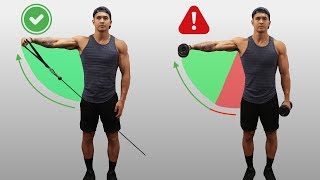
This transcript is from Jeremy Ethier's YouTube video about building wider shoulders by better training the lateral deltoids. It identifies three common training mistakes — (1) relying only on dumbbell lateral raises (poor resistance curve), (2) leading with the hands instead of the elbows (reduces shoulder abduction and shortens ROM), and (3) allowing the upper traps to elevate and take tension away from the side delts — and provides corrective strategies (use cable/band variations, alternate dumbbell/cable raises, lead with the elbows or use kettlebells, depress the shoulder girdle, and practice thumbless grip and cueing). The video closes with promotional CTAs to a training program and social channels.
Wider, broader looking shoulders are one of the most sought after bodily features that most men aim to achieve. In fact, multiple studies have found that women rate broad shoulders as one of the most attractive features in a male's physique. And this is likely because wider shoulders not only accentuate a powerful looking upper body, but also creates the appearance of a smaller waist as a result. And although genetics will play some role in how wide your shoulders appear, you can definitely add further width to them by targeting a specific portion of the shoulder, the lateral deltoids. Given that the lateral deltoids comprise the middle portion of your shoulders, adding more size to them will actually create the effect of wider looking shoulders. However, despite the importance of this muscle, most people just don't train them as effectively as they could be and instead instead make several training mistakes that in turn limits the development of this muscle. In this video, I'll discuss exactly what those training mistakes are and more importantly, how you can fix them so that you can get broader, wider shoulders as quickly as possible. The first mistake is not effectively varying the resistance curve in your shoulder training. What I mean by this is that most people's go to exercise to target the lateral deltoids are dumbbell lateral raises, which is a good option since they've been consistently shown, such as in this 2013 EMG analysis by Botan et al. To elicit the highest lateral deltoid activity when compared to other common shoulder exercises. However, although it may provide superior EMG activation, the downside with the Dumbbell lateral raise has to do with its resistance curve. You see with dumbbell lateral raises, given the path of the weights and the force of gravity, this exercise produces a high degree of tension on the side delts only in the top half of the motion, whereas at the bottom portion of the movement there's very little tension placed on the shoulders. So if you stuck to dumbbells exclusively, then you wouldn't be maximizing the potential development of the side delt cable. Lateral raises, on the other hand, help to solve this problem by providing more consistent tension on the side delts throughout the whole range of motion. And this is simply because the resistance applied from the cable is out to the side rather than straight up and down, as is the case with Dumbbel, which enables the side delt to remain highly active throughout the whole movement and is therefore another version of the lateral raise that you'll want to implement. Lateral raises with a resistance band also help accomplish this and can be used in the event that you don't have access to a cable and in addition, to potentially make the resistance curve even better for the side delt, you can slightly lean away towards the direction of the raise by hanging onto a pole with one hand as you perform the movement. This idea is based on the findings of a paper by McMahon and colleagues that found that the supraspinatus, one of the rotator cuffs, is most active during the beginning of the raise, whereas the side delt becomes more active from the mid to end range of the movement. Therefore, by leaning away slightly, you're able to effectively shift more of the tension to the delts and away from the superspinatus and are just extra lateral raise variations for you to experiment with. But going back to what I mentioned earlier, to maximize your side delt development, you'll want to ensure you're performing both dumbbell and cable lateral raises in your routine, or at least cycling through them over time. A good option, for example, is if you perform four sets of lateral raises in your workout, then dedicate two to dumbbell lateral raises and two to cable lateral raises. This way you'll be able to reap the benefits that both exercises have. Another common mistake people make with a lateral raise is leading the movement with their hands and allowing them to raise up higher than the elbows. This somewhat defeats the purpose of the exercise by shifting some of the tension away from the shoulders and more so onto the rotator cuffs, since you're now actually performing more external rotation rather than the main function of the side delts shoulder abduction. And in many cases, it also shortens the range of motion of this exercise, which is obviously detrimental for side delt development. So to fix this, you'll want to ensure that your hands are more or less in line with the elbows as you raise up, rather than the hands being higher and leading the way during each rep, you'll want to also mentally think about leading with the elbows as opposed to raising the weight with your hands. By implementing these fixes, you'll both increase the range of motion of this exercise and maximize side delt involvement involvement by incorporating more shoulder abduction into the movement, and a good way to enforce this if you're having trouble with it, is to experiment with using kettlebells when you perform the lateral raise. I find that mentally it's a lot easier to drive with the elbows when using kettlebells as opposed to dumbbells or cables, and it's just another exercise you can definitely add into your shoulder training arsenal. And lastly, you want to ensure that you avoid letting your traps take over as you perform various should the upper traps are overactive in virtually everyone nowadays. This is mainly due to posture or common activities that cause us to inadvertently shrug and this actually causes the traps to get tightened and take over when we perform shoulder exercises like the overhead press and the lateral raise. This is detrimental since for the best activation of the side delts, you want your shoulder girdle to remain depressed rather than elevated. But luckily fixing this can be quite simple. You simply want to keep your upper traps out of the movement by pulling your shoulders down and back before you perform the raise, and then maintain this as you perform each rep by focusing on keeping the upper traps depressed as much as possible. Some helpful tips to reinforce this idea are to use a thumbless grip and think about pushing out during each rep rather than thinking about lifting the weight up. But if you're still struggling with this, then I'd suggest simply feeling your upper trap with one of your hands and then slowly raise the other arm out without any weight. Focus on keeping the shoulders down and avoid tensing your upper traps as you raise your arm. Once you master this, you can then slowly add weight to practice and then eventually apply this to your working sets. By properly implementing this, you'll be able to shift most of the tension away from the traps and onto your side delts, leading to better development and wider shoulders for you in the long run.
And that's pretty much it for the video. To sum everything up for you, here are the main points that you'll want to keep in mind. Although these little training tips may not seem like much, they really are what's going to make all the difference in your workouts and enable you to build muscle that much faster? And if you're looking for a step by step evidence based program that applies this into each and every one of your workouts such that you can build muscle and lose fat as efficiently as possible. So and what you can do is simply head over to builtwithscience.com and take my starting point analysis quiz I have.
Up in order to discover what program.
And what approach is best for you. Anyways, if you haven't already, I'd really appreciate a follow on Instagram as well. I post a lot more informative videos on there as well as the meals I have throughout the week and the reasoning behind them, which I think a lot of you will find useful. And as always, if you enjoyed this video then please don't forget to give it a like Leave a comment down below, subscribe to my channel and hit the notification bell as well so you can be notified every time I have a new video out. Thank you so much, everyone, for your continued support. I really do appreciate it, and I'll see you next time.