How To Get WIDER/THICKER Looking Biceps (Full Biceps Workout)
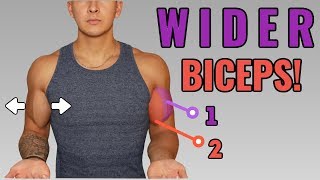
Jeremy Ethier breaks down how to build bigger-looking biceps by targeting the brachialis and whichever biceps head is lagging. Hammer curls with slow eccentrics, incline dumbbell curls, and behind-the-body cable curls force growth where you need it most.
When it comes to building the biceps, I think it's fair to say that most of us don't just want a well developed biceps peak. More importantly, we want biceps that are full and thick looking, such that they not only look good from the side or when flexed, but also look well developed from the front view or in a T shirt, for example. And if you're seeking to improve this, then what you're aiming to do is actually increase the width of your biceps. But is this even possible in the first place? Well, well, although it's true that genetics will play some role in this, and that bigger biceps in general often results in wider biceps as well, there are a few key things you can do to further improve the width of your biceps. And to learn what these things are, we need to first take a look at the anatomy of the biceps. The biceps, as the name suggests, is a two headed muscle consisting of a short head and a long head. The short head is located more on the inside and the long head is located more on the outside. And this shot of the biceps anatomy alone should already make you realize that you definitely can improve the width of the biceps. And you can do so by emphasizing the biceps head that is currently less developed on you. For example, the short head of my biceps has always been far more developed than my long head. And it wasn't until I started prioritizing the long head that I started to see a considerable improvement in the overall width of my biceps since the outer head was now larger. In fact, I recently ran a poll on my Instagram asking which head people thought was less developed on them from the front view, with 58% answering the long head and 42% answering the short head. So it's clear that the long head does tend to be less developed with others as well, but there is still quite a bit of variation. Therefore, in this video, I'll show you exactly what to do in either case. Before we dive into the workout, there is one even more important muscle you should be prioritizing for width. And it's called the brachialis, which actually lies underneath the long head of the biceps. And this muscle is not only responsible for some of the mass of the the outer arm, but it also anatomically pushes up the biceps, which all creates the illusion of a wider appearing arm. So, with that being said, let's take a look at a workout you can do to improve your biceps width by first prioritizing the brachialis and then working on your less developed biceps head. Unlike the biceps, the brachialis muscle only has one purpose and that is to flex the arm, therefore, in order to target it, and is recommended in this EMG analysis by NATO and colleagues. You. You want to flex your arm with a pronated or neutral grip when curling, which will shift some of the work away from the biceps and onto the brachialis. And one great exercise that implements this is dumbbell hammer curls, where you perform a curl with a neutral grip. However, taking this even one step further, we can implement the findings of this paper from the American College of Sports Medicine, which found that by slowing down the eccentric portion of the movement movement, you're actually able to further decrease the involvement of the biceps and increase that of the brachialis, which the researchers speculate is due to the structural and fiber type differences between the brachialis and the biceps. Therefore, when you perform your hammer curls, you can apply the protocol they use by Simply implementing a 5 second eccentric during the weight down of each rep, which will just enable you to isolate the brachialis that much more. Next, if your long head is lagging behind, then what you want to do is start implementing exercises that preferentially target this head. And as stated in my other biceps videos, any biceps exercise where the upper arm is held behind the body, such as here with the inclined dumbbell curl, will favor the long head since it crosses over the shoulder joint, whereas the short head does not. So this exercise is a great way to emphasize the long head. But as shown in this 2009 paper from the Journal of Sports Science and Medicine, during the incline dumbbell curl, the biceps are most active in the final one third of the movement when the arm is fully flexed, since there is less resistance during the beginning portion of the movement due to the position of the arm relative to gravity. Therefore, by pairing this exercise with the behind the body cable curl, which has a more complete resistance curve due to the constant tension from the cable, you're able to maximize the growth of the long head. Now, in terms of emphasizing the short head, we simply reverse what we did for the long head, given that the short head does not cross the shoulder joint. This now means that any biceps exercise where the arms are held in front of the body will preferentially target the short head more while lessening that of the long head. For example, concentration curls where the arm is placed in front of the body as shown here, is a great exercise that accomplishes this. But in addition, of particular importance for the short head. We know based on EMG analysis that activation of the short head is maximized with combined flexion and supination. So to further preferentially hit the short head, you want to ensure that you're actively supinating your wrist like so during each rep, which you can do by simply thinking about twisting your pinkies towards the ceiling as you curl. Another similar movement you can incorporate is spider curls where you lay on an inclined bench and let your arms hang in front of your body. Again, focus on locking the elbows in place and supinating your wrists as you curl in order to best hit the short head. Now as for how to combine this all into a biceps width workout that you can get started with right away, I'd suggest the following if your long head is lagging, which seems to be the case for most people, then stick with this routine. Whereas if your short head is lagging, stick with this routine. You can either perform this as a workout on its own, or simply replace your current biceps isolation exercises with these instead. Either way, by implementing this into your routine, you'll be able to successfully add the much needed width and thickness to your biceps that you're after.
That's pretty much it for the video guys. I hope at the very least I was able to give you some insight as to how to improve your current biceps routine. And if you're looking for a step by step program that uses both scientific research and our knowledge of the human anatomy to transform your body as efficiently.
As possible, then what you can do.
Is simply head over to builtwithscience.com and take my starting point quiz I have up in order to discover which program and which approach is best for you. Honestly, nothing makes me happier than seeing members of the program reach their goals and I'd love to have you on board so you can too. Anyways, if you haven't already, I'd really appreciate a follow on Instagram. I post a lot of informative videos and content on there as well, which I think a lot of you will find useful. And if you enjoyed this video then please don't forget to give it a like Leave a comment down below. Subscribe and turn on notifications for my channel as well, as this all really does help me out. Thank you so much everyone for the continued support. I really do appreciate it and I'll see you next time.










