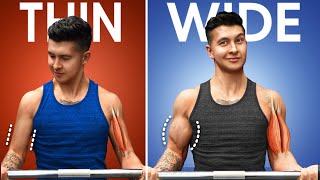
This YouTube video (April 2024) explains how to increase biceps width by targeting the two primary biceps heads (long and short). The presenter describes anatomy; reports EMG testing showing the long head is about twice as activated vs the short head during curls in the scapular plane; and demonstrates exercise variations and positioning cues (scapular-plane/cable curls and external rotation to emphasize long head; concentration curls, across-body curls, and internal rotation to emphasize short head). He also gives practical tweaks (e.g., raise cables 2–3 notches to around wrist height) and programming advice to prioritize the lagging head.
Rice, biceps aren't just big, they're wide, especially when looking at them from the front. But isn't this just genetics? Is widening your biceps even possible? Well, once you understand their anatomy, you'll see it's definitely possible. And after strapping some electrodes to my arm, I found the best exercises to do so. But here's what most guys miss. The bicep isn't just one muscle. In fact, recent studies have shown there may be up to six different parts. So if you want to get the best results, I highly suggest you follow a six day bicep split. Just kidding. Don't do that. Really? There's only two heads of the biceps that, when well developed, give it that full and wide look. And with the red exercises, you can actually choose which one to emphasize. The long head is the muscle on the outside of your arm, providing that outer thickness. And the short head runs down the inside, giving you more of that inner peak. Now, whenever you do any biceps exercise, whether that's a standard dumbbell curl or even a chin up, both heads are being used to some degree. But if you know how to target one more than the other, you can not only create more effective targeted bicep workouts, but you can also prioritize the part of your biceps that may be lacking. Now to do so, here's a basic rundown. If you want to work one head of your bicep more than the other, it all comes down to positioning. You need to position your arms so that the effort you're putting is directed in line with the area you're trying to now. In the past, I'd often do curls on an incline bench. I used to think that targeting the long head or outer thickness was best achieved with behind the body curls like you get with this movement. But after gaining a deeper knowledge into the anatomy of the biceps and working with some of the top experts in the industry, such as Coach Kassim of M1 Training, I learned about some other variations that seem a lot more promising. And this is where things get interesting. To find out what exercises actually target each of the two bicep heads, I did what any normal gym bro would do. I attached electrodes to my skin, hooked myself up to an electromyography machine, or emg, and measured the level of muscle activation in each movement. Now, while we're here, it is worth mentioning that EMG is just one way of assessing each exercise. Muscle activation isn't the end all be all for muscle growth, but it is a very good indicator of what specific parts of A muscle are working the hardest part, especially when you're comparing similar types of exercises like we are here. Anyways, using the amg, I found that the long head was activated two times more than the short head when performing curls in what's known as the scapular plane. Now, this might sound technical, but it's actually really straightforward and you can try it out right now as you watch it. To get into this position, all you got to do is stand up straight and bend your elbows into a 90 degree angle. Then, while keeping your elbows at your sides, turn your wrist outward as much as you can. So if you want to really target the outer part of your biceps or the long head, I recommend performing cable curls in this position. Just add a few steps in front of the cable machine and then a small side step towards your working arm. Keep your arm in that scapular plane with your elbow tucked into your side and use the resistance from the cable to keep your arm locked into that position as you curl. Now, for even better results, you can move the cables up by about two to three notches to around wrist height. This tweak adds more tension to the very start of the movement when your arm is straighter and the biceps are more stretched, which research suggests will lead to more growth. But if you don't have access to cables, you can always replicate this movement with dumbbells. Either way, just promise me that you'll at least try this exercise out and let me know what you think. When done properly, you should really feel it in the outer part of your biceps, especially once the soreness kicks in the next day or two. Now, before we discuss which biceps head you should focus on to fill out and widen your biceps, I need to show you the best exercises I've learned for targeting the inner biceps, also known as a short head. Now, while the long head is emphasized by external rotation, which is why we rotated our arms out into the scapular plane in the previous exercise, the short head is emphasized by internal rotation. And so compared to the muscle activation I got from the long head dumbo curls, doing a dumbbell curl with internal rotation now shifted the activation towards my shorthand. And one of the best exercises that applies this arm position is a concentration girl. You just sit down, pick up a dumbbell, and then perform a curl while resting your elbow against your inner thigh. And to really nail down the arm path of the short head, just think about it as if you were doing a curl across your body towards your opposite pec. Now, the only potential downside with this Exercise is that it's most challenging near the top position of the curl when the biceps are almost fully contracted. But remember, we ideally want an exercise as hard as near the bottom. Luckily, you can easily accomplish this by using an incline bench or preacher curl, but angling your body sideways against it and curling the dumbbell across your body towards your neck. Now, so far, all of this information has been focused around exercises with dumbbells and cables. You might be wondering if there's anything you can do with a bar to target one head or the other. Well, before, I said to flare your arms out into the scapula plane to better target the long head, but with the bar, you actually want to use a close grip, which will flare your arm inwards. Now, this might sound contradictory, but I'll explain. See, when you're holding the bar in the close grip, your elbows are trying to get back to neutral. But differently, when you're using the close grip, it's like they're trying to externally rotate or pull the bar apart. This is why when I tested close grip curls with emg, the long head had more activation relative to the short head, whereas the opposite happened with a wider grip. Because your arms are now trying to internally rotate, the emphasis shifts to the inner part of your biceps or the short head. But my personal recommendation is that you use these exercises with caution, as I found they can place a lot of stress on your joints, like your wrists and elbows, especially if you loading them up with weight. So if you have dumbbells or cables handy, take advantage of those instead. Now, which exercise should you focus on in your training? Well, my advice is to prioritize whichever head seems to be lagging most. For some guys, exercising the short head more will help their biceps look wider, whereas others might need to focus more on the long head if it's less developed. Of course, if you're still a beginner, I'd recommend you just focus on following a solid routine that builds your biceps big enough to the point where you'd be able to recognize if one head was less developed than the other. And the easiest way to do this is just follow a comprehensive program that nails all the basics and lays it all out for you. And my team and I have developed a bunch of these programs for all different types of bodies over at built with science.com but if you are in the intermediate stage, these exercises are perfect for putting more focus on the area of the biceps that you'd like to grow. It also might be a more effective way to grow your biceps. In general, since you can be sure that your biceps exercise takes each specific head to failure, rather than just using general bicep exercises that may not push either head as hard as they could be. Now, the easiest way to find out which head is lagging is literally just flex like this in the mirror and see which side looks less developed. Or you can always just test out the different exercises and see which one you find more challenging and gives you the better pump. I feel the best right here in this area. Okay, let me know what you guys noticed with your biceps. But in my case, I noticed my long head was a bit less developed than my short head, so I'll now be spending more time on it to try to bring up some of that outer width practically. This just means that if I'm doing, let's say, three biceps exercises each week, I'll focus two more on the long head and one around the short head. That said, most guys think they want bigger arms, but what will actually enhance their upper body the most is growing wider shoulders. And for a full shoulder workout designed to do just that, you can give this video a watch next. Thank you so much for watching and see you next time.