How to Lose Fat AND Gain Muscle at the Same Time (3 Simple Steps)
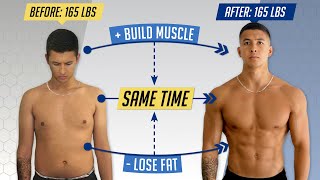
The video explains how to achieve body recomposition—gaining muscle while losing fat—despite the challenge that calorie deficits reduce muscle protein synthesis. It recommends a modest calorie deficit (approx. 5–20% or ~100–500 kcal below maintenance, with maintenance estimated as bodyweight in lbs ×14–16), a high protein intake (~1 g/lb), higher-carb/lower-fat macros, training each muscle ≥2×/week with 10–20 sets per muscle per week and periodic routine changes for novelty, and optimized nutrient timing (protein spread over 3–5 meals and peri-workout carbs/protein). The creator notes that beginners, detrained individuals, those >~25% body fat, and previously inconsistent trainees are most likely to succeed. The video ends with measurement-based progress assessment and a promotional CTA to billscience.com.
How do you get your body looking from this to this? Well, one option is to go into bulk to focus on building muscle and putting on more size first, and then focus on losing weight to strip off the excess fat afterwards. Another option is to do the reverse, so focus on leaning down by stripping off the excess fat first and then focus on building muscle afterwards. But what if we could take a shortcut? What if we could instead just build muscle and put on more size while simultaneously getting leaner in the process? And this is the whole idea behind what's known as body recomposition, which is the holy grail when it comes to body transformations, especially for those with a skinny fat or higher body fat physique, since with one process you'll be able to build muscle while stripping off excess fat, which are the two exact things that your body needs to aesthetically look the best. However, body recomposition does come with a catch because the basic law of thermodynamics tells us that we need to be at a calorie deficit in order to lose weight and strip off fat. But the drawback with being at a calorie deficit is that it severely compromises our ability to build muscle. Not only does our performance in the gym tend to suffer, but multiple papers have also shown that muscle protein synthesis significantly reduces by about 20 to 30% as we just aren't providing adequate fuel for our muscles to recover and grow bigger. Which just makes building muscle while losing fat very difficult for your body to physiologically do when its in a calorie deficit. However, this does not make this impossible as there does seem to be a loophole to this, because with the protocols I go through in this video, the body has actually been shown to be able to metabolize and use your own body fat to now provide the necessary energy it needs to recover and grow your muscles despite being in a calorie deficit, hence enabling you to build muscle and lose fat at the same time. With that being said, though, research does indicate that certain individuals are more likely to experience this and and would therefore benefit the most from the protocol that I'm going to go through in this video. And these individuals include the beginner lifters with no or minimal training experience, detrained individuals who have spent some time off from the gym, those at quite a high body fat, for example anything over 25% and lastly slackers who have never taken their training and nutrition seriously or never really been consistent with it. Now, although trained experienced individuals are less likely to experience a body recomposition, it's nonetheless still occurred countless times in the research and in my own experience, and in my opinion is definitely still highly possible, especially with proper execution of the protocol that I'm going to share with you today. So with that being said, if you fit into one of the four categories that I previously mentioned, or you simply just want to give this protocol a shot, then here's what you want to do. The first thing you need to do is set up your diet, which is going to be the most important factor of achieving a body recomposition. Although yes, we do want to be at a calorie deficit to enable fat loss to occur, research has shown that the larger the calorie deficit, the greater the reduction in protein synthesis and therefore the less likely you'll be able to experience muscle growth as you strip off fat. So for this reason, what you'll want to do is eat at a very slight deficit of roughly 5% to a maximum of 20%, which for most individuals equates to about 100500 calories below maintenance calories. And if you're at a higher body fat percentage, I'd aim for the higher end and vice versa for those at a lower body fat percentage. This way your body will one have the sufficient energy it needs for optimal performance in the gym and recovery, two won't experience nearly as dramatic of a decrease in protein synthesis for muscle growth, and 3 it's going to be adequately fueled and hence be able to achieve further fat loss through better exercise expenditure, a faster metabolic rate and higher levels of need. In other words, you're going to burn more calories per day by being more subconsciously active since you're better fueled. So what I'd recommend to start is simply multiply your body weight in pounds by 14 to 16 depending on your body fat to get a rough idea as to what maintenance calories is for you, and then subtracting that number by 100500 calories to get your suggested daily calorie intake. Then as for your macros, protein is where you want to place most of your attention. Illustrating its importance are two recent protein studies that compared the effects of a higher versus lower protein intake on body composition. Both studies found that despite being in quite an aggressive calorie deficit, the subjects in the higher protein groups were able to build muscle and lose fat simultaneously, whereas the lower protein groups failed to do so and instead lost muscle mass. Therefore, what I'd recommend is aim for a protein intake of around 1 gram per pound of your body weight, with the possibility that shooting even higher than this may in fact, boost the likelihood of your ability to build muscle and lose fat at the same time, especially if you're on the leaner side, and then for the rest of your calories you simply fill them up with carbs and fats. I would, however, personally recommend a relatively higher carb and lower fat approach to again, better fuel your body for performance in the gym. Next, we're going to dive into your training. Now, what we want to do here is first ensure that we're adhering to an optimal training plan that, as I've discussed in my past videos, should ideally train each of your muscles at a frequency of at least two times per week, with sufficient volume of around 10 to 20 sets per muscle per week. Going beyond this though, what I'd advise you to do is actually switch up your routine, for example switching up to a new training split, increasing or decreasing your muscle training frequency and or switching up some of your exercises or the manner in which you perform them. What this is going to do, and is shown in past training frequency research is it's going to provide a novel stimulus to your muscles that'll increase the likelihood likelihood that you can spark new muscle growth as you continue to lose fat, especially if you've been stuck using the same routine for the past little while. And if you're unsure as to what to switch up, I'll leave links in the description box down below to three different free routines that have released that you can consider transitioning to in order to introduce that novel stimulus to your muscles. And then simply use your new routine consistently and focus on gradually getting stronger and progressively overloading it week after week to to continue stimulating your muscles for growth. Next, we need to optimize our nutrient timing, which you should ideally already be doing but need to start taking more seriously if you like to increase your chances of a body recomposition. And there's two things that we want to do here. First, you need to ensure that you're evenly spreading out your daily protein intake into about three to five meals throughout the day in order to keep your protein synthesis levels elevated and optimized throughout the day to best help your muscles recover and grow despite being in a calorie deficit. Illustrating the importance of this is a 2020 paper released just last month that compared the effects of evenly spreading out one's daily protein intake into three meals throughout the day, as opposed to skewing most of the protein into just two meals a day. Calories and total daily protein intake were both equated and controlled for. What they found was that after 12 weeks of this combined with regular resistance training and despite both groups eating at around maintenance calories, the evenly distributed protein group managed to achieve a body recomposition and gained a few pounds of muscle while simultaneously dropping their body fat by half a percent. Whereas the other group gained less muscle and actually ended up experiencing a slight increase in their body fat percentage, which the researchers attributed to the better 24 hour muscle protein synthesis levels in those who evenly distributed their protein compared to those who did not, even though both were still consuming the same amount of protein and calories by the end of the day. So take your daily protein intake and ensure that you're spreading this out as best as possible into at least three meals per day. Now, taking this one step further, we also want to optimize the meals that we eat around our workouts because when you're in a calorie deficit, we again not only experience a decrease in protein synthesis levels, but we also see a rise in cortisol levels, especially when we train, which can negatively impact our resulting muscle growth and recovery. And research has shown that by ingesting adequate protein around our workout with a post workout shake, for example, we're able to blunt the cortisol response and significantly increase protein synthesis compared to if we didn't ingest anything or just didn't ingest enough protein, thus increasing the chances that we can build muscle despite being in a deficit. And in fact, a study in trained lifters put this to the test. They had one group of subjects optimize their pre and post workout nutrition by having sufficient carbs and protein before, before and after the workouts, whereas the other group of subjects instead had the exact same pre and post workout meals but much earlier, before and much later on after their workout. After 10 weeks, what they found was that the group that timed their meals around their workouts were able to significantly increase their strength and muscle gains while dropping their body fat percentage by 1%, whereas the other group ended up gaining less strength and less muscle mass and failed to lose any fat, therefore failing to achieve a body recomposition despite all other variables being held equal. Meaning that if you want to maximize your chances of experiencing a body recomposition, then you should not only optimize your protein distribution throughout the day, but also aim to optimize the meals around your workouts by having adequate carbs and protein shortly before and shortly after you train. So to sum up the steps for you, here's what I recommend as an action plan as you implement these steps and progress throughout the weeks though, take measurements to assess your results. If your weight is more or less remaining the same, yet your waist circumference is decreasing, your muscle measurements are increasing, you're getting stronger in the gym, and you visually look better, then these are all signs that you are indeed successfully achieving a body recomposition. All in all though, guys, a body recomposition honestly isn't for everyone. But in the cases that I went through and with the protocol that I previously outlined, it can be an effective way for you to essentially shortcut your transformation and take advantage of the current situation that you're in. But in the long run, you'll likely eventually want to transition to a dedicated muscle building or fat loss period and prioritize one or the other. And for an all in one step by step program that shows you not only how to successfully achieve a body recomposition, but also then shows you exactly what to do afterwards so that you can continue to strip off fat and build lean muscle as a fit efficiently as possible with science, just like countless other members have done with their Bill Science programs. Then simply head on over to billscience.com and take the analysis quiz to discover which program is best for you and where your body is currently at. Anyways, guys, that's it for today. Thank you so much for watching. Hope you enjoyed this one. Please don't forget to show your support by giving the video a like leaving a comment down below as to what you'd like to see me cover next, subscribing to the channel and turning on notifications for the channel as well. This all really does help me out. Much appreciated. I'll see you next time.










