How To Lose MORE Fat And KEEP/BUILD Muscle (3 WORST Dieting Mistakes You Need To Avoid)
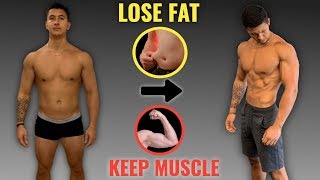
Jeremy Ethier breaks down three dieting mistakes that sabotage fat loss and muscle gain. Losing weight too fast, cutting calories too hard from the start, and skipping diet breaks all backfire. Pace your loss and take planned eating breaks to keep muscle while getting lean.
What's going on, everyone? Jeremy here. And today we're going to cover dieting. More specifically, we'll cover the wrong ways in which people approach and go about implementing a diet that in turn not only limits the amount of fat that you lose, but also compromises your ability to retain or even build muscle throughout the process. Which is detrimental because by the end of your dieting period, you don't just want to end up skinnier or skinny fat, for example, you want to instead strip off a significant amount of fat or while maintaining or building as much muscle as possible in the process in order to achieve a lean, well defined physique. And in this video, that's exactly what I'll show you how to do. So the first mistake people make is actually losing weight too aggressively. Because when it comes to maximizing fat loss while increasing the odds of you keeping and even building muscle throughout the process, you need to supply your body with enough energy and nutrients to do so, which can only be achieved by actually slowing down the rate at which you lose weight during your diet. And I've not only noticed this myself when dieting, but I've also seen this multiple times in the literature as well. So, for example, A well known 2011 paper illustrates this perfectly by comparing the effects of a fast diet versus a slow diet on body composition and strength. So they had two groups of trained subjects who were all put on a calorie deficit to lose weight, but with the fast diet group being put on a more aggressive deficit than the slow group. So on a daily basis, the fast group was eating roughly 300 calories less than the slow group. They then analyzed the effect it had on their muscle and fat levels. After each group lost the same amount of total weight, which keep in mind, took the slow group 60 days to do so and the fast group only 40 days to do. But what's interesting is that despite reaching the weight loss mark faster, the fast group actually lost significantly less fat than the slow group and they also lost a little bit of muscle mass as well. Whereas the slow flow group was actually able to gain a little bit of muscle, gain significantly more strength, and lost a greater amount of fat as well. And other papers have found similar results, with the general suggestion being made that while more aggressive diets may yield faster weight loss, the percentage of weight loss coming from muscle instead of fat tends to increase as well. So what I'd suggest is instead taking a slower approach that you can preserve or even build muscle as you burn off your fat. A good general recommendation is to aim to lose around 0.5 to 1% of your body weight per week. But this does depend on your current level of body fat. So for example, if your body fat is relatively high, I'd stick to the higher end of this range since you're actually able to lose more fat per week without losing muscle. Whereas the opposite is true for leaner individuals who should instead slow down their rate of weight loss even further by aiming for the lower end of the range. But regardless, by sticking to this range, you'll be able to maximize your chances of building or at least preserving your muscle as you strip off your excess fat. And the next mistake I want to go through is simply doing too much too soon at the start of your diet. So, for example, what a lot of people do as soon as they start dieting is they'll drastically reduce their food intake or even cut out their carbs completely while ramping up their cardio and thinking that this is going to speed up the process. And while that may be true in the short term, its actually going to prevent you from losing a significant amount of fat and getting really lean in the long run. Because not only is this approach very difficult to sustain for extended periods and will cause you to feel the effects of the diet very quickly. What most people don't realize is that this approach actually prevents you from having any leverage when you reach a fat loss plateau. Because when you start dieting and you put your body in a calorie deficit over time, your body compensates by decreasing its metabolism to burn less calories, which it does mainly by decreasing the various movements that you make throughout the day, or your neat, which eventually leaves you stuck in a fat loss plateau since your metabolism has decreased to the point where you're no longer in a calorie deficit to lose fat and then to break through this fat loss plateau, typically it would be simply a matter of either decreasing your calorie intake slightly and or adding a little more cardio. But the problem is, if you're already starving yourself and you're already doing a ton of cardio, then how on earth are you going to consistently continue to push more and more to break through this fat loss plateau and through the several other plateaus that you're going to encounter in the future? It's simple. You're not. And this is what leaves a lot of people both stuck spinning their wheels in their fat loss journey and losing a lot of muscle from just doing too much. So instead, you want to first start at a small to moderate calorie deficit of roughly 10 to 20% or 500 calories below your maintenance. For example, you also want to start out with minimal cardio. So for example just one to two low intensity sessions per week. And then as the weeks go by and your weight and your fat loss begins to stagnate, you can simply drop your calories for further and or increase your cardio slightly as needed to break through these plateaus every time that you reach them. So for example, during one of my last dieting periods, I started out eating at roughly 2500 calories with just one low intensity cardio session per week. 12 weeks and 20 pounds later though, I was much leaner and down to roughly 2200 calories with about 4 low intensity cardio sessions per week before I then transitioned out of my diet. But had I not started out easy, I wouldn't have had that leverage. I needed to break through the various plateaus I encountered, which is what ultimately enabled me to drastically drop my body fat. Now, the last mistake is not taking breaks, and more specifically I mean breaks with your calorie deficit. Because as I mentioned earlier, the longer you diet for, the more your body begins to physiologically adapt to both slow down your fat loss and make you more prone to losing muscle. To reverse this effect though, you can use a strategy where instead of dieting continuously for X amount of weeks for example, you die intermittently with the use of something called diet breaks. Now diet breaks are somewhat novel yet very effective dieting strategy where you simply increase your calories back up to maintenance for a week or two during your diet. And what this does is it actually reverses a lot of the physiological adaptations that your body has made in response to your diet in order to make your weeks of dieting after this break a lot more effective for both fat loss and muscle retention. And illustrating this is a well known 2017 paper where researchers compare dieting continuously for 16 weeks versus taking a two week diet break after every two weeks of dieting. After both dieting periods were over. Despite being in a calorie deficit for the same amount of time, the diet break group ended up losing 50% more fat without losing more muscle and experienced significantly less of a drop in their metabolism throughout their diet while which actually help them better maintain their new weight after the diet when compared to the continuous group. The only major downside with diet breaks though is that it will extend the length of your diet as a result. But rather than implementing the protocol that was used in this study, what I'd recommend for a similar effect is simply implementing a one week diet break after every four to eight weeks or so of dieting. This way, you're going to avoid increasing the length of your diet too much while still still getting the many benefits that diet breaks have to offer. So as you may have noticed guys, when it comes to properly leaning down and retaining or even building muscle in the process, you need to avoid rushing the process and instead slow it down by using a more controlled and a more systematic approach. And if you're looking for a step by step program that shows you exactly how to implement this with both your workouts and your nutrition, such that you can lean down while improving your muscle definition and strength, just like Jason Statham over here was able to do on his Built with Science program. Then simply head on over to buildwithscience.com and take the Analysis quiz to discover what science based program best suits you and your starting point. Anyways, I hope you enjoyed this one guys. Please do show your support by giving the video a like leaving a comment down below as to what you'd like to see me cover next, subscribing to the channel and turning on notifications for the channel as well as this all really does help me out. Thank you so much everyone and I'll see you next time. Don't.










