How to Perform Your Reps For FASTER Growth (LIFT LIKE THIS!)
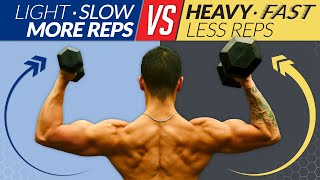
Use 6-12 reps with moderate weight and focus on perfect form and internal cues, actively squeezing the target muscle. Research shows internal focus boosts lat activation by 20%, doubles glute activation, and nearly doubled biceps growth. Skip the mental cues on heavy sets above 75% of your max, where execution matters most.
One of the biggest areas of confusion for lifters is how exactly you should execute your reps of your exercises in order to elicit the most muscle growth from those reps. I mean, let's just take a look at the standard biceps curl, for example. One option is to use higher reps with lighter weight and a slower tempo. Another option is to instead use lower reps, but with heavier weight and a faster tempo. Or you could even do a set of 21s where you perform seven reps at the bottom range of motion, set seven reps at the top range of motion, and then finish your set off with seven full range motion reps. Or another popular option is to just transition over to the squat rack and do your curls there. So how do you know which method is best for growth? Well, as I've gone through some of my past videos, research has shown that we do have a lot of flexibility when it comes to the way that we should perform our reps for maximal muscle growth as long as volume is equated for, then we can use lighter weights for higher reps, heavier weight for lower reps, a slightly slower tempo, a slightly faster tempo, and so on. To simplify this for you though, although research shows that we do have quite a bit of flexibility here, it is also shown that for the best bang for your buck, it would be in your best interest to execute your reps in the following fashion. One, stick mostly to a rep range of roughly 6 to 12 reps for each of your sets, as this rep range is the most effective way to accumulate volume for growth without also accumulating excessive fatigue on your joints and nervous system. 2. Use moderately heavy weight or resistance so that you can stay stay within that 612 rep range for most of your sets, so not too heavy of a weight so that you can only do a few reps with it, but also not too light of a weight where you can easily do well over 12 reps with it, and three, use a lifting tempo that is around a second on the way up and a second on the way down of each rep. These three rules are for the most part how you'd want to perform your reps on any exercise in order to stimulate growth in the most effective manner. However, with that being said and implemented, there is another major area where most people tend to overlook with their reps reps that severely compromises the resulting growth and is also often the culprit behind lagging body parts. And this has to do with tension, because if you want to build muscle as fast as possible, then Maximizing tension and stimulating as many muscle fibers as possible within your target muscle during every single one of your reps needs to be your priority, as this is imperative to maximizing growth long term, regardless of the rep, range, exercise, tempo or weight that you choose to use for your reps. But going beyond the guidelines that I previously provided, how exactly can we go about further maximizing tension in each of our reps? Well, there's two steps to this that you're going to want to start applying right away. The first step you need to implement is mastering and perfecting the execution of every single rep of all the exercises that you do, because your body is designed to cheat, meaning that it's always going to try to find the easiest way out during your reps. For example, on curls, what tends to happen when someone decides to start adding more weight or do more reps is that they'll compensate by using a little bit more momentum or start swaying with their elbow a little more, which as a result shifts tension away from the biceps and onto other muscle groups like the lower back and the front delts instead. And the same idea goes with push ups. For example, as soon as fatigue sets in, people tend to start shortening the range of motion and sagging their lower back to make it easier. So, yes, while in these two cases you may be lifting heavier or you may be doing more reps than you typically would, you're not actually providing more tension to your target muscle and hence won't experience the growth that you'd expect in that muscle because of a breakdown in execution. So take a look at your exercises, especially the exercises for your more stubborn muscle groups, and see if you've been compromising your form during your reps in order to lift more weight or do more reps. Most of you will likely find that you're guilty of doing just that, even if it's very subtle. If so, lighten the weight or decrease the reps so that you can execute your sets to the point where every single one of your reps are identical and executed with precision and optimal form. This way, you're actually using the muscles that you tend to grow with that exercise. And also best setting yourself up for success with step two, which has to do with applying internal focus. So internal focus is the idea that we can stimulate and grow our target muscles to an even greater degree by shifting more of our focus towards them during each rep. Now, this theory was first tested back in 2009, where team of US researchers rounded up a group of subjects to do lat pull downs and measure the resulting muscle muscle activation in the lats. They wanted to find out if it was possible to make their lats work harder by simply shifting their focus during their reps. So with one group, they used an external focus cue that simply instructed them to pull the weight down, whereas with the other group, they instead used an internal focus cue, instructing them to pull with their back instead of their arms and focus on the tension in your lats. The researchers found that muscle activity in the lats was boosted by nearly 20% with the internal cue. And other studies have reported similar results as well, even in different muscle groups, with one study showing more than double the glutes activation during prone hip extension in subjects who were given the simple internal cue for them to use their glutes to lift their legs while keeping their hamstrings relaxed. And what's interesting is that this simple shift in focus has been shown to not only boost muscle activation, but also seems to make the target muscle grow faster than normal as a result, with a recently published 2018 study showing that subjects who were instructed to study squeeze the biceps as they performed each curl, as opposed to being instructed to simply get the weight up, experience almost double the biceps growth after a period of eight weeks. Meaning that as you perform your reps for any exercise, you need to be mindful your main goal should not be to simply do your required number of reps and sets for that day. Three sets of ten becomes pointless and counterproductive for growth if you're not actively using your target muscle during each of those reps. And we can do so most effectively by applying this simple concept of internal focus. So what I want you to do is first focus on execution. As I went through in step one, as this is basically a prerequisite for activating the right muscles in your exercises. But going beyond this now, I want you to try to shift your thinking during your reps. You need to realize that we don't just lift weights or do reps with each of our exercises. All that we're doing is contracting our target muscle by bringing its origin and insertion points closer together, which then as a result moves whatever load of resistance we're using. And that's what I want you to try to think about as you perform your reps, as opposed to externally focusing on just getting the weight up or doing a certain number of reps. For example, right now, get down into a push up position and we'll test something out. I want you to pause the video and just do five reps of push Ups with however you typically perform your push ups. Now, if you're like most people, you mindlessly went about doing those five reps with the main goal of just hitting those five reps and as a result, fail to provide very much tension to your chest. But now what I want you to do is retry this with another 5 reps. This time though, first make note of the origin and insertion points of the chest, which is at your sternum and the top of your humerus, shown here. Now, during your push ups, focus on simply bringing these two points closer together in order to fully contract your chest, which will then, as a byproduct of this, press your body up. Although you're not going to be able to actually bring these two points together, you want to actively focus on this idea and squeeze. Squeeze that arm in towards the middle of your body as if you could bring them together. As you can see, all we're doing is we're bringing these two points closer together and further apart to fully contract and fully stretch the chest. And if it helps you out, you can even focus on simple internal cues during your reps, such as squeezing your biceps together or squeezing your biceps into your armpits. And with all that in mind, pause the video again and retry your push ups for another five reps. What you've likely found is a significantly greater contraction and fatigue in your chest from those exact same five reps. We haven't changed anything aside from your internal focus, yet. We were able to add considerably more tension to the chest, which will, as a result, lead to far greater growth when applied to all of the reps that you do for all of your chest exercises. And the same idea goes for something as simple as biceps curls. For example, rather than thinking about just lifting the weight up, note the origin and insertion points of the biceps, and instead just think about bringing those two points closer together to fully contract the biceps as you curl, which will then, as a result, lift the weight up. So think less about the action or movement involved and more about fully contracting the right muscles every single rep, as this will result in far greater growth and with less work. Now, do note, however, that applying this will inevitably result in many of your exercises now becoming consistent, considerably more challenging. In fact, research has shown that subjects applying an internal focus to their chest during the bench press did significantly boost chest activation, but resulted in less reps being performed in their sets as a result. Meaning that for a lot of you, it can be tempting to stop using this internal focus, especially towards the end of a set. Purely in order to achieve your target number of reps or to hit a certain amount of weight for that day. But all this does is it leads to the appearance of progressive overload being achieved and makes it seem as if your chest did in fact get stronger, whereas that wasn't the case as you instead simply shifted more of the tension to other muscles to help out. And these extra reps and weight that you do by sacrificing your internal focus just do more harm than good, because that extra tension isn't being directed towards growing your target muscle, which is why you chose that exercise in the first place. So put the ego aside and realize that this is the more effective approach for long term growth. Now there is an exception to this because research has shown that the effectiveness of maintaining an internal focus on your target muscle in an exercise seems to decrease as the weight gets heavier and heavier. More specifically, it seems that you want to apply this only when you're lifting a weight that's around 75% of your one rep max or below, which is the equivalent to anything above around 8 reps per set. Meaning that for heavier sets of lower reps, and especially for compound lifts like the deadlift for example, here you would instead want to focus your attention on execution and simply getting the weight up. All in all though guys, you need to realize why you're doing your exercises. If your aim is to use those exercises to stimulate your muscles to grow them, then you're going to be far better off in the long run by prioritizing your execution and focusing on the muscles that you're supposed to be working as opposed to just moving weight from point a to point balance. Apply this simple concept to each one of your reps and I guarantee that you'll start to experience far greater growth as a result. And for an all in one step by step program that comes complete with both exercise tutorials for each and every exercise and follow along guides showing you exactly how to maximally activate each of your muscles for growth so that you can see faster results with less work. Then simply head on over to builtwithscience.com and take the Analysis quiz to discover what program would be best for you and where your body is currently at. Anyways guys, that's it for today. Thank you so much for watching. Please don't forget to show your support by giving the video a like leaving a comment down below as to what you'd like to see me cover next, subscribing to the channel and turning on notifications for the channel as well as this all really does help me out, and I really appreciate it. Thank you so much, everyone. I'll see you next time.










