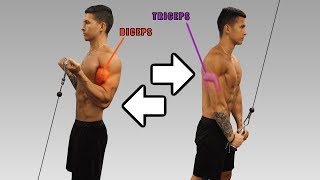
YouTube instructional video (July 2018) that explains how to properly use supersets to save time and possibly enhance muscle growth. The creator recommends primarily using agonist–antagonist supersets (opposing muscle groups) because they preserve rest for each muscle, reduce excessive damage seen when supersetting the same muscle, and can increase workout volume; advises using paired/staggered rest periods to ensure ~2–5 minutes total rest between sets per muscle; warns against supersetting very taxing lifts (squat, deadlift, Olympic movements) except with low-tax decompression movements (example: scapular pull-up paired with squats). Concludes with a practical upper-body superset workout and a closing call-to-action promoting upcoming online programs and social engagement.
Questions this video answers
July 2018
Approximately 2–5 minutes
2017 and 2014
When it comes to structuring your workout, there's a ton of different tools that you can incorporate to maximize your time in the gym and enhance muscle growth. Supersets, for example, is a well known and frequently incorporated tool that involves performing two different exercises back to back with minimal rest instead of completing all your sets with a single exercise and then moving on to the next. Supersets are mainly used to save time in the gym by potentially cutting your workout duration in half, but as you'll see, may also provide additional benefits in terms of muscle growth. But despite their popularity, most people just don't utilize them in a way that maximizes their effectiveness and instead of benefiting them, supersets become detrimental to their workout and muscle growth. Therefore, in this video I'll go through three evidence based tips that you can use in order to get the most out of supersets. Now, although you can theoretically superset any two muscles with each other, if you want to see the best results, then it's important that you choose the right ones. My recommendation is to mainly stick with what are called agonist antagonist supersets, which simply means that you superset two muscles that have the opposite function. For example, the biceps mainly work to flex the elbow, whereas the triceps mainly work to extend the elbow. Why do I recommend this? Well, for three main reasons. First off, as shown in my rest periods video and in several studies on the topic, we know that muscle growth and strength is optimized with rest periods of around 2, 5 minutes between sets strength. So if you were to do a superset of the same muscle group, for example alternating between the bench press and push ups, you wouldn't be providing your target muscle with adequate rest. Whereas when you use agonist antagonist supersets, one muscle rests while the other works and therefore enables you to save time without negatively affecting your rest times and performance, especially when the other two tips in this video are followed as well. And secondly, as shown in this 2017 study from the Journal of Strength and Conditioning Research, when supersets for the same muscle group are used, it causes excessive muscle damage and negatively interferes with the recovery process without providing additional benefit. And lastly, utilizing agonist antagonist supersets also seems to actually enhance performance when compared to other forms of supersets or even traditional sets. For example, this 2017 study by Paz and colleagues compared agonist antagonist supersets of the bench press and seated row where subjects alternated between the two versus a traditional set approach where subjects first did three sets of bench press and then three sets of the seated row. The researchers found that the superset group was not only able to complete their sets in half the time, but they were also able to perform better during their sets and achieve more total volume when compared to the traditional set group, which is something that has actually been replicated in multiple other studies of similar design. And although it's unclear as to why exactly this occurs when agonist antagonist supersets are used, it it's speculated that some mechanism within the stretch shortening cycle of your muscle enables you to achieve more volume when this form of superset is used. Therefore, for these reasons, I'd suggest mainly incorporating supersets with the following paired muscle groups and ideally incorporate opposing movement patterns for each of these supersets. Keep in mind though, that incorporating supersets for unrelated muscle groups like shoulders and calves, for example, are a viable time saving option as well, but just don't seem to provide the enhanced effect previously mentioned. But regardless of what type of superset you choose to use, the two next points should first be taken into account. As mentioned previously, you need to stick to rest periods of roughly two to five minutes for most of your exercises, and this still holds true when utilizing supersets, meaning that during a superset, if you're jumping from one exercise to the next right away and then immediately back to the first exercise, you're not providing your muscles with optimal rest and your performance will suffer as a result. Therefore, you want to instead use what are called paired sets, which is something that was incorporated in the previous studies I mentioned that found supersets to be beneficial. Now, paired sets simply means that rather than going from one exercise to the other right away, you instead incorporate shorter staggered rest periods in between for example, performing the bench press resting for a minute, performing the barbell row resting for another minute, and then going back to the bench press again. This way you're not compromising performance since you're still getting the total recommended three minutes of rest between sets for both exercises, while saving time in the process. And for less demanding exercises like bicep curls and tricep extensions, for example, you can instead use shorter 3045 second staggered rest periods to allow at least 2 minutes of rest for each musc. Now, despite what I've said in the last two tips, I would for the most part advise against utilizing supersets on certain movements, mainly the squat deadlift and the various Olympic weightlifting movements. This is because supersetting, very taxing movements like these can actually do more harm than good. For example, one 2014 study from the Journal of strength and conditioning research found that even when staggered rest periods were used with a superset between the squat and the row, the the subjects couldn't do as many reps with a squat when compared to using a traditional set approach, and the same would likely be true for the other taxiing exercises I mentioned as well. However, with that being said, if you want to best utilize your rest time with squats, then I think that one great and viable superset for the squat would be the scapular pull up. This is because a squat is a spinal compressor since your feet are fixed on the ground and the weight pushes you down, whereas the scapular pull up is a spinal decompressor. Since since you're hanging from the bar and lengthening your body, and since the scapular pull up isn't a taxi movement at all and in fact might even boost your squat performance rather than hinder it, since it helps activate the muscles that keep your back set and upright during the squat, it makes for a very effective superset. But again, use what I mentioned in tip number two by incorporating staggered rest periods between each exercise to minimize any potential negative effects on your performance. So to sum up the video, here are the main points you want to keep in mind when utilizing in supersets and to put this into practice, here's how you would properly incorporate supersets into the following Upper body workout as you can see, this enables the workout duration to be cut down substantially, but this also means that your workout will be more taxing both mentally and cardiovascular wise. So if you're just starting out in the gym or aren't very fit cardiovascular wise, you want to refrain from supersets or use them sparingly until you feel more comfortable with them. But all in all, when done properly, supersets do seem to be an effective tool to both save time and potentially enhance performance. Now as for whether this would lead to more muscle growth in the long run when compared to not using supersets at all. It's definitely up for debate and will require further long term research for a definite answer.
Thanks so much for watching guys. I hope you enjoyed the video and found it useful. As I announced in my last video, my online programs are really close to being done and I'm hoping to get them out sometime in early August. So for those of you who haven't already, I'd really appreciate it if you joined my early bird mailing list by simply entering your email here at builtwithscience.com forward/earlybird. This way you'll be notified as soon as my programs are released and you'll also receive various updates regarding the program. I'll also leave a link to this in the description box down below so you can follow that to enter your email as well. I honestly just can't wait for you guys to see these programs. Anyways, if you enjoyed this video then please don't forget to give it a like. Leave a comment down below as to what your favorite superset is. Subscribe to my channel and turn on channel notifications as well as this all really does help me out. And for those of you who haven't already, I'd really appreciate it if you gave me a follow and connect with me on Instagram so you can stay updated with what I'm doing and see a lot of the informative content that I post on a more regular basis. Thank you so much for all the support everyone. It really does mean a lot. That's it for today guys. I'll see you next time.