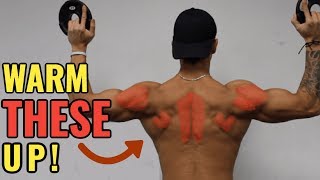
Jeremy Ethier breaks down a three-part warm-up: light cardio to raise body temperature, dynamic stretches and mobility work like leg swings and band dislocations, then progressive sets starting at 50% of your working weight. Done right, it improves performance and muscle gain over time.
A proper warm up is essential for any workout, yet it's often either overdone or not done at all. The main goal of the warm up is to reduce stiffness, awaken motor units and raise the temperature of the muscles and joints that are going to be worked. But extending your warm up beyond the point that each of these has been accomplished will only lead to a depletion of energy that could be better used towards your high exertion working sets. When done properly, a warm up provides several benefits that can translate to better muscle gain over time. Several studies have shown that a proper warmup boosts strength and performance in the workout to follow. And in the long run, this translates to better muscle gain since you're able to perform better and more effectively progressively overload your muscles. And although we commonly think that the main reason of the warmup is to reduce injury, this idea isn't well established in the literature. But recent studies have shown a reduced risk of injury when a proper warmup is used. And just through experience, I think the majority of us can say that our injuries often happen when we lift heavy weights or do certain movements without being sufficiently warmed up. Which is just more reason for you to include a proper warmup. So so in this video I'll explain the three essential parts of your warmup and then give you guys a sample. Upper body and lower body warmup that you can use. This part of the warm up mainly applies to lower body workouts as the leg muscles require a lot more blood flow and time spent warming them up than the upper body muscles do. The main goal here is just to raise the temperature and increase blood flow to the legs. So for this portion of the warm up, you're simply going to cycle at an easy pace of around 50 to 60% of your max heart rate for five minutes. A recent study in the Journal of Strength and Conditioning showed that subjects that performed a low intensity cycling warm up prior to leg press led to significantly increased strength when compared to a high intensity cycling warm up or just jumping right into the leg press. And since cycling mimics a lot of movements that are used in lower body workouts, it's likely a better option than walking on the treadmill or using other cardio machines. And as for warming up, the upper body, part two and three of the warm up, as you'll see, is likely enough to adequately warm up the upper body muscles to be worked more. And keep in mind that the goal is to warm up these specific muscles that you'll be training. This means that you're probably wasting your time and valuable energy by cycling for five minutes before an upper body workout. Which is why I suggest keeping part one for lower body. You've probably heard of the ongoing debate between static and dynamic stretching. To sum the research up for you, dynamic stretching leads to better performance and warming up of muscles than static stretching does and has shown in many studies. When static stretches are held for too long or done immediately before exercise, it can actually negatively affect your strength and overall performance. Therefore, this next part of the warmup will consist of dynamic stretches to help reduce joint stiffness and further warm up the muscles to be worked for upper body workouts. One of the main concerns in addition to warming up major muscle groups is adequately warming up the shoulder stabilizers as well as various small yet essential muscles like the lower traps, which all play a role in many upper body exercises. Here's a good routine to follow that covers these points. Start with wrist circles by keeping your palms together and make sure you do them in both directions. For these, keep your palms facing forward and protract the shoulder blades as you come forward and retract them as you come back. For this one, keep your core tight and try not to compensate by arching at the lower back. On the arm swings, try to get as much range of motion as you can and allow your shoulder blades to move up, forward, down and back throughout the movement. For the rotations, make sure you're getting sufficient rotation in both the upper and lower back and not just rotating at the hips. For the band dislocations, use an appropriate hand width and pull the bat apart slightly to create some tension and and then bring the band over and behind your head for band pull aparts. Keep your arms extended in front of you and initiate the movement by performing a reverse fly motion by moving your hands out laterally to the sides. You want to include the next two exercises just to further warm up your rotator cuffs. Use a light weight and focus more on the range of motion. Try not to let your elbow drift away from your side Again, use a lightweight here for these and slowly control it throughout the movement while keeping your traps depressed. And for lower body workouts, here is a good routine to follow. Keep your core tight and swing front and back as far as your leg will go. Follow this with side swings. For these, you want to put your hands on your feet and come down into a deep squat while keeping your chest up and hold this position for a couple of seconds. You can also do these by holding onto something instead to make it easier for these, lay with your arms Straight out to the side and drop your knees to both sides as far as they will go. Keep your knees and ankles together and face your head in the opposite direction of the way your knees drop. Get into a push up position and bring one foot up beside your hands while pushing the hips forward and hold this position for a second. Then do the other side for these. Come up to a wall and plant one foot forward with the other behind. Keep the heel of the front foot on the floor and bring your knee towards the wall and back out. The further away you are from the wall, the more ankle mobility you will need. This last exercise is something I believe pretty much all of us should do for both upper body and lower body warmups. The majority of us, myself included, sit for hours a day and lack sufficient thoracic extension, which which is something that is required in several weightlifting movements. So reducing joint stiffness and improving range of motion in thoracic extension is something that will really benefit you in your lifts. To get into position, you want to lay on the floor with your feet and butt on the floor, the foam roller in the middle of your back and your hands placed over your head like so to get your shoulder blades out of the way. Then you want to lift your hips into the air and slowly roll up and down for a bit to loosen up your upper back before we get into the next step. Once you've done this, you want to put your butt back on the floor and place the foam roller between your shoulder blades. Take a deep breath in and as you exhale, you want to extend over the foam roller while holding your head to release any tension in your neck. Relax in this position for a few deep breaths and then come back up. Move the foam roller slightly lower on your back and repeat the process one or two more times, getting lower on your back each time. Part three of the warm up is very important and will get your joints and muscles prepared for the movement you're going to perform and the heavy weights you will lift. What you're going to do is perform two warm up sets and then two of what are called weight acclimation sets. Before you start your working set, you want to do the set one, do 12 reps with about 50% of your working weight and then rest for a minute. Set 2. Do 8 reps with the same weight at a slightly faster pace and then rest for a minute. Set three, do three four reps with about 70% of your working weight and then rest for a minute. Set 4 Do one rep with about 90% of your working weight and then rest for two minutes before you start your working set. Now, by the time you start your first working set, the muscles you'll be working on will be adequately warmed up without being fatigued due to too much warm up. You want to do these for the first main exercise of your workout, for example, bench press, if you're starting with that as your first main exercise. And that's pretty much it guys. Thank you for watching. Here is the upper body warm up routine all written up for you. And here is the lower body routine. Now at first glance it may seem like a lot, but trust me guys, this is only going to take maximum of around 10 to 15 minutes to do. And that extra 10 minutes is going to benefit you a lot in terms of injury prevention, increasing your mobility and range of motion over time and also boosting your strength and performance in the gym. So it's definitely something that you want to start incorporating in your routine if you aren't already. And one thing to always keep in mind is individual variation. So as with many things, it's not a one size fits all and you want to tweak it according to your body and what helps you the most. And for those of you asking, my legs video will be up probably sometime next week and then I'm going to move on and do shoulders after that as well. As always, if you like this video, please give it a like and leave a comment down below. And also don't forget to subscribe to my channel. Thank you again for all your continued support guys. I really appreciate it. Anyways, that's it for today guys. I'll see you next time.










