How To SCULPT Your Lower Abs: 3 Key Exercises You Should Be Doing
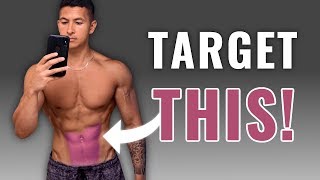
YouTube instructional video explaining how to target and lower abdominal muscles using three key exercises (reverse crunches, hanging leg raises, ab wheel rollouts). It covers the theory that lower and upper abs can be selectively emphasized, demonstrations of correct form (notably posterior pelvic tilt), progression/overload strategies, and brief promotion of a nutrition/workout program.
The lower abs are one of the most important features that you'll want to develop if you're seeking to complete a well defined six pack and achieve an attractive looking midsection. However, it's also typically the most difficult part of the abs to reveal, which is mostly due to the low level of body fat you'll need to achieve in order to do so, and is something that nutrition will be largely responsible for. But although nutrition will play a huge role in revealing your lower absurdity, just like any other muscle, you can actually prioritize and develop this region of the abs to make them more visible and pop even at a higher body fat percentage. And the way you do this is by first choosing the right lower abs exercises and then performing and progressing them in the right manner. And in this video, that's exactly what I'll show you how to do. But before we dive into the exercises, for those who believe that the lower abs cannot be selectively targeted, research clearly indicates that it is indeed possible. This is because the upper and lower abs are actually innervated by different nerves, and this hence provides a mechanism for selective activation. And in fact, researcher Brett Contreras has performed extensive research on this very topic with his EMG findings concluding that the upper and lower abs can, beyond a shadow of doubt, be selectively emphasized depending on the type of exercise you perform. More specifically though, top down ab exercises that involve bringing your shoulders down towards your hips, such as crunches, are going to preferentially activate the upper abs more so than the lower abs. Whereas bottom up ab exercises that involve bringing your hips up towards your shoulders, such as leg raises, are going to instead preferentially activate the lower abs more so than the upper abs. So now that we know the theory behind lower abs exercises, let's take a look at the best ones you can do to start developing the first exercise. Reverse crunches is going to enable us to target the lower abs by bringing the pelvis up towards the shoulders. Now, although this is a well known exercise, most people just don't perform it in a way that actually targets and activates the lower abs. What most people do is they aimlessly swing their legs up and down, which makes the movement more of a hip flexor exercise and momentum ends up driving the movement rather than the lower abs. And in fact, this was actually pretty proven in a study that looked at the reverse crunch. They found that subjects who performed the movement using the form I previously described were unable to effectively target the lower abs, whereas subjects who performed the movement using correct form with something called a Posterior pelvic tilt, which I'm about to show, you were now able to activate their lower abs to a significantly greater degree during the movement. Therefore, instead of performing it like this, here is what you'll want to do to maximize your lower ABS activation. First, lay on a flat bench or on the floor with your hands held behind the bench for support. Next, raise your legs up and bend to roughly 90 degrees. And from here, before starting the exercise, it's absolutely crucial that you initiate something called posterior pelvic tilt, as pictured here. You can do so by squeezing your glutes and contracting your abs to tilt your pelvis upwards, which as a result is going to completely flatten your back onto the bench. And you want to maintain this posterior pelvic tilt throughout the whole movement. Next, lift your pelvis up off the bench by thinking about raising it up and curling it towards your belly button. And as you do so, visualize and think about contracting your lower abs and then slowly lower back down to the starting position, ensuring that you maintain that posterior pelvic tilt and that flat lower back against the bench every time you come down for the next rep. When done correctly, you should feel a very strong contraction in the lower part of your abdomen, signifying that you're successfully working the lower abs. And then once you're able to easily perform over 15 reps or so with this exercise, you'll want to progressively overload it just like you would any other exercise in order to further develop and stimulate the growth of the lower abs. And one easy way to do so is by using any kind of weighted ball and squeezing it between your knees as you perform the movement, which as a bonus, will further boost your core activation as well. Just be careful with this, guys, as you don't want the ball to end up smacking you right in the face. Another option as well is to simply move onto a decline bench when performing it. Either way, it's vital that you overload the movement in some fashion over time to progressively make it harder and harder. Next, we're going to move on to the hanging leg raise, which is another bottom up ab movement that's going to effectively hit the lower abs as a result. In fact, this exercise was shown in two separate EMG analyses to elicit the highest lower ABS activation when compared to several other abs exercises. However, just like with the Reverse Crunch, its effectiveness on lower ab activation is highly dependent on how you perform it, as this can again very easily become a hip flexor dominant movement when done incorrectly. So to correctly perform it, start by Hanging onto a bar. Or you can set up on a captain's chair leg raise if the hanging version is too difficult for you. Either way, though, before you initiate the movement, move into posterior pelvic tilt by again flexing the core and tilting the pelvis upwards like so, in order to flatten the curvature of your lower back. And then from here, rather than thinking about just raising your legs up, I want you to simply think about raising the pelvis up and curling it towards the belly button as much as your ab strength allows you to, which is just going to bring the legs up with it. As a result, by consciously thinking about this while avoiding swinging and using momentum, you'll be able to successfully shift tension away from the hip flexors and onto the lower abs. But if this movement is initially too difficult for you, you can start with bent knees and use the same cues I previously went through. And then, as you get stronger, you can both gradually straighten the knees out more and lift the pelvis and legs higher up to make the movement more difficult. And then when that becomes easily done for 15 or more reps, for example, you can then load the movement with a weighted dumbbell or weighted ball to ensure that you're continuously progressing and effectively growing the lower abs over time. The last exercise, the ab wheel rollout, is another great movement to effectively target the lower abs along with various other muscles as well. Now, although this movement isn't technically a bottom up movement like the previous exercises I went through, when performed properly, the lower abs will be involved to a very high degree, something that's actually been shown in various EMG analyses that have compared the ab wheel rollout to various other commonly performed ab exercises. But once again, its effectiveness on lower ab development depends on proper execution, which most people just don't do. First off, you want to get into the right starting position by again moving into posterior pelvic tilt. So rather than having a curve or straight back, you actually want to contract your abs to tilt your pelvis towards your belly button, which will now slightly flex your spine. As a result. This will not only help us better engage the lower abs during the rollout, but is also going to put the back in a much safer position. From here, you want to maintain this position with your abs contracted as you begin to roll out, and then roll out only as far as you can while maintaining this posteriorly tilted pelvis. Because the second that your lower back begins to cave is an indication that your ab strength is not yet at that level. So start out with short rollouts first, and then gradually progress further as your ab strength improves. And on the way back you want to avoid simply bending at the knees to cheat back to the starting position. Instead, you want to maintain that posterior pelvic tilt which we talked about and pull up with the midsection to roll back in. One helpful cue I actually use is to think about as if there was a string pulling your mid back back up to the starting position. When done properly, you should feel a very strong contraction, especially in the lower abs.
I hope that you were able to.
See that when it comes to developing.
Your abs just like any other muscle group, you need to ensure that you're not only choosing the right exercises, but that you're performing these ex in the optimal manner. Because doing so when combined with the right nutrition plan really is going to be the key to dropping your body fat and attaining that six pack that you're after. And for a step by step science based nutrition and workout plan that puts all of this together such that you can lean down and drop your body fat percentage as quickly as possible to attain your six pack. Then simply head on over to builtwithscience.com and take the body type quiz to discover what SHRED program is best for you. And a quick shout out to the transformation of the week. Vincent, who actually ran this program for just a few months and was able to attain the six pack that he was after. Anyways, thank you so much for watching guys. I hope you enjoyed this one. Please don't forget to show your support by giving the video a like leave me a comment down below. Subscribing to the channel and turning on notifications for the channel as well as this all really does help me out and I appreciate it. I'll see you next time guys.










