How To “Sculpt” Your Serratus Anterior (STOP Neglecting This Muscle!)
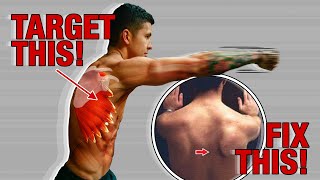
This YouTube tutorial explains the anatomy and function of the serratus anterior, why it’s often neglected, and how weakness leads to scapular dysfunction (winging), rounded posture, and shoulder injuries. The presenter demonstrates three evidence-informed exercises—push-up plus, serratus jabs (band/cable upward punches), and wall slides—explaining setup, execution cues, EMG-based rationale, progression, and how to program them into routines to improve scapular stability, overhead strength, and midsection aesthetics.
Serratus anterior is one of the most overlooked muscles of the body. In fact, most of you watching likely have no idea what this muscle is yet alone what it's even responsible for doing. Which, as you'll soon find out, is problematic given how important this muscle really is. So, the serratus anterior is a fan shaped muscle that's located on each of your sides, right on top of the ribs. And it functions mainly to retract your shoulder blades, for example, when you punch, but it also assists in upwardly rotating the scapula when you move your arms overhead. And not only does this muscle play a role in improving the aesthetics of your core, since, as you can see, it helps complete the look of a shredded, well developed midsection, but more importantly are the various movement functions that is responsible for. Because given that this muscle actually attaches to the shoulder blade, it plays a critical role in stabilizing and facilitating proper movement of our scapula anytime we raise our arms up. For example, whether you're performing a pressing movement in the gym or, or just simply reaching to grab something overhead. And as a result, what multiple papers have shown is that when this muscle becomes weakened or fails to properly activate, it can lead to unwanted movement within the shoulder joint and the shoulder blades, which creates various dysfunctions such as the forward rounded posture, the common sticking out and winging of the scapula, and even eventual injuries such as rotator cuff tear or shoulder impingement, for example. And unfortunately, given that the bulk of most people's exercises in the gym involve pressing movements where the shoulder blades are retracted and pressed against a bench where the shoulder blades can't move freely, the serratus anterior, over time gets understimulated and essentially becomes dormant as a result. So to mitigate this, in this video, I'll show you three of the best exercises that you can incorporate to develop your serratus anterior and to get it to start firing properly. The first exercise we're going to start with is something you may have already seen on my channel, and it's the pushup plus, which will emphasize the protraction function of the serratus anterior. Now, research just indicated that regular push ups on their own actually already activate the serratus anterior to quite a high degree, given that the shoulder blade is allowed to move freely. But by performing a plus component where you protract your shoulder blades at the top of the push up position, by pushing your hands into the ground and slightly rounding your upper back, the activation of the serratus anterior increases by an additional 50%, which is a very high degree of activation for this muscle when compared to other exercises designed to train it. Not only that though, but research has also indicated that of all the serratus anterior exercises, the push up plus elicits the lowest upper trap to serratus anterior activation ratio, meaning that it better activates the serratus anterior while minimizing the activation of the upper traps, which is important because most people with a weakened serratus anterior can't properly activate in the first place as they tend to overcompensate with their upper traps. And to boost the activation of this exercise even further, you can externally rotate your shoulders as you perform it by twisting your hands outward during your setup, as two EMG analyses have shown that this modification leads to significantly greater serratus anterior activation than the standard grip. However, there is a downside with this exercise that we need to accommodate for, and the downside is that this exercise activates the serratus anterior in a fixed arm position at 90 degrees, because research has shown that the serratus anterior becomes more involved and better activated as your arm angle is elevated to a greater degree above your shoulder. Since this will now incorporate this muscle's other movement function, which is upward rotation of the scapula, which is so while the push up plus is a great exercise to get the serratus anterior firing with minimal compensation from other muscles like the upper traps, we'll want to then move on to something called serratus jabs, which researchers indicated elicits high EMG activity of the serratus anterior and accomplishes what the push up plus doesn't by incorporating both protraction and upward rotation of the scapula. And it also does so in a more functional manner that can then carry over into various overhead lifts you perform in the gym. But in order to maximize the effectiveness of this exercise, there's a few setup and execution tips that you want to make sure you implement correctly. To start, set up the resistance by either using a band looped around a fixture or a cable system, and you want to set it up at a low angle such that your arm can travel upwards as you punch to promote upward rotation of the scapula. Then get into the starting position with your arm by your side, and all you're going to do now is perform an upward punching motion which can be broken down into two distinct phases. So phase one simply involves you punching forward, and then phase two involves the active protraction of your scapula at the very end of the punch. So similar to the plus in the push up plus that we did, you simply want to reach out as far as you can at the end of your punch by thinking about bringing that shoulder blade around you, as this subtle movement is what will enable you to fully activate the serratus anterior through retraction of your shoulder blade. Then come back to the starting position with your elbow stopping by your side, and then repeat the movement. And for this exercise, just like any other movement, you'll want to gradually increase repetitions and or weight that you use to continue to further develop your serratus anterior as it gets stronger over time. Now, the last exercise we're going to use are wall slides, which have been cited and researched to be one of the best exercises at activating the serratus anterior and is especially useful since it involves even greater arm elevation than the previous exercises, meaning that it helps strengthen the serratus anterior in overhead positions, which will again more effectively carry over to your overhead lifts and can also help with a common symptom of shoulder pain when the arm gets in overhead positions. To perform this exercise, you want to place a long foam roller against the wall at about eye level, assume a staggered stance in front of the wall, and then place your hands on the foam roller slightly wider than shoulder width apart. Now, before you slide your arms up, you first need to protract your shoulder blades, which you can do by lightly pushing away from the wall and slightly rounding that upper back. Then slowly slide your arms up overhead into a Y position and then back down while keeping your core tight and your shoulder blades in that protracted position you initiated in the beginning. And a helpful cue that researchers have used with their subjects to boost activation is to think about bringing your shoulder blades out and around you as you slide up the wall, which will just with keeping them protracted. And during each rep, you should feel a stronger and stronger contraction in the serratus anterior as your arms move upward along the wall, since research shows that its activation in this exercise increases as the arms move further up the wall, where more upward rotation of the scapula occurs. But at the same time, you want to avoid shrugging your traps up excessively and letting the upper traps take over, as this is going to hinder the activation that you get from the serratus anterior. And to progress this exercise over time, you can simply stand further out from the wall and lean into the foam roller more, which is just going to provide a greater challenge for the serratus anterior to maintain the various cues that we covered earlier as you raise your arms overhead. Now, in order to then properly implement these exercises into your routine, here's what I recommend. If you currently experience overhead shoulder pain or scapular winging, for example. What you'll want to do is progress from exercise 1 to exercise 2 and then to exercise 3 since the overhead demands increase throughout each of these exercises. So start by first performing the push up plus two to three times a week and then transition to this radius jabs after a couple of weeks and then finally to the wall slides again after a couple of weeks if you can do them pain free and with the proper form that I went through. Otherwise, if there's no pain and you simply want to better target this muscle to ensure that it doesn't get weakened or lag behind over, you can simply throw in a couple sets of each of these exercises one to two times per week into your current ab workouts or after your main workouts, for example. Doing so will not only drastically improve the look of your midsection, but will also have a host of benefits in terms of improving your overhead stability, strength and long term shoulder health. So I hope you were able to see that it's the often overlooked muscles like the serratus anterior that not only contribute to a better looking physique but but also a more stable and functional body. And for a step by step science based program that shows you how to train all of these key muscles within your weekly routine such that you can lean down and improve your muscle definition in the most effective way possible. Just like Andrew over here was able to do. Then simply take the Analysis quiz to discover which built with science program is best for you and where you're at right now. Anyways guys, I hope you enjoyed this one. That's it for today. Please don't forget to show your support by giving the video a like leaving a comment down below as to what you'd like to see. See me cover next. Subscribing to the channel, turning on notifications as well as this all really does help me out. Thank you so much everyone and I'll see you next time.










