How To Squat Properly: 3 Mistakes Harming Your Lower Back (FIX THESE!)
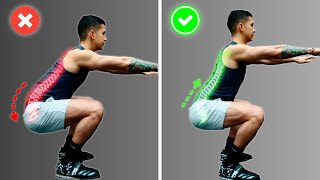
Three squat mistakes wreck your lower back: butt wink from tight ankles, hips rising before your chest from weak quads, and bad breathing. Fix them with ankle stretches, pause squats, and braced breathing during heavy lifts.
When it comes to lower body strength and size, there's no doubt that squats are king. But at the same time, the squat is one of the more risky exercises in the gym. In fact, research in train lifters often finds that squats are the most commonly cited injury causing exercise performed in the gym. More specifically though, it seems that of these squatting injuries, the lower back tends to come up as the most frequent site of injury, which is simply because the spine is biomechanically the most vulnerable of the joints when squatting. Now, this doesn't mean that the squat is a dangerous exercise that you should avoid, because it's not and it's actually a great strengthening movement for your lower body. But this does mean that you need to pay careful consideration to how you execute the squat, as there's a few common mistakes that people make with it that can contribute to lower back pain and injury over time. And in this video, I'll go through exactly what those mistakes are and how to fix them so you can avoid injury and build up a stronger, pain free squat. The first mistake you're making has to do with something called butt wink, which is a term used to describe when someone gets close to the bottom of their squat and their pelvis starts to posteriorly tilt and their tailbone tucks under them, creating a little bit of rounding or flexion in the lumbar spine. And although there is some controversy behind this, research does seem to indicate that this subtle rounding of the lumbar spine is associated with spinal disc injuries and can become problematic over time, especially when it's done repeatedly with heavy loads as we do in the weighted squat. So instead we ideally want the pelvis to remain as neutral as possible as opposed to rounded at the bottom position of the squat. Now, although some individuals just can't change the amount of butt wig they experience due to anatomy issues where the femur actually only so much available range of motion and means that deep squats just wouldn't be best for them. Most individuals instead experienced this butt wing due to mobility issues, with the most common issue being a lack of sufficient ankle mobility. In fact, in two recent papers that analyzed the effect of ankle mobility on the squat, they both found that when the ankle mobility in subjects was put in a restricted condition to simulate poor ankle mobility, the there is an increase in lower back stress as well as a greater amount of lumbar flexion or butt winks seen when compared to subjects who were unrestricted in their ankle mobility during the squat. And we can clearly see why this happens here. With Skeletor, because when you have adequate ankle mobility, your knee is able to travel forward more as you descend and you can reach proper depth without your lower back and pelvis having to compensate. But on the other hand, if your ankle mobility is restricted, your knee can't travel forward as much. So in this case, if you wanted to reach proper depth in the squat, you just wouldn't be able to because your body would fall backwards since your center of gravity has shifted back. So to compensate to prevent this from happening, what the body does is it's going to round the back and the pelvis so that you can achieve proper depth without tipping backwards. Which is why having tight ankles is often the culprit to this butt wing problem. I mean, I personally have very tight ankles and for example, when I do a barefoot squat without warming up, you can clearly see butt wink recurrent. But if I then raise my heels up on some plates as a squat, the butt wink completely disappears because the lift helps with my ankle mobility. So what I suggest is that you film yourself and try out this little experiment to see if this is indeed the case for you as well. And if it is, then what you want to do is simply start incorporating ankle mobility stretches daily and before you squat, as that's been shown to significantly improve ankle mobility restrictions. So so exercises like various weighted ankle stretches, wall ankle stretches and just holding the deep squat are all great daily movements that you should be doing to quickly improve your ankle mobility. In addition to this though, some quick fixes are to one, use a wider stance, as this is going to enable you to squat deeper with less ankle mobility since the knees don't have to travel forward as much. And 2 invest in lifting shoes as these provide a heel lift which helps with your ankle mobility. And I'll leave a link down below to the ones that I use and recommend. But regardless, until you improve that excessive butt wink in your squat, it would be best to either limit your depth during heavy squats to parallel or however deep you can go without that excessive rounding to avoid any potential issues from arising over time. The next crucial mistake you're making with your squat is very subtle to catch, yet is a big problem when it comes to lower back stress and pain. So ideally, when you rise out of the bottom of the squat, your chest and your hips should rise at approximately the same rate in one fluid motion, which enables the bar to travel straigh up and down as you squat. But what some people do instead is something termed as a good morning squat, which is when the hips shoot up first and rise at a much faster rate than the chest does, which causes the bar to now shift forward and the upper body to lean forward excessively out of the bottom position. And this is problematic because we know that greater forward lean and forward bar movement during the squat increases the lumbar forces and sheer stress experienced at time the same spine. So instead, to minimize these dangerous forces on the lower back as you squat, you need to focus on keeping that chest upright during the ascent and ensuring that your hips aren't shooting back behind you, especially as you fatigue later on during your sets. And if you struggle with this, then this likely has to do with both your motor coordination and potentially a weakness in your quadriceps. Because if your quadriceps are weak at the bottom position, your body will compensate by relying more on your relatively stronger glutes and lower back to now carry the load. And which is why we see the hips shoot back. And in fact, multiple research papers like this one from the Spine Journal are in support of this and found that when subjects pre fatigue their quadriceps so that they'd be relatively weaker before performing a squat, they tended to now lift with the stooping squat pattern discussed earlier to decrease the demand placed on their quadriceps. Now, to correct this, the best course of action would be to lighten the weight weight and start incorporating pause squats instead. Where you'll want to briefly pause at the bottom position of the squat, come up to about halfway up, pause again, and then come back to the top. And during each rep, you need to ensure that your hips and your chest are rising at the same rate. It's also useful to use various cues to help you with this, such as thinking about driving your chest up as you come out of the bottom position of the squat. But performing pause squats in this manner will help force your quads to remain involved during the most difficult parts of the squat, help you nail down that much needed coordination, and then as you get better and stronger with this, you can start transitioning back to the normal squats and overloading them, as long as you can maintain that new proper form. Now, the last mistake has to do with how you actually breathe during your squat, which is something that most people overlook. So I'm sure many of you have been advised to breathe in on the way down and breathe out on the way up for exercises. Although this is fine to do for most exercises and sets that are less strenuous when it comes to your more fatigue and heavy sets of barbell squats, doing this is going to result in a ton of instability as you lift. So instead you need to use a breathing technique that increases something called your intra abdominal pressure within your abdomen as you squat, which has been shown in multiple papers to stabilize and protect your lower back when squatting by significantly reducing the spinal compression and lumbar load that it experiences. And to do so, you want to think about it as if you were going underwater every time you squat. So to start, take a big breath into your abdomen and then brace your core as if someone were about to punch your stomach. Then you keep bracing and hold this breath as you go underwater, going down in the back up during your rep and then exhale and reset at the top position as you come out of the water. It does take some practicing to get used to, but it is essential that you do as it will lead to a stronger, more stable squat and better ensure that your lower back is protected as you start working with heavier weights. So to sum the video up, here is the exact action plan you want to take with your squats. I would highly recommend that you actually take the time to film yourself from the side or just get someone to film for you just to see if you're making any of these mistakes. But by being aware of these key points as you're squatting and implementing the necessary fixes for them, you'll be able to both alleviate any lower back pain you may be experiencing when squatting and better protect your lower back from injury in the long run. And if you're looking for a science based plan that optimizes your exercises and all the various aspects of your program for you in an easy to follow manner such that you can quickly build strength and size as effectively and as safely as possible with science. Then simply head on over to buildwithscience.com to take the analysis quiz to discover which specific program is best for your body and where it's currently at. Anyways, guys, I hope you enjoyed this one. Please don't forget to show your support by giving the video a like leaving a comment down below as to what you'd like to see me cover next. Subscribing to the channel and turning on notifications for the channel as well as this all really does help me out. Thank you so much everyone. I'll see you next time.










