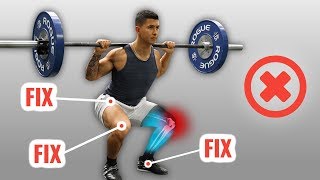
This transcript is from a Jeremy Ethier YouTube tutorial explaining four common squatting mistakes that often cause knee pain, how to test for and correct them, and alternative exercises and load-management strategies to reduce knee stress. Key points: avoid leaning forward and keep the bar over mid-foot; assess and improve ankle mobility (wall knee-to-wall test); actively engage hip flexors to control descent; use reactive neuromuscular training (banded RNT split squats) to prevent knee valgus; reduce training load and try box squats for tendinopathy or persistent pain. The video ends with a promotional call-to-action for the creator's program.
Squats are one of the most effective exercises for developing the lower body, primarily the quads and glutes. However, despite this, it's also labeled as one of the more dangerous exercises due to the high prevalence of knee pain people experience during or after performing the squat, which often presents itself as pain or discomfort experienced either on and around the kneecap or pain above or below the kneecap at the attachment points of the quad and patellar tendons. And the truth is, although you may think you just have bad knees, there's often just a few common mistakes that you're making during the squat that contributes to the pain that you feel. And in this video I'll go through exactly what those mistakes are and how to fix them in order to prevent future injury and get back to pain free squatting as soon as possible. One of the most common mistakes people make with the squat is leaning forward and shifting the weight onto the toes, while often raising the heels up in the process. What this does is it transfers more of the load onto the knees as a result and can lead to the symptoms of knee pain that we discussed earlier, especially around the kneecap. So instead, as you squat, you need to ensure that the bar remains over your mid foot and travels vertically up and down during each rep, as opposed to letting the bar shift forward over the toe. And as you squat, you should also be applying pressure into the ground with your entire foot rather than shifting most of the pressure towards the toes. This is going to help you better distribute the load onto the ankle and hip joints to prevent excessively straining the knees. But if you struggle to do this, then the problem more often than not has to do with your ankle stiffness because when your ankles aren't mobile enough, your body can't get enough bend at the ankle in order to properly execute the squat and instead compensates by creeping up on the toes. And to find out if that really is a problem for you, I'd suggest taking the following test which research indicates is an excellent and reliable indicator of your ankle mobility. To perform it, simply kneel down by a wall without shoes and place your toes five inches from the base of it. Drive your knee forward over your toes, attempting to touch the wall without letting your heel lift off the ground. And if you end up failing this test, then you uncovered a weak link in your ankle mobility that needs to be addressed, which can be done by regularly performing ankle mobility drills and foam rolling the calves and shins, especially right before you squat. You can also experiment with a wider squat stance and or pointing your toes out a little more and see if this helps, as these two adjustments will decrease the level of ankle mobility needed to properly squat. Another common mistake people make is not actively engaging the hip flexors during the squat. Whenever you begin the squat, you want to think about actively pulling yourself down into the bottom position as opposed to just letting gravity and the weight of the bar plop you down. This, as a result will engage the psoas muscle and the other hip flexors during the squat, which will help with trunk stabilization and enable you to sit deeper into the squat with a more balanced center of gravity over your feet, resulting in less pressure placed on the knee. If you've never properly done this, then you'll likely feel immediate relief in your knees when you do so. So to properly apply it next time you squat, try to visualize the hip flexor muscles shown here, actively pulling your body down into the bottom position of the squat. Another tip to get this activation down is to perform the squat while holding onto a band attached above you as the counter resistance that applies will force you to actively use your hip flexors to pull you down into the bottom position. Another mistake that can contribute to knee pain is not properly aligning the knees with the toes during the squat and instead letting the knees collapse inwards, something termed as knee valgus. And this causes a lot of instability in the knee during the squat and over time creates imbalances and actually wears away at the knee cartilage, eventually resulting in knee pain most commonly located around the kneecap. And the main reason why this inward knee collapse occurs is due to poor coordination and an inability to activate the lateral glute muscles at the right time during the squat in order to prevent the knees from collapsing inwards. And to improve this, you'll want to start doing something called reactive neuromuscular training, or rnt, which has been shown to improve this much needed coordination and activation of the lateral glutes. One such exercise is the RT Split squat, where you place a resistance band around your forward leg and either have a friend pull the band inwards or attach it to a fixture to provide an inward resistance. Then, as you perform the split squat, try to maintain your knee in direct alignment with the direction of your foot. The resistance from the band should stimulate your lateral glutes to kick on at the right time in order to keep the knee in a stable position. Adding two three sets of 1520 reps of this into your leg workouts is a great way to help teach your body to now properly activate the lateral glutes during your squat, which will prevent knee valgus and mitigate any knee pain you may have been feeling. And I'll leave a link in the description box down below to the resistance band I'm using here. Another mistake that even I've been guilty of is simply doing too much too soon in terms of squatting or just your lower body exercises in general. And over time this can lead to tendinopathy in the tendons surrounding your knees, which presents itself as pain located above or below the kneecap at the attachment points of the tendons. So if you experience this type of pain and have recently increased the volume of your squats or leg work in general, or you're coming back from time off from the gym and went right into your usual workout volume, then this is likely what's causing it. But the good news is that this is easily reversible if properly managed. Researchers support the idea that these overworked tendons have the potential to return to their normal pain free self within just a few weeks if the training load is significantly reduced. And to do this, you'll want to play around with decreasing various aspects of your lower body workouts to find what provides the most relief for your knees while still enabling you to train, as this will help the tendon heal and strengthen, I'd recommend picking one of the listed variables to change and see if that provides relief to your tendons. In addition, another thing you can do is start replacing your regular squats with other exercises that don't stress the knee as much. One such example is the box squat, which is a great option for two reasons. One, if your knee pain has limited your ability to squat to full depth, then using the box squat to control the amount of depth and and setting it such that it's above the point that causes knee pain for you is an effective way to work around it. Reason Number two Biomechanical analyses of the box squat have found that this exercise elicits a more vertical shin angle than the regular squat, which as a result limits forward knee movement during the squat and therefore reduces the amount of stress placed on your knees. Simply meaning that if you're struggling with knee pain during regular squats, then box squats are a great alternative since you'll be better able to tolerate them and adjust it accordingly.
Guys, as I always try to emphasize, it's absolutely vital that you pay close attention to how exactly you're performing your exercises in the gym in order to prevent injury over time and just progress faster in general. I personally could have saved myself from a lot of injury and setbacks had I taken this seriously sooner. And for a completely evidence program that's fully equipped with in depth tutorials for each and every exercise in your program just so that you can ensure you're safely maximizing your efforts in the gym in order to build muscle and lose fat as quickly as possible. Then what you can do is simply head on over to built with science.com and take my Starting Point Analysis quiz, which will just determine what program is best for you. Anyways, as always, if you enjoyed this video, please don't forget to give it a like. Leave a comment down below as to what other topics you'd like to see me cover. Subscribe to the channel and turn on notifications as well, as this all really does help me out. Thank you so much everyone. Hope you enjoyed this one and I'll see you next time.