How To Train For Six Pack Abs (3 Fixes You Need To Make)
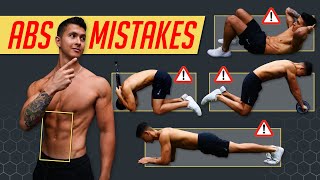
Most people train abs wrong because their hip flexors take over. Fix it by tilting your pelvis back during sit-ups, using band assistance, and treating abs like any other muscle that needs progressive overload and rest between sessions.
Most of us know that to get our abs to show in the first place, we need to get to a low enough body fat percentage for them to start peeking through. The same is true for any muscle for that matter. But in addition to that, by training our abs in the right way, just like any other muscle, they will respond with growth and as a result, your six pack will be even more visible and better looking as you start chipping away at the fat covering them. So in this video, I'll cover three fixes that you need to make with the way that you train your abs that'll help you actually target and grow your six pack back much more effectively. The first mistake you're making with your ab training is letting your hip flexors take over the movement. And the reason this can happen is because many abs exercises like leg raises, sit ups and reverse crunches, they involve a great deal of hip flexion, which as the name implies, is the main function of our hip flexors. And research has shown that if your hip flexors are already shortened all day due to prolonged sitting, or if your abs are just relatively weak, then your hip flexors will be more likely to take over and as a result reduce the involvement of the abs during these movements, which is obviously detrimental for our overall abs development, but can also create a problematic imbalance between our hip flexors and ab strength that can potentially lead to back issues and pain down the road. So one way to address this is by simply changing your focus during your abs exercises. Ignore what your legs or your upper body are doing during the movement and instead focus on your pelvis. For bottom up abs exercises like leg raises or reverse crunches, simply focus on curling your pelvis up towards your belly button. And for top down abs exercises like cable crunches or sit ups, simply focus on bringing the ribcage forward and down towards the pelvis. This mindset shift alone will do wonders in terms of helping you feel the movement more with your abs and less with your hip flexors. Going beyond this though, another solution is to tweak your current abs training to help take the hip flexors out of the equation. For example, during sit ups, one solution is to perform what's called the Yonda sit up, a move devised by Czech physician Vladimir Yonda, which through a concept called reciprocal inhibition has been shown to reduce the activation of the hip flexors by using a band to force the hamstrings to remain contracted throughout the sit up. To perform it, wrap a band around a fixture and place it either behind your knees or your heels. Keep your feet planted and mindfully contract your hamstrings and glutes to resist the pull of the band. Then you simply perform your sit up while squeezing your hamstrings and glutes throughout each rep. If you don't have a band, you can use a ball behind your knees like so, and again, focus on contracting the hamstrings and glutes. And even with something like cable crunches, the same concept can be applied. What you'll find is that this simple tweak will force your abs to work much harder than you're used to, and eventually you'll be able to strengthen your abs and improve your mind to muscle connection with your abs to the point where these modifications will no longer be needed. In addition to this, though, during moves like the Reverse Crunch, most people are unaware that the range of motion of the abs during this movement is actually quite short. In fact, on the way down, as soon as you pass roughly 90°, your abs begin to do considerably less work and your hip flexors will start to take over instead. So stopping this short on the way down is a very easy way to again shift more tension to the abs and minimize the involvement of the hip flexors. The next mistake you're making is you're failing to initiate and maintain what's called a posterior pelvic tilt during your abs exercises. This subtle movement of tilting the pelvis by contracting the glutes and abs is another key function of the abs, and it's been shown to not only significantly boost activation, but also helps to further prevent the hip flexors from taking over during our abs exercises. In fact, in a 2008 paper from the Journal of Strength and Conditioning Research, properly initiating and maintaining a posterior pelvic tilt during a move as simple as a lion leg raise led to less hip flexor activity and greater upper and lower abs activation when compared to a neutral or anteriorly tilted pelvic position. In fact, as you can see in the following graphs, hip flexor activity increased and abdominal activity decreased as subjects got further away from a posterior pelvic tilt. A similar finding was showcased in another paper analyzing lower ABS activity during the reverse crunch. So just realize the importance of this and apply this subtle tweak to all of your abs exercises. For example, during the reverse crunch, initiate the posterior pelvic tilt by contracting your glutes and abs before you go to perform each rep and maintain that position as you go through each rep. The same applies for moves like hanging leg raises, sit ups, ab rollouts, and even planks. Make this change and you'll not only instantly feel a much greater contraction in your abs, but also less involvement of other muscle groups like the hip flexors and lower back that we want to keep out of the movement. The last mistake is treating your abs like some kind of special muscle. On one end of the spectrum you have those who don't do any direct abs work. On the other end you have those who train their abs completely differently than how they train any other muscle group. Both are suboptimal approaches if you want to maximize your abs growth. Because although our abs are indirectly worked during many of our compound exercises, research has shown that they are stimulated to a much higher degree during direct abs work and would therefore respond better with growth. You can think of it just like any other muscle. Take your arms for example. Most people will be able to maintain their arm size and see some growth just from the indirect arm work that they get from compound exercises like the bench press and pull ups. But more often than not, they can get better results by adding in some additional direct arms work. And the same applies when it comes to building the abs. But then when you do add direct abs work, approach it like any other muscle group. A lot of people will make the mistake of training their abs several times a week with high rep ranges, short rest periods, and will leave them for the end of their workouts when they're already pretty fatigued. Instead, train them like your other muscle groups by providing them with adequate attention and volume, but also with adequate rest and as they get stronger over time, overload your abs exercises with additional weight or difficulty instead of simply sticking to the same routine over and over again. By training them in this fashion, and as shown in the literature, they'll respond with growth the exact same way that any of your other muscles would. All in all, though, as mentioned earlier in this video, just realize that while ab training does help to build your six pack, you need to combine this with a proper nutrition plan designed to then reveal your hard work and to get your abs more visible. The exact same is true for all of your muscle groups. Focusing all of your efforts on training while remaining oblivious to the importance of your nutrition will get you nowhere but for a step by step program that shows you exactly both how to train and how to eat week after week so that you can not only build muscle, but then also strip off the fat that's covering them to reveal that hard earned muscle. Just like several of our members have done with their built with science programs. Then simply head on over to builtwithscience.com and take our analysis quiz to discover which of our science based programs is best for you and where your body is currently at. Anyways, that is it for today guys. I hope you enjoyed this one. Please don't forget to show your support by giving the video a like leaving a comment down below as to what you'd like to see me cover next and subscribing to the channel and also turning on notifications for the channel as this all really does help me out. Thank you so much everyone. I'll see you next time.










