How To Unf*ck Your Shoulders In 10 Minutes (FOR GOOD!)
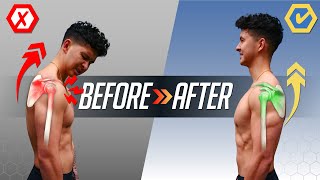
Fix rounded shoulders and impingement with two parts: activate weak muscles like your lower traps and serratus anterior, then stretch tight pecs and thoracic spine. Do it 2-3 times daily until pain-free, then keep the good habits.
Sam if your shoulder has, over time, slowly rounded into what I'll just call mom posture and it's suffering from aches, pains, popping and or instability, especially when you reach for something or perform certain exercises, then this video is for you. Before we dive into the solution though, let's talk about how you got here in the first place. Odds are two things contributed to this and are continuing to worsen the problem. The first likely contributor is the muscle imbalances around your shoulder that were created as a result of spending a lot of time in poor posture. Over time, this not only tightens the muscles in front of our shoulders, which will pull it forward into this rounded position, but it also weakens the important back muscles that are supposed to keep it back in place. The second likely contributor is what you do during your workouts, where you worsen the muscle imbalances previously mentioned by overtraining your pushing and internal rotator muscles while neglecting the often overlooked rotator cuff and scapula muscles, muscles that help keep your shoulders healthy. Combine these two things and you have the perfect recipe for common type of shoulder impingement to occur. This can happen when, as a result of your muscle balances, certain parts of your shoulder are moved out of their proper position, which can cram up your shoulder joint and lead to a pinching in one of your rotator cuff tendons. This can then lead to pain in your shoulder, especially when lifting your arm overhead or behind your back. In fact, you can test for this by raising your arms up with your thumbs up, like so. Repeat this, but with your thumbs down. If you experience pain or the pain worsens in the thumbs down position, this is an indication that you may have this specific type of impingement. Another indication is if your shoulders feel better when you press with a neutral or underhand grip instead of overhand. Regardless, the key to fixing this, preventing this, and just keeping your shoulders healthy in general is quite simple and it involves two easy steps. The first step here is to create more space in your shoulder joint to relieve the pinching on your tendon and the pain that you're feeling. To do so, we need to activate the various muscles that you've been neglecting and have weakened over time. As for what these muscles are as shown in the following graphs, most of the studies that have analyzed subjects with impingement find a decrease in activation of the lower traps in the serratus anterior on the injured side as well as weakness in the external rotators of the shoulder, meaning that we want to focus our efforts on activating and strengthening these specific muscles. The first muscle of the lower traps can easily be activated and strengthened with a simple bodyweight progression. Level one involves first lifting your chest off the ground slightly by using your mid back muscles, raising your arms up while turning your palms out and then pulling your shoulder blades back and down as if you were reaching your fingers down towards your feet. As these are the two main functions of the lower traps and the key to activating them. Hold this position for 10 seconds and then repeat for more reps. You should feel a strong activation in the muscles just above your lower back and then as you get stronger you can progress to the next progressions but still apply the same concepts of raising your chest off the ground and focusing on squeezing your shoulder blades back and down. Next, to strengthen the serratus anterior, we need to focus on first activating it in the first place and we're going to do so with the following drill. First, you want to assume a wall plank position with your forearms on the wall. Then think about pulling your shoulder blades down and around your R by pushing away from the wall with your forearms. You should feel the contraction in the region shown here. If you can't feel anything, try to round your back as you push your forearms into the wall. Hold this for 20 to 30 seconds and then repeat this for more reps. To progress this, you can then start adding overhead movement only if you can do so pain free by using a shirt or cloth to help slide your forearms up and down the wall as you actively p But if that progression does cause pain, then you can easily switch it out for another movement called the push up plus shown here where you apply a similar technique but by pushing into the ground instead of on the wall. Lastly, to strengthen the external rotators, we're going to perform the sideline external rotation with a leg dumbbell or even a book or water bottle. I'd also suggest that you add a rolled up towel or T shirt under your upper arm as that's been shown to help Prevent compensations and BO by 20%. To set up, pull your shoulder blades back and down and keep them locked. Then you simply rotate your arm upwards while keeping your elbow pinned to the side. When done properly, even with just minimal weight, you should quickly feel a burning sensation in your shoulders signaling that your weak external rotators are being worked. To eventually progress this only if you can do so without pain, you'll want to add a raise at the end of the movement like so. This will help train your external rotators in a more functional 3D manner and will be the key to regaining your ability to press pain free. The next step is to address the root cause of your shoulder issues, which lie in the various mobility restrictions that were created from a sedentary lifestyle or just time spent in poor posture. Because although the exercises we did earlier may help alleviate pain and improve shoulder function in the short term, a lack of mobility in key areas can just cause you to continue having recurring shoulder issues in the long run, particularly because of the ways your body will compensate during your exercises. No amount of rotator cuff strengthening would truly fix the issue, which is why in step two, you need to focus on mobilizing some of the tightened structures and address the poor posture positions that likely caused the issue in the first place. Now, I have done quite a few videos on improving mobility and would highly suggest that you take a look at those, but the two most problematic areas that you will want to focus on are the pecs and the mid back. When the pecs are tight, they pull our shoulder into this forward rounded position to help mobilize them. All you need is a wall or something to prop your elbow against. Keep your elbow at 90 degrees, brace your core and then lunge forward gently until you feel a stretch in your pecs. Then slide your arm up and down slowly to stretch out the different fibers and muscles of your chest. Do this for 3060 seconds and then switch side. After the pecs, we're going to work on the mid back with the following simple yet effective thoracic extension move that I've shown in several of my past videos. To perform this movement, place your elbows on top of a bench or couch with your hands together. Sit your hips back into your heels and simultaneously drop your chest towards the ground. Hold that bottom position for a few deep breaths before repeating for more reps. By working on these two specific areas while focusing on just being more aware of your postures throughout the day, you're going to be able to address root cause of your shoulder pain for long term success rather than just short term relief. So as a summary, here is a corrective routine that you'll want to run through initially two, three times a day. Part one focuses on creating more space within your shoulder joint to relieve the pain caused by an impingement. Part 2 then focuses on mobilizing some of the areas that likely contributed to the impingement in the first place. By implementing these two parts, you're going to be able to not only quickly relieve your shoulder pain, but but we'll also be addressing the root cause of the problem. Now Although it may sound tedious, you won't need to do these every single day indefinitely. If you simply choose the right exercises to include in your workouts while making an effort to move more and be mindful of your posture throughout the day, then you're going to be able to keep these muscles strengthened and prevent imbalances from occurring without having to do a ton of different corrective exercises every single day. And for a step by step program that uses science to show you exactly how to transform your body as efficiently as possible without overlooking key muscles that make all the difference and simply head on over to built science.com and take our analysis quiz to discover the best program for you and your specific body. Anyways, that is it for today guys. I hope you enjoyed this one and found it useful. Please don't forget to show your support to this video by giving the video a like leaving a comment down below, subscribing to the channel, and turning on notifications for the channel as well. This all really does help me out and it's much appreciated. Thank you so much and I'll see you next time. Sam.










