“I LIFT BUT DON’T LOOK LIKE IT” (The 5 Reasons Why)
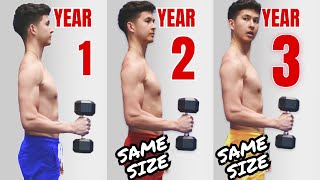
A single-speaker YouTube tutorial explaining five common reasons lifters fail to see muscle growth: insufficient effort (not training close enough to failure), inadequate intensity (weights too light), lack of progressive overload, poor exercise execution (partial ROM or momentum), and insufficient training volume. The video cites research (2017 study on reps-to-failure estimation; 2018 load study), gives practical rules (aim ~1–3 reps shy of failure; avoid loads that permit >30 reps; ~10 sets/muscle/week baseline; increase volume 20–30% if needed), and ends with a program promotion and viewer engagement prompts.
Do you lift weights every week? Twice a week? Three times more? But are your arms, chest or whatever muscle you're trying to make bigger actually staying the same size? Well, listen up because with regards to training, I'm going to show you five reasons why people who lift consistently stay the same size and if that describes you how to fix each one Reason one Effort first step ensure that you are training with sufficient effort. Research implies that it's not necessary to train to absolute failure every set, but you do need to get close enough to it. Meaning that during each of your sets you need to push hard enough such that you are at least 13 reps short of the point where you could not possibly do one more rep with proper form. But many people miss the mark on this one by either one simply not pushing hard enough during a set to reach this 13 reps short of failure zone, or or 2 overestimating how close they really are to reaching the zone, for example thinking that they just did a set with only one rep left in the tank before they reach failure, but in reality could have done five more if they really pushed themselves. A 2017 study took 141 lifters and grouped them by lifting experience. They were then asked to choose a weight that they regularly used in their training on various exercises and then predict how many reps they could do to failure. They then performed each of the exercises with their self selected load for as many reps as possible. What they found was that beginners significantly underestimated how many reps they could actually do, sometimes by even up to 8 reps, whereas more advanced lifters in the group did estimate more accurately, but still underestimated their true capabilities by about 12 reps on average. Meaning that some of you watching are likely either failing to push yourselves hard enough to reach the zone needed to maximize growth, or or think that you are. But in reality you have much more left to give than you think. It won't be comfortable and you will have to push past the point where your mind is telling you to stop, but is necessary to stimulate the growth of more muscle. Reason 2 intensity. You want to make sure that you're training with enough intensity, or in other words, using heavy enough weight. For a long time it was believed that the most muscle was built in the hypertrophy rep range of 6 to 12 reps. This concept has since been disproven many times over, and it appears that similar muscle growth can be built across a wide range of repetitions. But it does appear that there is a limit to how low of a weight and how high of reps you should go before muscle growth is compromised. For example, in a 2018 study, researchers had participants train for 12 weeks using either 20%, 40%, 60%, 60% or 80% of their maximal strength for each exercise. Despite taking all sets to failure, gains in the 20% condition were approximately half that achieved in the 40%, 60% and 80% conditions, which all had similar growth. Based on this, the authors concluded that hypertrophy is likely impaired when training with loads lighter than around 20 40% of your maximal strength for an exercise or your one rep max. So as a general rule of thumb, what this means is that if you can perform more than 30 reps with a given load, even if it is to failure, you likely need to increase the weight to drop the reps or else you will be leaving gains on the table. Reason 3 Overload Even if you're training with enough effort, and even if you're using a heavy enough weight, what was once hard enough to cause growth when you started working out will likely not be hard enough after a few weeks or months. The easiest and most straightforward way to make sure that you continue to push yourself is to periodically try and increase the weight of an exercise. For example, if you used 30 pounds last week and performed 10 reps, try to use 35 pounds this week and perform 10 reps. But this strategy works very well for new lifters. But as you become more and more trained, it is unlikely that you're going to be able to make noticeable progress on a week by week basis. For more advanced individuals, a more likely scenario is to try and increase the number of reps. For example, start by using a weight that you can perform for three sets of 10 reps. The following week, try and do another rep on the first set. The week after that, try to do another rep on the first two sets, then an extra rep on all three sets. Continue this process until you're able to perform 12 reps for all three sets and then finally increase the weight and start that process over again. These are only a few examples. There's plenty of ways to do this, but what's most important is that you do not let yourself fall into the mistake of doing the same exact thing for too long. Make sure that every week or every month you are challenging yourself and progressing by training with enough effort and then increasing the weight or reps when you start to feel it become easier. Reason 4 Execution as you continue challenging your muscles and pushing them harder than you're used to, you need to ensure that your technique remains on point, many make the mistake of trying to do too much too soon and sacrificing good technique to use more weight or add another rep. So so even if you checked off point number three, you could be artificially getting stronger and improving your sets and reps every week, but compensated by using more momentum or shortening the range of motion. This minimizes the tension and growth that your target muscle will experience and in many cases is why those of you who have been getting stronger and progressing your exercises just don't see the growth along with it. We've seen multiple times in the research that using a partial range of motion rather than a full full range of motion generally leads to less growth even if heavier weight is used. And I'm sorry to break it to you, but many of you watching will need to reduce the weight that you're used to using and focus on improving your form. Trust me, I know you'll be feeling as if you're taking a step backwards, but that couldn't be further from the truth and is necessary if you want to start actually seeing results. Now, before we dive into reason number five, what I want you to first do is run through the following checklists based on the points that we previously covered. 1. Are you taking each of your sets in your workouts to within one. Three reps of true failure? A good way to make sure that you are training with enough effort is to perform a single set to failure for a given exercise every few weeks. Doing this will help to make sure that you are actually training as close to failure as you think you are. Say that you normally do three sets of ten on the chest press every two to three weeks. Perform your first two sets as you normally would, but then take your last set to absolute failure. If you can do more than 12 to 13 reps, then that's a good indication that you're normally just not training hard enough and need to add more weight or reps. But just keep in mind that training to true failure can be dangerous and it should be implemented with caution. This practice works very well for machine and single joint exercises, but if you're going to do this for a multi joint exercise such as the bench press, then just make sure that you have a spotter and stop before your form starts to really break down. Number two Are you training with enough intensity? If you can Perform more than 30 reps when you take a set to failure, then you need to increase the weight that you're using. 3. Are you progressing your training to keep up with your gains. Remember, what was once enough to stimulate growth in your muscles eventually will be no longer enough. You will have to increase the weight and or reps at some point, some point to stimulate more growth and you need to use a systematic way of implementing this. 4. Finally, are you training with good technique and a full range of motion? Many of you will say yes to this, but in reality you're failing to check this off and you need to lighten the weight. During your next workout, take a video of yourself doing an exercise with a certain weight. Then take a video of yourself doing that exercise. Once you have overloaded it with more weight or reps, the two videos should look identical. In fact, aside from your facial expressions and the speed of the rep, your form for your warm up sets and your most difficult sets should look pretty much identical. If not, then you're likely compensating and sabotaging your gains as a result. If you have checked all of these boxes and you're still not making good progress, then and only then should you start considering number five Training volume. Now, the training volume that you're going to need to grow the fastest is is highly variable and what will be enough for one person to grow may not be enough for somebody else. Based on the current research, it appears as though at least 10 sets per muscle per week is a rough estimate of where to start. But once again this will be different for everyone. If you find yourself in a place where you need to increase volume, then a good rule of thumb is to increase whatever you are currently doing by about 20 to 30% to stimulate more growth. For example, if you are currently performing 10 sets of chest exercises per week but are failing to make good gains, then increasing this up to about 12 to 13 sets per week is probably a good place to start. But again, this is the last consideration you should be making. If you're not experiencing the gains you know you should be, then go through this checklist and odds are you'll find at least one culprit that may be the reason why. But keep in mind that it's also absolutely essential essential that you pair all of this with a solid nutrition plan to fuel and support your recovery and growth and for a step by step program that does all of this for you by showing you how to train and how to eat week after week to maximize growth and strip off excess fat. Then simply head on over to builtwithscience.com and take our analysis quiz to discover the best program for you and your specific body. Anyways, that is it for today. Guys. I really hope you enjoyed this video. Please show your support by giving the video a like leaving a comment down below as to what you'd like to see me cover next. You and if subscribing to the channel and turning on notifications for the channel as well as this all really helps me out and I really appreciate it. Thank you so much guys. I'll see you next time.










