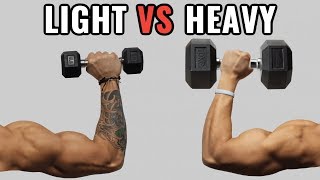
Jeremy Ethier reviews research showing light and heavy weights produce similar muscle growth when volume is equated and sets go near failure. Phillips et al. studied 18 men doing leg extensions at 30% versus 80% of max weight for 10 weeks with identical results. The practical takeaway: use heavy compounds for strength, then add high-rep accessory work to near failure.
Questions this video answers
18 male subjects; leg extensions 3×/week for 10 weeks; one group used 30% 1RM for 30–40 reps, the other used 80% 1RM for 10–12 reps.
49 men with an average of four years lifting experience using a whole-body resistance training program.
When training volume is equated and sets are taken close to failure.
Across eight relevant studies, heavy weights tend to produce greater strength gains than light weights.
Everybody want to be a bodybuilder, but don't nobody want to lift no heavy ass weight?
Conventional wisdom has us convinced that high reps and light weights builds muscle endurance and makes little contribution to gains in muscle mass. Heavier weights in the low to moderate rep range, on the other hand, has long been accepted as the best way to maximize muscle growth. In fact, many of you are probably familiar with simplified charts like these showing that moderate to heavy loads leads to greater hypertrophy and strength, whereas lighter loads leads to more muscular endurance with less contribution to hypertrophy. So based on this, it may seem that heavier loads is a way to go in terms of hypertrophy. But to determine whether this is a valid perspective or not, in this video we'll cover the research behind the use of heavy weights versus lightweights and which is more optimal in terms of muscle growth. So let's start by quickly covering the research behind it, which is pretty clear cut. A lot of the initial findings regarding this topic was done by Stuart Phillips and his colleagues. In their 2012 study. They gathered 18 male subjects to train their legs on the leg extension machine three times a week for 10 weeks, with one group using 30% of their one rep max for 30 to 40 reps and the other group using 80% of their one rep max for 10 to 12 reps. The result? As seen in this graph, quadriceps muscle growth was nearly identical in both the lightweight and heavyweight groups. But although this was a novel finding at the time, it attracted a lot of criticism, most notably because it used untrained beginners as subjects who often grow no matter what they do. So, in response, Philips and his team performed a similar study in 2016, but this time using 49 men with an average of four years lifting experience and a similar protocol as a previous study, but this time using a whole body resistance training program. But surprisingly, once again, the results showed that lo did not dictate hypertrophy, meaning that both both light weights and heavy weights elicited equal amounts of muscle growth. In addition, both protocols led to similar increases in type 1 and type 2 fiber growth, which are typically believed to be load dependent. After this study, several studies and a large meta analysis have been done on the topic with all concluding the same result. Lightweights and heavy weights lead to similar muscle growth when volume is equated for and sets are taken close to failure. So based on this, it might seem as if lifting light weights is equally as beneficial as heavy weights. However, there's a couple things to consider. 1 When looking at strength, this meta analysis of eight relevant studies comparing heavy versus light weights showed that the use of heavy weights tends to be better in terms of strength gains, which in the long run I think would lead to better hypertrophy when compared to lighter weights. And two Keep in mind that these studies involve the use of pushing to near failure regardless of the weight used, and training to failure in a higher rep range is a a lot more uncomfortable than doing so with lower reps and heavier weight due to the increased metabolic stress. In fact, some of the subjects performing the lightweight protocols even ended up throwing up after high rep sets.
It could happen. I threw up many times while I was working out, but it doesn't matter because it's all worth it.
So again, in the long run, unless you have Arnold's mindset, it's not really a viable option given that it's just generally unenjoyable to train to failure with higher reps, especially on compound movements. I know you might be a little confused now as to what to do with these findings, so let's take a look at how you can apply this to your workout in order to maximize muscle growth. Two of the main mechanisms of muscle growth are mechanical tension and metabolic stress. These two mechanisms are basically in a constant tug of war during your workout, meaning more of one generally means less of the other. When you lift heavier weights, you induce more mechanical tension when you lift lighter weights, but for more reps you you can cause more metabolic stress. This is probably why lighter weights and heavier weights leads to equivalent muscle growth when equated for volume since they each target separate mechanisms but leads to the same outcome of muscle growth. So in order to maximize muscle growth, it may be beneficial to target both mechanisms in your workout since heavy loads are more beneficial for strength gains and mechanical tension and are easier to take close to failure. Increasing strength on your heavy compound movements should be the foundation of your long term training. But in addition, as stated by her hypertrophy expert and researcher Brad Schoenfeld, it is likely that exercise centered on achieving a pump via higher rep sets with low weights and short rest also provides a potent hypertrophic stimulus that is synergistic to heavy compound lifting. Therefore, you should also consider utilizing higher reps with lower weights in your accessory movements after your heavier sets on compound movements are done, as this will enable you to take advantage of the multiple pathways involved with muscle hypertrophy. Some ways to achieve this are through the use of drop sets, reverse pyramid training, or also including a couple sets of 25 to 40 reps to near failure towards the end of your workout, but let's take a look at a more in depth example of how you could apply this to your workout. For example, let's say you're doing the following chest workout. The first two compound movements should utilize heavy weight in the moderate rep range and a focus should be placed on getting stronger with these movements. This will cover the mechanical tension mechanism of muscle growth in this workout and then to cover the metabolic stress mechanism of muscle growth in this workout, you can add a few drop sets into your last set of Flat Dumbbel Dumbbell Press and you can also utilize a higher rep range with low weight and go to near failure on the accessory movements. But keep in mind that there are several ways to incorporate both mechanisms of muscle growth. This is just an easy to follow example for you guys to apply what's going on guys? Thank you so much for watching. I hope you found the video useful and enjoyed it. I just want to let you guys know that from now on I'll be posting summaries of all my videos in the form of articles on my new website, builtwithscience.com so feel free to check it out if you want to read a little bit more about the top and the research behind it. And I'll leave a link in the description box down below for the summary to this video so you guys can check that out. Anyways, as always, if you enjoyed this video, please don't forget to give it a like leave a comment and subscribe to my channel if you haven't already. And also give me a follow on Instagram as well, where I'll be posting informative content on a more regular basis. Anyways, that's it for this video guys. Thank you so much for all your support. I'll see you next time.