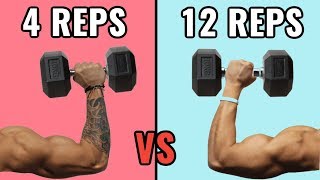
This YouTube video (Jeremy Ethier) reviews evidence on rep ranges and muscle growth, arguing that when volume is equated, training close to failure with loads ≥30% 1RM produces similar hypertrophy across rep ranges (citing a 2017 meta-analysis). Practically, Ethier recommends using the 6–12 rep range for most working sets because it allows efficient accumulation of volume without excessive joint stress or metabolic fatigue, while still including some low-rep (strength) and high-rep (metabolic/mind-muscle) work. He outlines ways to combine rep ranges across workouts and offers program/CTA at the end.
Questions this video answers
At least 30% of one rep max (1RM).
2017.
Using the right rep ranges within your workout is an extremely important factor for muscle growth, yet it's also an area of confusion for many lifters. In fact, most of us simply follow what's known as the strength endurance continuum, which is the belief that training with low reps, for example a powerlifting type routine, is the best for increasing strength, but not the best for adding size. Training with high reps, on the other hand, is best for muscular endurance, but again not the best for size. And as a result, there exists a hyperbaric hypertrophy rep range of roughly 6 to 12 reps, which is often proposed as the best rep range to maximize muscle growth. But the truth is, recent emerging research has indicated that this hypertrophy rep range is actually much bigger than most people realize. In fact, multiple papers, including this recently published 2017 meta analysis on the topic, have come up with the following given that one volume is equated for two you're training close to failure, and three you're using a weight that is at least 30% of your one rep max, then muscle growth will be similar regardless of what rep range you choose to use, and therefore disproving this concept of the hypertrophy rep range altogether. However, when you take a step back and start to think about it more practically rather than scientifically, the hypertrophy rep range actually starts to make more sense. For example, we know based on the recent work of researcher Brad Schoenfeld that there exists a dose response relationship whereby increases in volume perform close to failure leads to increased muscle growth, and this is exactly where the 612 rep range comes in handy. It's simply the most effective rep range to use in order to accumulate volume. For example, if you stuck mainly with a lower rep range, you'd be able to use heavier weights, but you would need to do more sets than you'd have to when compared to using a higher rep range in order to match volume. Now, although this is doable, aside from being harder on your joints and making your workouts take longer to complete, for many people, utilizing this approach can also cause a significant amount of physical and mental fatigue or burnout, which can negatively affect your workouts and recovery throughout the week. And on the other end of the spectrum, if you're stuck mainly with a higher rep range, for many people this would be extremely metabolically taxing and exhausting, especially during compound exercises like squats and deadlifts. And this is problematic since it would negatively affect what you're capable of doing for the remainder of your workout. Whereas in the 612 rep range, the weights are heavy enough such that you're able to provide adequate tension on your muscles without running into the problems of joint aches and pains or metabolic exhaustion after completing a few sets. Hence why in reality, it is actually the ideal rep range to use in order to build muscle, since it enables you to accumulate volume most effectively without overtaxing the body. But does this mean that you should exclusively stick to 612 reps? No, not at all, especially since there's benefits to incorporating lower reps and benefits to incorporate in higher reps. For example, we know that lower reps are more beneficial for strength gains. This 2016 paper by Schoenfeld et al. Illustrates this idea and compared the effects of sticking to a rep range of 24 reps with heavy weight versus sticking to a rep range of 1012 reps with relatively lighter weight. After eight weeks, it was clear that the lower rep range was superior for strength gains, whereas the higher rep range was superior for muscle growth since subjects were able to achieve more volume. And on the other hand, incorporating higher reps with lighter weight can both indirectly help you push through metabolic fatigue during your sets and other rep ranges, and it may in fact stimulate more growth itself from the added metabolic stress. Not to mention that certain exercises like lateral raises and cable flys simply lend themselves better to higher reps in terms of maximizing your mind to muscle connection and minimizing joint stress, therefore suggesting that incorporating both approaches would likely be optimal in the long run for strength and size. Thus, here's what I'd recommend given that you're past the beginner stage and are now more familiar with the main movements. Aim to get the majority of your working sets done in the 612 rep range and the remainder done with a mix of both lower reps with heavy weight and higher reps with light weight. And in terms of how to incorporate this into your routine, there's several ways of doing so. For example, in the following chest workout, here's how you could effectively vary the rep range within it in order to maximize growth and strength. Or if you run an upper lower or push pull leg split, for example, you can structure it such that some days are more strength based in the lower rep range with heavier weight, whereas other days are higher volume by using the moderate to high rep range with lighter weight. Another option is to use some form of periodization, for example going from blocks of training that are more strength focused in the lower rep range and then transition transitioning to higher reps and lower weight over time in order to manage your fatigue. These are just a few of many examples, but the key is to experiment with it and see what you'll be most consistent with and find what your body responds to best. Whatever it is you do though, avoid sticking exclusively to just one rep range in order to reap the benefits that they all have to offer.
Thanks so much for watching guys. I hope you enjoyed the video and found it useful.
The rep range you use within your.
Workouts is just one of many factors that you need to optimize if you want to see the best results in the gym. And if you're looking for a step by step evidence based program that does.
All of this for you so that.
You can transform your body not only as efficiently as possible, but also as safely as possible, then what you can do is simply head over to builtwithscience.com and take my Starting Point Analysis tool which will determine which of my programs and which approach is best for you. And if you haven't done so already, I'd really appreciate a follow on Instagram. I post a lot of informative videos and other content on there which I think a lot of you will find really useful. Anyways, that's it for today. Please don't forget to give the video a like. Leave a comment down below and subscribe to my channel if you haven't already. Thank you everyone so much for the constant support. I really do appreciate it and I'll see you next time.