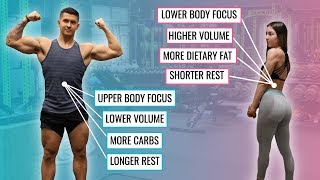
This YouTube video (Jeremy Ethier) explains how men and women differ physiologically for fat loss but argues core fat-loss principles are similar. Both sexes should prioritize regular heavy resistance training and a calorie deficit with ~1 g protein per pound bodyweight; differences include women recovering faster (allowing higher frequency/volume and shorter rest) and women possibly benefiting from relatively higher dietary fat (30–40%+ of calories) for satiety due to greater fat oxidation. The video cites several papers and ends by promoting female-specific programs and social-media engagement.
It's no secret that men and women are physiologically quite different. We start out with different levels of muscle mass, store fat differently, and have drastically different hormonal profiles. So it only makes sense that our approach when it comes to fat loss should drastically differ as well, right? Well, this is a yes and no answer. Despite our physiological differences and despite what mainstream media may promote, the optimal approach to losing fat will actually be quite similar regardless of gender. But with that being said, for the best results, there are also key differences that should be implemented in each respective routine. And in this video I'll discuss exactly what those gender differences are and how to implement them in your training and nutrition. Let's start with training. For the most part, the basic concepts of training for fat loss will be the same for both men and women. Both need to put less emphasis on cardio and instead prioritize weightlifting on a regular basis and progressively getting stronger in the gym. This will not only aid in the fat loss process, but will also prevent you from simply ending up skinny fat rather than well defined or toned with adequate muscle mass after all your weight loss and hard work. So focus on the weights and simply use cardio to speed up the process as needed. Now, as for the differences between how men and women should train before diving into physiological differences, we need to first take into account gender specific goals and how they differ. For instance, most men typically want a big chest, broad shoulders, a wide back and big arms, and therefore their training should reflect this by emphasizing movements that target these areas. Whereas the vast majority of women just don't really place growing their chest muscles, for example, as a priority, and instead simply want more muscle definition while often placing a priority on growing their glutes. Therefore, in this case, women with these goals in mind should prioritize and add more volume to movements that target these areas and compensate by slightly reducing their upper body volume, for example. But training goals aside, there are also various physiological differences that should be considered as well. Let's start with the differences in training volume and frequency. Multiple papers have indicated that women actually seem to recover faster after their workouts than men do. For instance, a 2010 paper from the International Journal of Sports Physiology and Performance found that after one set of bench press to failure, trained men needed 48 hours to recover and re establish their baseline strength, whereas trained women only needed four hours to do so, which is thought to be due to females having a better nutrient delivery to their muscles. So as a result, they don't experience as much muscle damage from a workout as men do and can thus recover faster between sessions, which implies that females may be capable of doing slightly higher volume workouts compared to men, and are also able to work out each muscle more frequently throughout the week without experiencing symptoms of overtraining, which can be especially useful if there's certain muscle groups they'd like to bring up or prioritize by dedicating more weekly sets than usual to them for similar reasons. As previously discussed, women also seem to recover faster after a set than men do. For instance, a paper by Fulko et al. Found that when the adductors were worked to physical exhaustion during a set, the female subjects were able to recover significantly faster for the next set than men could, especially during the first minute of rest. And other papers do agree with this finding as well, implying that women may be able to get away with shorter rest periods between sets than men. So practically speaking, since we know that the optimal rest time for men seems to be around two to three minutes or even slightly more between sets, depending depending on the exercise and intensity, women may want to experiment with slightly shorter rest periods than this in order to best take advantage of their faster recovery and greater ability to handle metabolic stress. But obviously experiment with it and ensure that this isn't impairing your overall strength as a result. Now moving onto nutrition and optimizing your diet for fat loss, there's actually not too much difference between genders. The key in both cases will obviously be ensuring that you're eating at a calorie deficit with adequate protein of around 1 gram per pound of body weight, as these will be the most important factors determining the success of your fat loss efforts. However, what's really interesting is that women may do better dieting with slightly higher fat intakes than men. As for the reasoning behind this, research on female exercise metabolism has shown that women burn more fat and less carbohydrates and protein compared to men men at any given exercise intensity, meaning that their bodies don't depend on carbs as much as men do to replenish their muscle glycogen for fuel during their workouts. And as a result, the lesser need for carbohydrates frees up more calories to be consumed as fat, which can be particularly beneficial for women when dieting since it seems to help with their satiety. For instance, a 2016 paper from the journal Nutrition compared the effects of a high fat meal versus a low fat meal on appetite in men versus women. They found that the high fat meal was 15% more satiating for women, but this effect was not found for men, meaning that for women eating at a deficit a relatively higher fat diet. For example, having 30 to 40% or more of your daily calories coming from fat may help better manage hunger without negatively affecting gym performance given their greater ability to use fat for energy. But in my opinion, the benefits of higher fats versus higher carbs when dieting is very individual. So I encourage you to experiment with it to find what works best for you. So I hope you're able to see that although the main principles of training and dieting are actually quite similar for both men and women, there are minor differences that should definitely be considered and implemented appropriately. All in all though, what's going to enable you to lose fat most effectively while retaining your muscle and process is a combination of heavy weightlifting on a regular basis and a calorie deficit. And this is true regardless of gender.
So to sum the video up, here are the main gender differences and how they can be applied in your training and diet. Although these little differences may not seem like much, they really are what's going to enable you to transform your body as efficiently as possible. This is exactly why I've actually created and recently launched my two new female programs which are optimized specifically for female and it's something that I'm honestly just super excited about. These programs, just like my existing male programs, are designed to transform your body from your starting point to a lean, toned physique in the fastest, most effective way possible. And to join the program, simply head on over to built with science.com and take the body type analysis quiz I have up which will determine what program is best for you. Anyways, I'd also really appreciate if you gave me a follow on Instagram as well. I post a lot more informative content on a regular basis and videos that I think a lot of you will find really useful. As always, if you enjoyed this video then please don't forget to give it a like Leave a comment down below and subscribe and turn on notifications to my channel as well as this all truly does help me out. Thank you so much for all the overwhelming support. I really do appreciate it and I'll see you next time.