More Gains, Half the Time (LIFT LIKE THIS!)
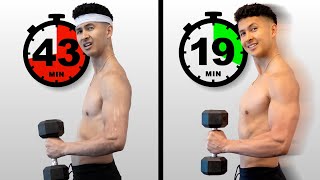
YouTube tutorial ("More Gains, Half the Time (LIFT LIKE THIS!)", May 30, 2021) explaining four time-efficient resistance-training methods—3:7 method, rest-pause sets, drop sets, and supersets. The video cites multiple studies (2017, 2018, 2019) and gives concrete protocols and examples for each method, showing large reductions in workout duration (example baseline 43 minutes reduced to ~24, 19, 19, and 25 minutes respectively) while maintaining or in some cases improving hypertrophy and strength outcomes. The presenter closes with a promotion for a related training program at builtwithscience.com.
If you're in a crazy rush, have no time, or just want to be really efficient, then can you work out ridiculously fast and build the same amount of muscle as someone who's taking their time? Lifting, then resting, then lifting. And can you build more muscle rushing through your workout than someone who's training normally? Lifting, then resting, then lifting? Yes. The answer to both is you most definitely can. In this video, I'm going to show you how with four unique training methods, you can get the same gains that you're getting right now in literally almost half the time that you're spending now. And on an even more interesting note, I'm also going to show you how with three of the four methods rushing through your workout doesn't have the potential to just produce the same amount of muscle, but Even more Method 1. The 3:7 method, popularized by a recent 2019 paper. Researchers had subjects perform bicep curve for 12 weeks using either the traditional method of eight sets of six reps with two and a half minutes of rest between each set, or a new set configuration called the 3:7 method. For the 3,7 method, participants use the same weight, but instead perform 3 reps, rested 15 seconds, perform 4 reps, rested for 15 seconds, perform 5 reps, rested 15 seconds, perform 6 reps, rested 15 seconds, and then finally performed 7 reps to finish off their set. They then rested for two and a half minutes and repeated all of this one more time. What they found is that the 3, 7 method resulted in significantly greater gains in both muscle size and strength when compared to the traditional group with the 37 method, resulting in nearly double the improvements. In addition, the 37 method finished all of their training sessions and in less than half the time as the traditional group. Now, although this was just one study, and there's a lot of variables to consider, it does showcase the potential effectiveness of this method when it comes to cutting down your workout time while potentially even getting better results. So how exactly can you implement this? Well, if we go off this study, one round of the 3:7 method seems to be the equivalent to four sets of traditional training. So, for example, if you normally do four sets or less in an exercise, then you can substitute that for one round of the 3:7 method. Let's say with a bench press that you typically do three sets of 135 pounds for 10 reps. With the 3:7 method, using that same weight, you would perform three reps, rest 15 seconds, perform four reps, rest 15 seconds, perform five reps, rest 15 seconds, perform six reps, rest 15 seconds and then finally perform seven reps. The first few sets should be very easy, but by the time you get to the sets of 6, 6 and 7 reps, it should be very difficult and you should hit failure or very close to it by the end of it. As for time savings, let's look at the following workout as an example. Excluding a proper warm up. If you're totally focused, perform each rep with a controlled 2 second eccentric and 1 second concentric and take exactly 2 minutes of rest between each set and the exercise. You could expect this workout to take just under 45 minutes to complete, but but with one round of the 37 method applied to each of these exercises instead, while still performing the same exercises, you could take a workout that originally took 43 minutes and reduce it down to just under 24 minutes. Method 2 Rest Pause Sets with this method, rather than performing traditional sets with a standard rest period in between each set, you instead set a goal number of reps that you want to achieve and basically perform a bunch of mini sets with minimal rest periods in between until you reach the goal number of reps. For example, let's say that your goal was to perform three sets of 10 reps for bicep curls, which would amount to a total of 30 reps by the end of it. What you could do instead is set a goal of 30 reps in total, ideally using the same weight, do as many reps as you can on the first set, then instead of resting for 12 minutes in between, rest for just 203 seconds and then go again trying to do as many rests as possible. Your reps will likely drop off significantly in that next set, which. But that's okay. You simply repeat this process until all 30 reps are completed in total. This might look something like sets of 15 reps, 8 reps, 4 reps, and then finally 3 reps to reach 30 reps in total. As for the theory behind it, we know that the last few reps of a set where you're really close to failure are the most important for growth because of the most stimulating. So by using a rest pause approach, you are able to repeatedly stress your muscle with these stimulating rests because they're not fully rested. As for its effectiveness, in the 2019 study, researchers had a group of resistance trained subjects train four days per week for six weeks using either a traditional approach performing all exercises for three sets of six reps, or a rest pause approach performing multiple sets with 20 seconds of rest in between until 18 total rests were completed. What they found is that Both training methods elicited similar improvements in strength and muscle growth of the upper body, and the rest pause group actually had greater improvements in lower body hypertrophy than the traditional training group, which suggests that you should be able to at least maintain your gains with this approach and perhaps even augment it. So how much time can you expect this to save you? Well, if we look back at our example workout, while still performing the same exercises for the same number of reps, you could take a workout that originally took 43 minutes to complete. Apply rest pause sets to every exercise and reduce it down to just 19 minutes. Method 3 drop sets so let's say that you typically do three sets of biceps curls with 40 pounds in each hand and two minutes of rest in between sets. With drop sets, you'd perform the first set the exact same way as you normally would and with the same weight. But after completing that set instead of resting, you immediately decrease the weight by 10 to 20% and perform another set very close or all the way to failure. After that set, you decrease the weight again by 10 to 20% and do this once again. You repeat this process for a minimum of the number of sets that you would normally do, so in this case at least three. Illustrating this effectiveness is a 2017 paper where over the course of eight weeks, researchers had participants perform bicep curls using either three sets to failure with 90 seconds of rest between sets, or using five sets with the drop set method by dropping the starting weight by about 10 10% each set with no rest between sets. What they found is that both training methods elicited similar gains in hypertrophy and strength, with no differences between groups. However, the group using drop sets finished each training session in less than a third of the time as a traditional training group. A 2018 study employed a similar protocol by using the tricep pushdown instead, and again found that both groups gained the same amount of muscle and strength and but again, the group using drop sets finished each session in less than half the time as a traditional training group. As for how exactly to apply this to your workouts at a minimum, you want to ensure that you use the same number of drop sets as total sets in your normal workouts. So for example, if you normally do three sets for an exercise, then you want to do at least three drop sets. So looking back at our example workout, let's say that you normally do three sets of ten on a barbell curl using £20 on each side. What you could do instead is perform your first set to failure using that same weight, but then reduce the weight again by another 20% by stripping off five pounds from each side and immediately perform another set to failure. Then reduce the weight one more time by another five pounds each side and then perform your final set to failure. As for how much time this can save you, if we look back at our example workout while still performing the same exercises, you could take a workout that originally took 43 minutes and reduce it down to just 19 minutes. Last but not least method 4 supersets a superset is where you perform two different exercises immediately back to back, take a short rest and then repeat. By doing this, you are essentially removing half of your typical rest times from your workouts. However, many people are not doing supersets correctly and ultimately they're hurting their workouts by using the wrong exercises for their supersets. This is because numerous studies have now found that supersets that train the same muscle tend to be less than ideal for optimizing gains. For example, a 2019 paper had participants perform five sets of bench press and five sets of incline bench press as a superset and compared that with the traditional method of just using standard rest periods between sets and finishing one exercise before moving on to the next. What research has found is that when subjects use the superset method, they not only perform 15% less reps when compared to the traditional training method, but also experienced a significant reduction in muscle activation, which both of which would likely lead to not as much growth over time. So what should you do instead? Well, research is pretty clear that supersets training opposing muscle groups such as your chest and your back is the way to go. Illustrating this is a study published in 2017 where researchers had participants perform a super set of three sets of bench press and three sets of seated rows and compare this to their performance using a traditional training approach. What they found is that in addition to the traditional training approach taking about twice as long to complete, performing the exercises as a superset led to an increase in muscle activation of the chest and back muscles and on average a 13% boost in their workout performance. Another paper showed similar results and found that performing a superset of leg curls immediately followed by leg extensions significantly increased quad muscle activation and the amount of reps that could be performed when compared to just doing the leg stack extensions alone. As for the reasoning behind this, there may be a benefit in activating the opposing muscles of a muscle group prior to training it. And although counterintuitive supersets training opposing muscle groups actually allow the working muscle to rest even longer when compared to traditional sets. As for time savings, if you apply supersets to the example work I shown earlier by using opposing muscle groups and movement patterns like so, then while still performing the same exercises for the same amount of sets and reps, you can take a workout that originally lasted 43 minutes and cut it down to just over half at 25 minutes, while potentially boosting your performance in the process. So play around with these four methods in your routine and see how you like them, but hopefully you were able to see that if you're in a rush or you just want to maximize your efficiency, then you have plenty of options to do so. At the same time though, just keep in mind that in order for these methods and your overall training to be effective, you need to pay attention to the little details as that's what makes all the difference. And for a step by step program that shows you exactly how to train week after week to maximize your gains, build lean muscle and strip off stubborn fat in the most efficient way possible, then simply head on over to builtwithscience.com and take our analysis quiz to find out which of our solutions is best for you and your specific body. Anyways, that is it for today guys. I really hope you enjoyed this video. Please don't forget to show your support by giving the video a like leaving a comment down below as to what you like to see me cover next, subscribing to the channel and turning on notifications for the channel as well as this all really does help me out and it's much appreciated. Thanks so much guys and I'll see you next time.










