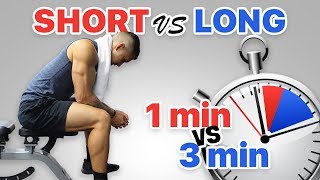
Jeremy Ethier breaks down how rest periods affect muscle growth: short rests create metabolic stress but limit how much weight you can lift, while longer rests let you do more total volume. Research shows 3+ minutes between heavy compound lifts and 2+ minutes for isolation work produces better hypertrophy and strength gains.
As mentioned in many of my other videos, when it comes to optimizing your training program, there's a lot of variables that need to be considered. How much time you rest between sets is one of the more important variables, yet is often something that's overlooked. On one end of the spectrum are those who keep their rest periods as short as possible in order to sweat more, achieve a better pump, and experience more general satisfaction after their workout. And on the other end, you have those who take their time with all of their sets and seem to barely break a sweat. But but which one is better for muscle growth? Well, let's start by taking a look at the pros and cons of each approach. The main reason why shorter rest periods of a minute or less are believed by some to be superior is due to the increased metabolic stress or the burn in sensation that your muscles experience. And since metabolic stress was shown in Brad Schoenfeld's 2010 meta analysis to be one of the main drivers of muscle growth, it makes sense that it would be the better option over longer rest periods. But with that being said, short rest periods come with a price. With a short rest period, you're not going to be able to lift as heavy of a weight or perform as many reps as you would be able to after a longer rest period. This means that with longer rest periods you're able to achieve more total volume in your workout since you're better rested for each of your sets and able to lift heavier or perform more reps during those sets. So as you can see, it's essentially a competition between more total volume with longer rest periods versus more metabolic stress with shorter rest periods. But which one wins? Well, luckily for us, researcher Brad Schoenfeld has recently published a study on that exact topic. In this study, they took 21 young resistance trained men and assigned them to either a group that performed their resistance training program with 1 minute rest intervals or with 3 minute rest intervals with all of the exercises being performed within the 8 to 12 rep range. The result? After eight weeks, the long rest period group saw better muscle growth and strength gains than the short period group and was likely because the long rest period group was able to achieve slightly more volume during their workout since they were better rested for each set. Therefore, proving that total workout volume is a more important driver for muscle growth than metabolic stress, which is a finding that was then replicated in multiple other studies that looked at rest periods. Now, with that being said, theoretically you could just perform more sets with shorter rest periods to achieve the same amount of volume. However, this is generally unenjoyable, likely takes even longer, and as previously noted, will negatively impact your strength gains. So for these reasons, longer rest periods are likely the better option. But exactly how long should you rest for? Well, this does depend on several factors, but mainly the type of exercise that you're performing. For example, one 2016 study from the Journal of Strength and Conditioning Research examined the effect of varied rest periods on different exercises. The researchers found that at least two minutes of rest was sufficient for single joint exercises, whereas subjects responded best to at least three minutes of rest for heavy compound movements, which is in agreement with Brad Schoenfeld's study mentioned earlier. So for your main compound movements like the bench press, overhead press, squat and deadlift, it would likely be best to stick to at least three minutes of rest between sets. And when using very heavy weight for lower reps, increasing your rest period to even more than three minutes might be ideal. Whereas for your isolation movements, sticking to roughly two minutes of rest between sets or slightly shorter seems to be the best option. I should also note that so far no study has found any downsides associated with longer rest periods besides the fact that your workout will take longer to complete, meaning that if there's a day where you feel fatigued and need a little bit more rest than usual, you can do so without being concerned about it negatively impacting your growth. But does this mean that shorter rest periods of a minute or less don't have any place in your routine? Well, right now it's relatively unclear, but in my opinion they should mainly be incorporated for exercises that are relatively easy to recover from and reserved for later on in your workout. This will just help induce more metabolic stress, which might be beneficial. And as always, experimentation and trying things out to see what works best for you is key. But for example, this is how you could properly implement rest periods in the following chest and triceps workout. As you can see, longer rest periods are used for the main compound movements, especially when a lower rep range is used as in the bench press, whereas the isolation movements have shorter yet still adequate rest periods. And the very last exercise utilizes very short rest periods for added metabolic stress. Hopefully this example provides you with some insight as to how to incorporate rest periods into your own routine. Just keep in mind that although longer rest periods will provide less of a pump and less of a burn in your muscles and make you sweat less than shorter rest periods will, this should not be your basis as to whether the workout was effective or not. Muscle growth is very difficult to observe, but we do know that the most effective way to achieve it is by progressively overloading our muscles over time, which, as I discussed, is best done with adequate rest periods.
Thanks so much for watching guys. I hope you enjoyed the video and found it useful. I also just wanted to add that I'd highly recommend that you time your rest in between your sets, and it's very easy to do, yet it ensures that you're taking enough rest in between your sets and it holds you accountable to start your next set. Anyways, as always, you can find the written summary of this video on my website builtwithscience.com and I'll also leave a link to it in the description box down below. I'd also really appreciate it, especially those who are new to my channel, to give me a follow on Instagram and Facebook as well, or try to post informative content on a more regular basis. It would really help me out and I'd really appreciate it. Anyways, that's it for this video guys. Thank you so much for watching and if you enjoyed it, please don't forget to give it a like. Leave a comment down below and subscribe to my channel and turn on notifications for my channel as well as this all really helps me out. Thank you so much guys. I'll see you next time.