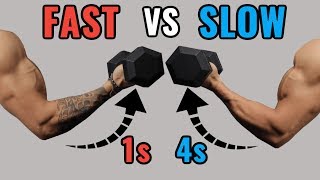
Jeremy Ethier breaks down whether slow or fast reps build more muscle. A 2016 meta-analysis found 2 to 6 seconds per rep works best, with faster tempos allowing heavier loads and better fiber recruitment. The key is a quick concentric phase with a controlled lowering, not extreme slowness.
When it comes to training for muscle growth, there's a lot of program variables that need to be considered. But one often overlooked variable is lifting tempo, or how fast you perform each repetition. You've probably noticed that some people in the gym tend to perform their reps as fast as possible, whereas others take a more slow and controlled approach. But which method is better in terms of muscle growth? Well, to answer this, let's first take a more in depth look at each approach. The main benefit of lifting with a slower lifting tempo is that you achieve a greater time under tension, simply meaning that your muscle is under strain for a longer period of time throughout the set. And since a greater time under tension is generally associated with an enhanced metabolic response, this theoretically leads to greater muscle growth in the long run. On the other hand, the main benefit of lifting reps with a faster tempo is that you can perform more reps or use a heavier weight than you can with a slower tempo. And although time under tension is reduced when using a faster lifting tempo, this actually doesn't seem to hinder muscle growth. One 2012 study from the Journal of Applied Physiology compared a very slow lifting tempo with a faster lifting tempo on various lower body exercises. And despite having an almost five fold greater time under tension for the slow group, they only experienced an 11% increase in muscle size compared to a 39% increase in the faster tempo group. Now, although this is an extreme example given the unrealistically slow tempo that was used, it helps illustrate that time under tension isn't the most important factor regarding muscle growth. In addition, the ability to lift heavier loads by using a faster tempo enables a greater overall recruitment of muscle fibers, which equates to greater activation of the target muscle. In fact, one study from the Journal of Strength and Conditioning research showed that when a slow lifting tempo is used, activation of the chest was reduced by up to 36% during the bench press when compared to lifting with a faster lifting tempo. And this was seen despite both protocols being taken to failure, indicating that very slow lifting fails to sufficiently stimulate or activate the higher threshold type 2 muscle fibers, which results in less overall muscle activation and presumably less growth of the target muscle. So, based on this, it's clear that using faster tempos may be more beneficial in terms of muscle growth. But exactly how fast should you be aiming for? Well, a recent 2016 meta analysis by Schoenfeld and colleagues is able to provide us with some insight. The researchers found that based on all of the studies currently published on lifting tempo, which to be honest is quite limited, a lifting tempo between 2 to 6 seconds per rep seems to maximize muscle growth, with tempos closer to 2 seconds being slightly more favorable than 6 seconds. Anything slower than this seems to be suboptimal in terms of muscle growth. But with that being said, I'd advise you not to obsess over the exact numbers regarding your lifting tempo and instead use the following advice. We know that based on experience, anecdotal evidence and scientific research that a solid mind to muscle connection plays a very important role in muscle growth. And we also know that controlling the eccentric portion of the rep seems to lead to greater muscle and strength gains while decreasing the risk of injury when compared to simply letting gravity do the work for you. Therefore, I think the best way to approach lifting tempo would be to one use a concentric speed that's on the faster side, but still enables you to feel your muscle working throughout the movement and ideally minimizes the momentum used. Whether this is one second or two seconds, for example, will completely depend on what feels best for you. And two perform the eccentric portion of your reps so that you're actively controlling the weight against gravity as opposed to simply dropping the weight. Utilizing these two tips will help you get the most out of your lifting tempo while keeping things simple and easy to implement. Now, with that being said, I just want to also mention a couple limitations regarding this topic. First off, lifting tempo becomes less applicable when you're using heavy weight. For example, if you're lifting close to your one rep max becomes a lot harder to intentionally slow down or speed up your reps. So it's when you're using relatively lighter loads where you have a lot more control over your lifting tempo. And secondly, this video was mainly geared towards muscle growth as opposed to strength gains. The ideal lifting tempo for a powerlifter, for example, will differ as they typically benefit from trying to move the bar as fast as possible and are usually less concerned with a solid mind to muscle connection during their lift. But if your main goal is muscle growth, then utilizing the tips mentioned in this video will likely be your best bet. And finally, it should also be noted that combining different lifting tempos or using specific lifting tempos for specific exercises might even be the best option, but it's impossible to say at the moment since no study to date has investigated it. So I'd advise experimenting yourself and seeing how your body responds.
That's pretty much it for the video guys. I hope you enjoyed it and found it useful. There's definitely a lot more research that needs to be done regarding this topic. Topic but I think there's enough for a general conclusion to be made. And as always, for those who are interested, you can check out the written summary of this topic on my website, builtwithscience.com and I'll also leave a link to the article in the description box down below. I'd also really appreciate it if you guys gave me a follow on Instagram as well, where I post a lot of the studies that I come across and also various other tips that don't always make it into my videos. And lastly, please don't forget to give the video a like leave a comment down below and also subscribe to my channel if you haven't already. Thanks so much for all your support guys. I really do appreciate it and I'll see you next time.