STOP Doing Bicep Curls Like This (5 Mistakes Slowing Your Gains)
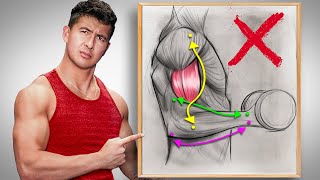
Five bicep curl mistakes that kill your gains: swinging the weight, not fully extending at the bottom, letting your wrist bend, letting your elbows drift forward, and ignoring the stretch. Fix these and you'll actually grow muscle.
Biceps training is not complicated. Although there are tons of different exercises, they pretty much all boil down to one movement. Curls hold the weight, flex the arm. Simple, right? Not really. There's five common mistakes almost everyone makes. Fix these, and your curls will instantly become far more effective at growing your biceps. Mistake number one. You might have already noticed that as you curl a weight up, it gets harder and harder and becomes the most difficult midway. When your elbow is at 90 degrees after this point, it actually gets easier and your body can sense this. And it finds ways for you to cheat through this difficult bottom half of the movement without you even realizing. One way it does that is by initiating each rep with a slight swing. I'm sure we've all seen guys in the gym who take this to the extreme, but even just a slight swing at this bottom position can make the exercise much easier and enable you to use heavier weights. The problem with that, however, is although you're able to use heavier weight and it doesn't result in more tension to your biceps, that additional load goes straight to your lower back, which is now helping you get the weight up by using momentum. In fact, next time you're in the gym, try doing a standard set of curls with your regular form, then stand with your back against the wall to prevent your body from swinging at all. If you had to drop the weight considerably, then it means that you've likely been incorporating too much momentum into your regular curls. Or, although I wouldn't recommend doing all your curls against the wall, you'll see far better biceps growth and reduce your risk of injury if you simply lighten the weight and minimize the amount of swing you use, especially towards the end of your set, when the reps start to get really tough. For the next mistake, I want you to take a look at two really interesting studies. One study, published just last year, had subjects perform the preacher curl, but under two different conditions. One group performed only the bottom half of the curl, and the other group performed only the top top half of the curl. Using a weight that matched their strength level in each position, the biceps of each subject were measured at three points. After five weeks, here's what happened. The group that performed only the bottom half experienced roughly 2.6 times more biceps growth when average across the measurement sites. However, what's interesting is that most of this growth occurred at the third measurement site, located towards the bottom of the biceps. Now, what makes this really interesting is that another study, also published just last year, replicated an almost identical design, not on the biceps, but this time on the leg. Muscles. They had subjects perform the bottom versus the top half of leg extensions and one more group who did the full range of motion. They measured the growth of the quad muscles at four different sites. After 12 weeks, here's what they found for the measurement site closest to the top of the quads. Growth was similar across the groups. However, as you got further and further down the quads, growth became significantly greater for the group who only performed the bottom half of the leg extension, even greater than the group who performed full range of motion. Groups so what does this all mean? Well, I wouldn't recommend doing only partial reps from now on, but it does seem that the bottom part of an exercise when the muscle is fully stretched provides a powerful stimulus for growth, especially in the distal regions of a muscle like the bottom part of your biceps. The so whenever you do your curls, avoid cutting the range of motion short at the bottom position. Instead, extend your arm fully by flexing your triceps at that bottom position before you go into your next rep to ensure your biceps get fully stretched. I remember for the longest time whenever I would do curls, I'd end up feeling it way more in my forearms than in my biceps. In some cases, I'd even have to stop my sets not because my biceps failed, but but because my forearms just couldn't handle holding the weight any longer. The reason for this had to do with my wrist position. The function of the inside forearm muscles is to flex the wrist. Many people when they curl, they subconsciously flex their wrist when trying to get the weight up. This can lead to the forearms working harder than they have to be and eventually lead to fatigue and cramping Instead. Next time you do a curl, first bend your wrist back so that it's aligned with your forearm and and then keep it that way as you curl. When done properly, you'll notice your forearms are now far less involved and your biceps are activating a lot more than they used to. Next, let's talk about the elbows. The primary function of the biceps is to flex the elbow. But whenever you curl with a weight that's too heavy for your biceps to lift, your front delts will start to help out by swinging your elbow forward. Now, some argue that this elbow forward movement, called shoulder flexion, is actually beneficial to do when you curl because it's one of the functions of the biceps. This is true, but it's only a secondary function of the biceps. The front delts are far better at performing this movement. And in fact, biomechanics expert coach Kassem tested this and found that allowing the elbows to excessively sway forward during the curl led to less biceps activation and more front delts activation, the opposite of what you'd want. So instead, keep your elbow locked and focus on the primary function of the biceps, flexing the arm. A little bit of elbow movement is perfectly fine and hard to avoid, but anything more than what's shown here will likely lead to more of your front delts taken over instead of your biceps. So if you take a look at my form now, you'll notice I've corrected all the mistakes I previously went through. But there's something else not visible to the eye that could potentially slow your gains. To explain this, let's refer to a 2018 paper that some of you keeners might remember from some of my past videos. Within it, researchers had one group of subjects perform the biceps curl while really focusing on squeezing the biceps and feeling the muscle work. The other group was instructed to simply lift the weight. After eight weeks of this, the group that focused on feeling their biceps working experienced almost double the biceps gains. Now, although proper form will help you maximally activate your biceps, already some of you, even with proper form, may have a hard time actually feeling your biceps. If that's the case, then try this out with your arms by your side. Flex your biceps as hard as you can. Then bring your arm up in front of your face and again flex hard. You should feel a very strong biceps contraction when your arm is in that position, almost to the point where your biceps are cramping. You don't want to do curls in that position, but you can do this to actually feel what a strong biceps contraction is like. And then when you go into your curls, you can. Here's some additional tips. First, rather than thinking about simply lifting the weight up, think about pulling the bar or dumbbell into your body. And as you curl the weight up, focus on driving your pinkies up towards the ceiling as if you were trying to rotate your hands outwards. This emphasizes another function of the biceps supination, which can help you get an even stronger contraction to get the most out of every single rep. If you want to speed up your results, then it's important that you're aware of all the little details when it comes to your exercise. Not just for your biceps, but for all of your muscles. For a step by step science based program that takes care of all the guesswork for you, just head over to builtwithscience.com and take my analysis quiz. To find the best program for you and your body. It's worked for countless others, and it will work for you. I'd also highly suggest that you give this video a watch next for some tips to speed up your biceps growth. Or you can give this video a watch next to help fix your dumbbell press form. Don't forget to subscribe and I'll see you next time.










