STOP Doing Chest Flys Like This (5 Mistakes Slowing Your Chest Gains)
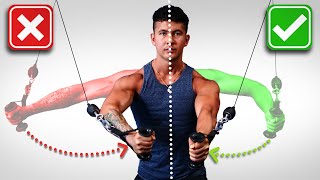
Five mistakes people make on chest flys that kill gains. Keep your elbows bent at 90 degrees, not locked straight. Cable and machine flys beat dumbbells because they keep tension at the end of the movement.
Chest flies are one of the most effective exercises for building your chest. But if you don't do them correctly, they'll end up working other muscles like your shoulders instead of your chest. There's five common mistakes almost everyone makes. They're easy to fix, but will make a massive difference in your chest growth. Now, there's generally three different types of chest flies you can do. Dumbbell flies, cable flies, and machine flies like the pectoral. As you'll learn later on in this video, some of these options might be better than others. But for now, as we go through the mistakes and fixes, I'll make sure to show you how they apply to each one of these variations. The first mistake actually has to do with your biceps. I'll first use the dumbbell fly to illustrate this. At the bottom position, the straighter your arm is, the more tension will be applied to your chest. In fact, if we apply simple physics, if you move your hand about 50% further out from your elbow, you it will result in roughly 50% more load on the chest. This is what makes the fly such an effective movement. You can highly stimulate your chest with less weight. However, the straighter your arms go, the more your biceps also get involved. Eventually, there comes a point where your biceps are starting to work harder than your chest is and will become the limiting factor in the movement. Instead of your chest, the same is true with a cable fly or a pec deck. So instead, at the bottom position, you want to keep a slight bend in your elbows such that your hands are just slightly outside your elbows. However, once you get to the top position, the opposite is now true. The main function of the chest is horizontal adduction, the act of bringing your upper arms together. So if you kept your arms bent, your upper arms wouldn't be brought together as far as they could be, and you'll be engaging less of the chest muscles and encouraging more of your shoulder muscles to take over. Instead, straighten your arms and think about squeezing your elbows together as you approach the end position. Here's how the proper form would look on all three fly variations. Simply focus on bent arms at the start position and straight arms at the end position. The next mistake has to do with something called the line of force. Let's first explain this with a cable fly. During this exercise, the direction of the cable will determine where on your body the force is being placed. For example, here the cable angle is set a little bit higher than the height of my head. Now, at the end position, I want you to look and notice at the direction of the cable compared to my arms, they're not aligned. As a result, the cable is pulling my arm up and my arm has to fight to pull the cable down as I perform the fly. This takes some of the tension away from the chest and puts it onto other muscles like the lats instead. On the other hand, here the cable height is set lower at the end position. The the cable is now pulling my arm down. In this case, my arm has to fight to pull the cable up as it performed the fly and take some of the tension away from the chest and puts it onto the front delts. So instead, to maximize chest activation, the direction of the cable needs to be aligned with the direction of your arms. You can play around with the cable height in your arm position until you get this right. Later in this video, I'm going to show you how a higher or lower cable setup would work, and when you do that. But for now, just try this out and you'll feel the difference right away. Now, the same applies for the pec deck or even the dumbbell fly as well. In this case, however, since you can't adjust the line of force that you can with cables, you'll simply want to keep your elbows up such that your hands and your shoulders are always at the same height rather than letting your elbows drop down. The next mistake is probably the most common mistake I see. Given that many of us are stuck in a hunched over posture, your shoulders will have a natural tendency to want to take over during your chest exercises. This can lead to the front of your shoulders experiencing most of the growth rather than the chest. Here I'm letting the shoulders take over and you can see how my shoulders round forward every time I reach the end of the movement. Instead, to ensure the tension is being placed on the chest, first bring your shoulders down and away from your ears and then stick your chest up and out. From here, simply focus on squeezing your biceps into the sides of your chest. And as you do this, your chest should remain up and out rather than letting your shoulders come forward and take over. And you may have to lighten the weight. But trust me, make this one fix alone on whatever fly variation you're doing, and it's going to make a world of difference in your chest development. The next mistake has to do with how you're setting up your fly. During a regular dumbbell cable or pec deck fly, the main area targeted is the mid chest. But if you're already doing a lot of flat bench press and flat dumbbell press, which already target the mid Chest, I'd highly recommend adjusting the setup of your fly flies to work more of your upper and lower chest to help round out and provide a more balanced look to your chest. Now, the pec deck unfortunately can't be adjusted much because of the fixed bench. But for a cable fly to target the lower chest, you'd want to bring the pulleys up higher and perform a high to low fly. Just make sure that your forearms still move and stay in line with the direction of the cables, like we talked about earlier. And then to target the upper chest, you'd want to use a bench setup at a slight, slight incline, like so. And the same can be done with dumbbells by using a slight incline to emphasize the upper chest a little bit more, and a slight decline by putting a plate under one end of the bench to emphasize the lower chest a little bit more. Now, the last mistake has to do with the type of chest fly you choose to do. A common choice is a dumbbell flat. Although with the fixes we already went through, your dumbbell flies will be made far more effective. They still have their limitations. Their main limitation is they're only really hard and challenge your chest at the bottom position. As you get towards the top, the tension placed in the chest reduces and becomes non existent as soon as your hands come in between your shoulders. This is why in studies that have compared the dumbbell fly to other chest exercises like the bench press, it doesn't seem to activate the chest very well. Now, this isn't necessarily a bad thing. In fact, exercises that challenge your muscles most when they're fully stretched, like at the bottom of a dumbbell fly, so seem to be the most effective exercises for muscle growth. So they're definitely still a good option, especially if you only have access to dumbbells. However, most of you are likely already doing either a dumbbell press, bench press or machine chest press before you get to your chest flies. These exercises already challenge your chest the most in the fully stretched position. So doing a dumbbell fly afterwards can be redundant. Pretty much like doing the same exercise again, but just with lighter weight instead. To potentially maximize growth, your workout should challenge your chest throughout the whole range of motion, especially in that end position when your arms are brought in together. How can you do this? Simple, with a properly executed cable fly or machine pec deck. With cables having a slight advantage because you can easily adjust them to target the different areas of the chest like we went through. Make these five changes and you'll instantly feel and see the difference. Even if you're using lighter weight than you usually do. But guys, it's important that you take the same detailed, science based approach to all of your exercises. By doing so, you'll maximize every single rep you do and will get results faster and easier. For a step by step plan that puts this all together for you and has helped thousands of others just like you lose fat and build lean muscle. Just head on over to buildwithscience.com and take our analysis quiz to discover which of my programs are best for you and your specific body. I'd also highly recommend giving this video watched next to fix your dumbbell press or give this video watch next for some tips on how to speed up your chest gains. Thanks for watching. Don't forget to subscribe and I'll see you next time.










