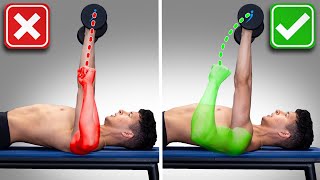
Jeremy Ethier breaks down five dumbbell press mistakes that shift work from your chest to shoulders and triceps. Keep elbows tucked 45-60 degrees, forearms vertical, and shoulders pinned back. Bending your forearms halfway can cut chest load in half.
Questions this video answers
About 45 to 60 degrees away from the body.
Rough estimate: the load placed on the chest is reduced by about half.
Stop once the arms are straight over your shoulders (do not bring dumbbells further together).
About 15 to 30 degrees (roughly one to two notches up from the bench bottom position).
A 2020 paper (cited in the video) stating incline press caused over double the upper-chest growth vs. flat only.
The dumbbell bench press is arguably the most effective choice for building your chest. That said, if you don't do it correctly, rather than working your chest, you'll end up working more of your other muscles, like the front of your shoulders and your triceps. There's five mistakes that cause this to happen. They're easy to fix, but will make a massive difference in your chest growth. Let's start with mistake number one. The first mistake has to do with your arm path. Typically, people use a very wide arm path and press the dumbbells straight up and down. And this is so common because pressing with this form actually makes the movement feel easier and will enable you to use heavier weights. But not only has this form been shown to have a greater risk for shoulder injury, but it also just doesn't stimulate the chest very well. To maximize chest activation, you want your arm path to line up in the same direction that the chest fibers run. A wide arm path with the elbows flared out doesn't accomplish this very well and instead lines up better with the front delts and a small muscle underneath the chest called the coracobrachialis. This is why many of you likely feel this movement more in the front of your shoulders rather than your chest. So to align the arm path with the majority of the chest fibers, you'll instead want to tuck your elbows to about a 45 to 60 degree angle away from your body and allow your grip to turn in slightly with your elbows. Just keep in mind that when you apply this form, the dumbbells will no longer move straight up and down, but rather forwards on the way down towards your mid chest and and then backwards on the way up towards your shoulders. So once you fix your arm path, it's important that you don't then make the next mistake, which has to do with your forearms. I remember back in my first few years of lifting, I got very strong with this exercise. Very quickly I take the 95 pound dumbbells and throw them around like they were nothing. Yeah, buddy. Lightweight. But I noticed that although my arms definitely got bigger, my chest just never really grew. Eventually I realized what I was doing wrong. I as the weights would get heavier, I'd start bending my forearms inwards more and more without realizing it. This is a compensation that is very common, especially among those who struggle with their chest development. This is because by bending the forearms inwards, you're actually shortening the lever, which makes the movement easier by taking some of the load off the chest. It also gets the triceps more involved to take on some of the load as well. And even the most subtle of a bend can drastically decrease the load placed on the chest. And in fact, if we apply very basic physics to get a rough estimate, if the forearms bend such that the weights end up halfway between your shoulder and elbow, you would end up reducing the load actually placed on the chest by about half. Although this can help you lift heavier weights, you aren't getting any higher stimulus on your chest and are simply causing more strain to your joints. Lighten the weight. Keep your forearm vertical over your elbow throughout each rep and you'll feel the difference right away. Now, even with your forearms fixed, you may be guilty of making this next mistake, which is the most common mistake I see. Given that many of us are already stuck in a hunched over posture, we have the tendency to round our shoulders forward whenever we press. This is especially true for those who lag in chest development because they'll often have stronger shoulders that will want to take over the movement. This can lead to the front of the shoulders experiencing most of the growth rather than the chest. To avoid this, I'd first suggest that you open up your chest before you even do the dumbbell press so that you're better able to activate activated. You can do this by extending your back over a foam roller and then performing over and backs and band pull aparts with a band. And I'll leave a link down below in the description box to the one I'm using here. Then, when you actually go into the movement on the way down, I want you to think about as if you were using your back muscles to pull the weight down towards your chest by pinching your shoulder blades together. And then on the way up, just avoid letting your shoulders round forward and take over the movement. And instead keep your chest up and think about squeezing your biceps into the sides of your chest. Focus on this every single rep and you'll immediately notice your chest rather than your shoulders now doing most of the work. Alright, so we fixed the shoulders rounded forward at the top, but it's important to avoid this next mistake at the top position as well. The main function of the chest is horizontal adduction, which is simply the act of bringing the arms together. This is what makes the dumbbell press such an effective chest builder since the arms are pulled together under load. Knowing this, you might think that bringing your arms in as close as possible at the top would better engage the chest. In fact, some people even touch the dumbbells to get at the top. However, since we're using dumbbells, the Line of force is straight down because of gravity. This means that once your arms are straight over your shoulders, there's actually no more tension placed on the chest because there's no longer any force pulling your arms apart. Going further than this doesn't stimulate the chest any further and is wasting energy that could otherwise be used towards your next reps. So. So instead, to keep constant tension on the chest, stop each rep once your arms end up straight over your shoulders. So the last mistake doesn't actually relate to form and instead has to do with the angle of the bench. The flat dumbbell press is great, but most of the growth you get from this exercise will be in the middle portion of your chest, which can lead to the upper and lower portions of the chest becoming underdeveloped. In fact, In a recent 2020 paper, subjects that perform the incline bench press experience over double the growth in the upper portion of the chest when compared to subjects that only perform the flat bench press. So, in addition to doing just the flat dumbbell bench press, I'd also recommend doing an incline dumbbell press once a week as well. However, when you do this exercise, research has shown that just a very slight incline of about 15 to 30 degrees is optimal to target the upper chest. This is usually just one to two notches up from the bottom position of a bench. For most individuals, anything higher than that often causes the front delts to take over instead. In fact, for some of you, even just a slight elevation by placing a weight plate under the end of a bench may be all you need to really target the upper chest. Now, as for the lower portion of your chest, for most people, the flat dumbbell press will already hit this region quite well. Some studies, however, suggest that a slight decline can actually help activate this region even more effectively. So in this case, you can place a weight under the other end of the bench to create just a slight decline. Try that out, see how it feels, and feel free to add it to your weekly routine such that you're doing a pressing movement that biases the upper chest, a pressing movement that biases the mid chest, and a pressing movement that biases the lower chest. Just remember that all the previous mistakes we went through apply to these dumbbell press variations as well. Now, after you apply these various fixes, you'll notice that you won't be able to lift nearly as much as you used to. It might hurt the ego. But realize that this is a good thing. It means that your chest is now doing most of the work rather than your other muscle groups. And you'll very quickly feel and see the difference this makes to your chest development. Just make sure that you don't fall back into your old habits as you try to increase the weight over time. And guys, it's important that you take the same detailed, science based approach to every single exercise that you do. That way you can get results faster and without harming your joints. For a step by step plan that puts this all together for you, just head on over to builtwithscience.com and take our analysis quiz to discover which of my programs are best for you and your specific body. I'd also highly recommend giving these videos a watch next to see if you might be guilty of making similar mistakes with your deadlift or with your squat. Thank you so much for watching and I'll see you next time.