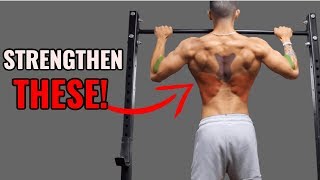
Five exercises target the weak points holding back your pull ups: scapular pulls, negatives, banded pulls, rows, and reverse curls. The video gives three progression plans depending on whether you can do zero reps, one to four, or five to eight.
For those of you who've been following me for a while, you know I'm a huge fan of pull ups. I attribute a lot of my backgrowth to weighted pull ups and high rep bodyweight pull ups. They work several upper body muscles, which is great when it comes to back development, but it also means that weakness in any of these muscles can prevent you from performing a pull up or progressing them with more reps or added weight. To keep it simple, there are five possible weaknesses that may be inhibiting you from progressing your pull ups or even performing your first pull up. They are as follows. Weak brachioradialis, which is a muscle in your forearm. Weak shoulder and scapular stabilizers. Lack of motor control, which is basically just teaching yourself how to pull yourself up. Lack of core stability and weak overall back strength. So in this video I'm going to show you guys 5 must do exercises that will improve each of these weaknesses to enable you to master and start progressing the pull up. This exercise is essential when it comes to learning a pull up and progressing it. They're called scapular pull ups and mainly strengthen your lower traps and improve your shoulder and scapular stability. If this is a weak area for you, then this will prevent you from being able to do a pull up with proper form or progress it with weight as your scapula needs to be stabilized throughout the pull up. To do this exercise, you simply want to hang from a bar and depress your shoulders down and away from your ears and pull your body up without allowing your elbows to bend. Perform the exercise in a slow, controlled manner and hold at the top for a second before coming down. You can progress it by performing more reps as you get stronger. This is going to help a lot with building up the strength needed to do a pull up and progress it with weights and will just enable you to feel what it's like to control your body weight against gravity. To perform them, you can either jump up to the bar or use a step up to help you from the top part of the pull up descend as slowly as possible. The slower you descend, the harder it will be. So if at first your descent only lasts around two to three seconds, that's fine. Just keep progressing and try to work up to a 32nd descent, which will translate to huge strength gains in your pull up. However, keep in mind that as shown in research such as this study by Gunderson et alp. Eccentric training is going to mainly provide eccentric specific strength gains, meaning that performing pull up negatives will help mostly with Building up strength during the lowering phase of the pull up. So additional exercises are needed to help with concentric strength, which is the strength needed to actually pull yourself up. And this is where the next few exercises will come in handy. These can be performed in a variety of ways, but I personally prefer using banded pull ups as it will give you a boost of confidence knowing you could perform the movement. This exercise is going to help you learn the movement and help you build the concentric strength needed to pull yourself up. And it's also going to help you get additional volume in if you can only do a few unassisted pull ups. However, the key when using banded pull ups is to ensure you're using strict form and not taking advantage of the added assistance. This means keeping your body in a straight line without any kipping or use of momentum as you pull yourself up. So start at a stronger resistance band and change to weaker ones as you progress. However, one downside with this exercise is the uneven assistance the band provides. It tends to help you out more during the beginning of the movement as opposed to the end, but this next exercise will help us with this. This exercise has great carryover in terms of building the strength needed to pull yourself up and improving your core stability during body weight movements. These can be done hanging from any bar and what you want to do is extend your feet straight out and keep your body in a straight line. Retract your scapula and pull with your elbows so that your chest comes up to the bar. The lower the angle you perform these in, the more difficult it will be. So start higher and come lower as you progress until you're at about parallel with the floor. This last exercise is going to strengthen your brachioradialis. The reason it's in here is because as shown in this study by James et al. The pull ups with an overhand grip has the highest involvement of the brachioradialis when compared to all other variations such as chin ups or neutral grip pull ups. What this means is that if your brachioradialis is weak and underdeveloped, this may be inhibiting you from performing overhand pull ups and maybe the weakness preventing you from improving your pull up. The good news is that this muscle is pretty straightforward to train. Simply perform reverse grip Dumbbell curls or reverse grip Easy bar curls, which are both effective exercises to hit this muscle and can be easily progressively overloaded with weight as you get stronger. Keep in mind that the key with these exercises is progression, so we'll provide you guys with three categories of progressions based on your current pull up level. Program one is if you can't do any pull ups at all. Once you can do one to four regular pull ups, you can progress to program two where the focus is on getting more pull up volume in and then once you can do five to eight regular pull ups, progress to program three. For each of these programs you want to perform them twice a week and you can throw them in with your current back workouts or somewhere else in your routine. Focus on progressing these exercises every week and checking to see how your max plan pull ups are improving. Then as soon as you can get about eight strict pull ups in a row is when you should start overloading with weight, but I'll make a separate video on that topic. Anyways, that's basically it for this video guys. Thank you for watching. I hope you found it useful. As always, if you enjoyed the video, give it a like share it. And don't forget to subscribe and turn on notifications for my channel. And if you have any questions, feel free to leave a comment down below. I'll see you guys next time.