The #1 Workout That BLEW UP My Shoulders (3 Exercises)
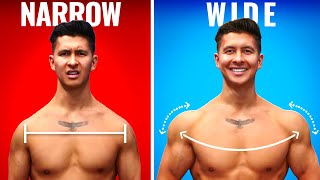
Jeremy Ethier breaks down three shoulder exercises: behind-the-body cable lateral raises for side delts, reverse cable flys at 45 degrees for rear delts, and seated dumbbell presses for front delts. Each targets muscles in their stretched position and aligns with fiber direction for better growth.
Today, I want to share the one workout that blew up my shoulders. My Filipino genetics blessed me with a one to one shoulder to waist ratio and narrow clavicles that made me look frail and weak. But I refused to let my genetics define me. This past year, my shoulders blew up. They're wider, broader and fuller than they've ever been. I didn't use any of this either. I followed a simple science based workout that's worked better than anything I've tried in the past. There's only three exercises, but proper form is crucial, so pay attention. First, up the side delts. This is the part of the shoulders that broadens your frame and is where I put most of my effort. Now, in the past, I'd always just do your typical dumbbell lateral raises, but there's an exciting new area of research called long muscle length training that suggests this may not be ideal for growth. This research has shown muscles tend to grow better if they're challenged in the stretch position. For example, one study published just this year found that preacher curls, which challenge the biceps the most right around here when they're almost fully stretched, groove the biceps 150% more than incline dumbbell curls, which are instead hardest right around here when the biceps aren't stretched as much. Similar findings have been shown in the triceps, hamstrings and quads as well. So although the shoulders have yet to be tested, it seems probable they'd also benefit from this. But the thing about dumbbell lateral raises is they're easiest at the bottom when the delta is fully stretched and hardest at the top when the delta is fully contracted. The opposite of what we want. So my main exercise was instead behind the body cable lateral raises where I stand in front and to the side, so my side delta is now stretched behind me. But simply stretching your delt isn't enough. You need to make sure the cable is at the right height, so it challenges your delt the most when it's stretched. If the cable set at the very bottom, the exercise will challenge your delts closer to the end, whereas if you bump it up by two or three notches, the exercise will now challenge your delts more at the beginning when they're stretched. Now, if you don't have access to cables, dumbbell lateral raises are still a great option and are probably complimentary to this exercise. And you can implement the stretch research with them by first doing as many full reps as you can and then finishing off your set with partials at the bottom to work your delts more in that stretch position. That said, there is one more tip I applied to my side delt training that made all the difference. It has to do with how much weight I used to. Usually whenever I do lateral raises and try to increase the weight, my form would get sloppy and I'd start feeling it all in my traps. But a recent 2022 study helped provide a solution to this. One of our built with science researchers, Daniel Plotkin actually ran the study, so I'll let him share the results.
We took trained individuals and we wanted to answer the question of if you increase in reps or you increase in load, will there be differences in muscle size? So one group, the load group, each time they trained, they tried to increase in the amount of weight, while the reps group stayed at the same weight each session but tried to increase in reps. So at the start of the study, the reps group was doing 10 reps per set. And by the end of the study, after the eight weeks, they were doing between 16 and 20 reps. What we found was from measuring multiple replacements thigh and calf muscles, is that this might be surprising. But there was virtually no differences between groups. So it seems like there's a good amount of flexibility in what you can choose for your progression. So it could be reps and it could be load.
So I applied this research by sticking to the same weight every week and trying to do just a couple more reps than last time. I'd start around 10 reps per set, and only once I was able to do at least 15 to 20 reps per set with good form. And did I increase the weight. So the side delts create width, but the rear delts help balance out the shoulder and give it that 3D look. But it is by far the most underdeveloped part of most people's shoulders, and I was no exception. My rear delts have always been trash. I'd spam them with dumbbell reverse flies and the reverse pec deck and couldn't figure out why they just wouldn't grow. Well, here's why. So we know that muscles are best grown if the arm path of the exercise matches the direction of the muscle's fibers. In the case of the rear delts, they run at about a 45 degree angle. This is why some people can end up building massive rear delts without even trying. They perform many of their rows with this 45 degree arm angle and end up growing the rear delts instead of other parts of their back. But this was never the case for me, so I needed an exercise that isolated my rear delts really well. What I found the most success with was using this 45 degree arm angle during the reverse cable fly, but with a few steps back from the cable to make it more difficult near the beginning of the exercise when the rear delts are more stretched. But you can apply this to the reverse pec deck as well. Move the seat up high and instead of sitting right up against the pad, scoot your butt back and lean your chest into the pad. This way, your arm angle will now line up better with the rear delts. And if you don't have access to cables or machines, you can do an incline dumbbell row with your arms kept in that 45 degree angle. In all these exercises though, to prevent your mid back muscles from taking over, don't squeeze your shoulder blades together. Push your arms forward to open up your shoulder blades and keep them that way as you pull your elbows back. Now, I'm going to share the sets and reps for each exercise at the end of the video, but for now, let's move on to the last exercise. Lastly, the front delts. So this is usually the most developed part of people's shoulders because it's already worked indirectly in many other exercises. In fact, in studies, researchers would count one set of bench press as one set for the chest, but also one set for the front delts. But it's still a good idea to do at least one exercise to work this area, especially since the exercise I'll show you can help indirectly grow the other parts of your shoulders as well. Now, unfortunately, there's no studies that have compared how well different exercises grow the front delts. But remember how we said muscles are best grown if the arm path of the exercise matches the direction of the muscle's fibers? The well, for the front delts, the arm path looks something like this, which matches quite well with overhead shoulder presses. Now, in the past I'd always do standing barbell overhead presses, but over time they just really started beating up my joints and it was always a struggle to stay balanced. So I switched this exercise out for a more stable and smoother exercise on my joints, the seated dumbbell shoulder press, but not the way most people do it. Let me explain. Bring your arms up directly to your side with your elbow at a 90 degree angle. Then without arching your back, rotate your hand back as far as you can. How far could you go? A 2020 study with over 2400 participants found that on average they could only get to about 60 degrees. But take a look at the dumbbell shoulder press with the bench straight up, you need to be able to comfortably get to 90 degrees, otherwise you'll end up pressing the weight forwards and using other muscles, or you just may end up aggravating your shoulder. So try to bring the bench back about one to two notches and as you can see now, it'll require far less shoulder mobility. Once you're set up, line up your arm with the front delt fibers by driving your elbows inward slightly with your palms facing in. Then press the weight over your shoulders and return back to the starting position after each rep. So here's the three exercises with the reps, sets, alternatives, and how often to perform them. You could do this on a workout on its own, but I'd recommend splitting these exercises up into two to three of your workouts throughout the week. Now that said, research is always evolving. I may end up being wrong about all of this in a few years time, but I will do my best in keeping you guys updated with the latest science. So far though, the research is promising and it seems like it's working. If you guys want a step by step plan that takes care of all the science and guesswork for you so you can build muscle and lose fat as efficiently as possible, just take our quiz at built with science.com to find the best plan for you and your body. I highly recommend giving this video Watch Next, which dives into all the exercises that are known to provide better muscle growth because of the stretch research we talked about earlier. Thank you so much for watching and I'll see you next time.










